


Unhoused Murals
The Open Air Museum of Valparaíso
The Museo a Cielo Abierto de Valparaíso (MaCA) is a collection of twenty murals and a mosaic, conceived in 1991 by Chilean painter, architect, and academic Francisco Méndez, and born from a mural workshop de la Universidad Católica de Valparaíso. Through an agreement with the Municipality, this initiative enabled the artistic transformation of public spaces in Valparaíso, Chile, and was inaugurated in 1992.
Introduction
The Museo a Cielo Abierto de Valparaíso (MaCA) is a collection of twenty murals and a mosaic, conceived in 1991 by Chilean painter, architect, and academic Francisco Méndez, and born from a mural workshop de la Universidad Católica de Valparaíso. Through an agreement with the Municipality, this initiative enabled the artistic transformation of public spaces in Valparaíso, Chile, and was inaugurated in 1992. It is located on the Bellavista hill, a distinctive area marked by steep staircases, winding paths, and houses precariously perched on the slopes. It is a quiet, middle-class residential area close to the city center and located on the way to Pablo Neruda’s house in Valparaíso, receiving a significant number of tourists.
The project involved 18 prominent 20th-century Chilean artists and pursued three main objectives. First, to revive the spirit of a workshop Méndez had initiated before the Chilean dictatorship, where students painted abstract designs on urban walls. Second, to present Valparaíso with an artistic gift that reimagined prior muralist traditions within the context of Chile’s return to democracy. Third, to foster a dialogue between mural painting and the unique urban and natural landscape of the port city. This dialogue necessarily extends to the local community, whose presence, practices, and responses shape and are shaped by these artistic interventions.
Alongside this practical endeavor, Méndez developed the concept of “unhoused painting,” which proposed a form of painting that transcends its traditional physical supports to exist as an independent artistic entity. These murals, characterized by an abstract visual language, embody this notion. Méndez sought to challenge the dominance of the political mural tradition in Chile, instead offering a pictorial intervention that harmonized with its environment through the universal language of abstract painting.
These murals are “unhoused” in a dual sense. First, through Méndez’s theoretical framework, which recasts them as exercises in pictorial resignification. Second, through their lack of institutional support, which has contributed to their current state of abandonment. Nevertheless, these murals remain a testament to collective and community-based creation. Despite their physical deterioration, they document a public practice that understood art as a gift to the community. From a modern historiographical perspective, MaCA exemplifies how artists used their neighborhood walls as spaces for participation and collective memory, solidifying art as a tool for engagement and social connection.
This research, some of the first to critically analyze MaCA, posits that the initiative represents a groundbreaking moment in the history of contemporary Chilean art. It reconnected the country with global artistic dialogues during the transformative period of democratic transition. Beyond its painted surfaces, MaCA should be understood as an innovative participatory proposal that integrated artists, students, and local residents into a collective exercise of symbolic and spatial construction.
MaCA can be interpreted through a global lens that underscores both its artistic innovation and historiographical significance, bridging modern abstract painting and contemporary collaborative, community-centered practices. Redefining MaCA as a cultural heritage landmark of Valparaíso and a milestone in Chile’s recent art history is crucial. Viewing it not merely as a set of murals but as a unique participatory experience could catalyze its recovery from current physical neglect and reinstate its rightful place in the contemporary Chilean art scene.
The origins
In 1968, painter and professor Francisco Méndez Labbé (Santiago de Chile, 1922-2021) returned to Chile after a decade in France. He then rejoined the group he had formed with colleagues at the beginning of the previous decade. The collective, with artistic and interdisciplinary work focused on the relationship between architecture and poetry, had led a reform process at the Catholic University of Valparaíso. One of its results was the creation of the Art Institute, which taught art subjects to students of all majors. Méndez taught the mural painting workshop, where he designed abstract murals that students painted in different parts of Valparaíso, dialoguing with the particular geography and architecture of the port city. More than 60 murals were created during almost three years of collective and collaborative work. The exercise ended with the coup d’état of September 11, 1973 and the seventeen-year dictatorship that began that day.
The return to democracy in 1991 was an opportunity for Méndez to redefine the project that had been interrupted almost two decades earlier. Unlike the first murals that were scattered around the city, this second moment had a defined circuit on Bellavista Hill, two blocks from Victoria Square.
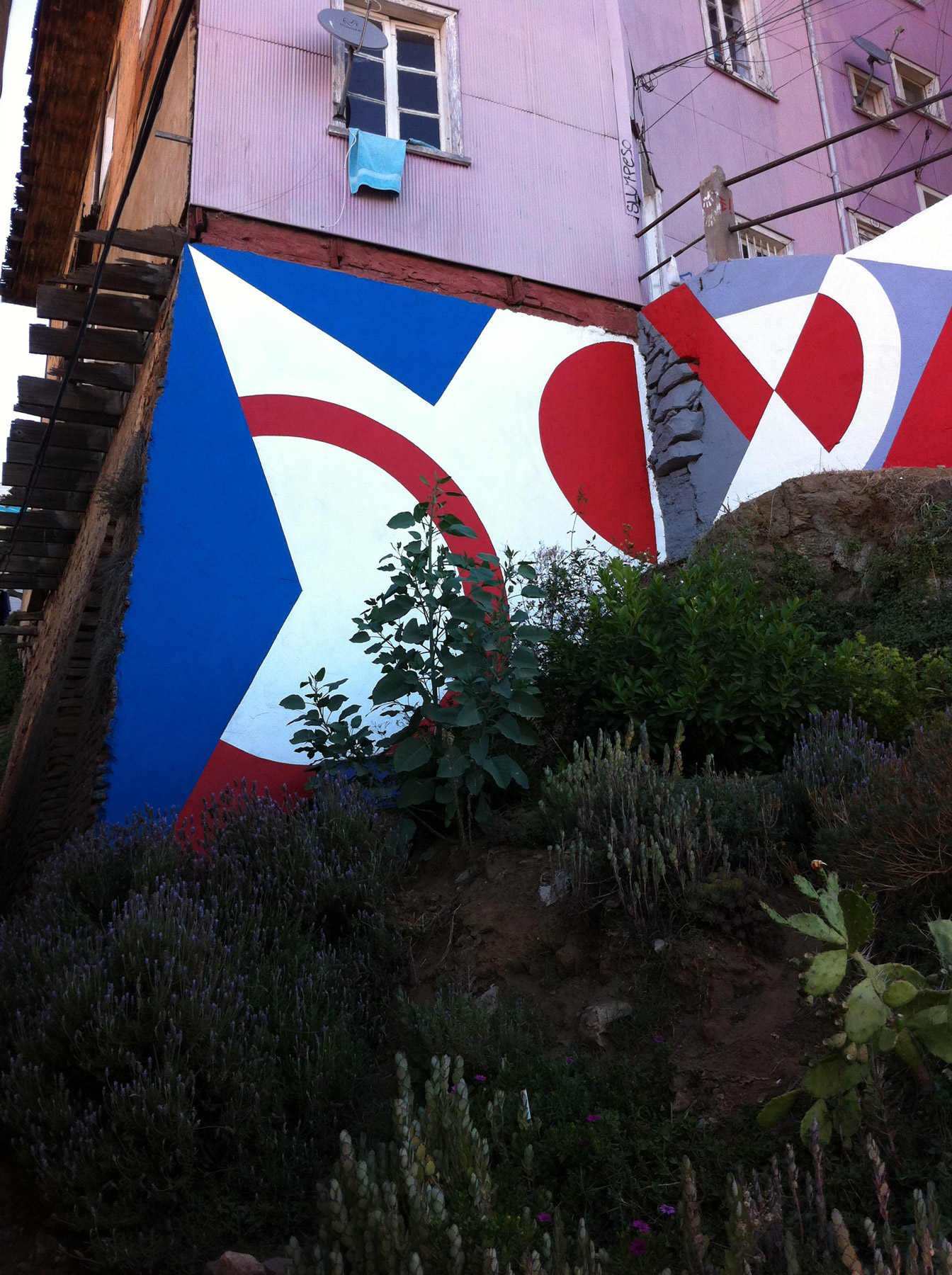
Detail of Mural 4-5 by Eduardo Pérez
This section was added in 1991 (the original mural was from 1972), connecting the two periods of the muralist’s work
Photograph by the author, 2015
In its initial objectives, the Open Air Museum of Valparaíso aimed to offer a gift to the city and the citizenship by recovering a proposal that had been developed before the dictatorship. The project understood itself as the continuation of the Mural Workshop, including the central aspect of that experience: the relationship between painting and the urban landscape, aiming to establish a dialogue between the two. To achieve this, it had a more defined structure than the first moment, thanks to the creation of a delimited circuit and its presentation as a museum, in the broadest sense.
In this project, with the help of the director of the National Museum of Fine Arts, painter Nemesio Antúnez, Méndez invited painters from very different backgrounds and positions. The idea was to appeal to a generation of artists who developed and consolidated their work around the same period, so the result of the Museum was a “diversity of pictorial proposals.”1 For the painter, “it was the generation that brought contemporary painting to our country, that established a link between Chilean and world pictorial activity.”2 The artists who participated in the project were Mario Carreño, Gracia Barrios, Eduardo Pérez, Matilde Pérez, Eduardo Vilches, María Martner, Ricardo Yrarrázabal, Rodolfo Opazo, Roberto Matta, Ramón Vergara Grez, Mario Toral, Roser Bru, Sergio Montecino, Guillermo Núñez, José Balmes, Nemesio Antúnez, Augusto Barcia and Francisco Méndez himself, all central figures of Chilean art in the second half of the 20th century.
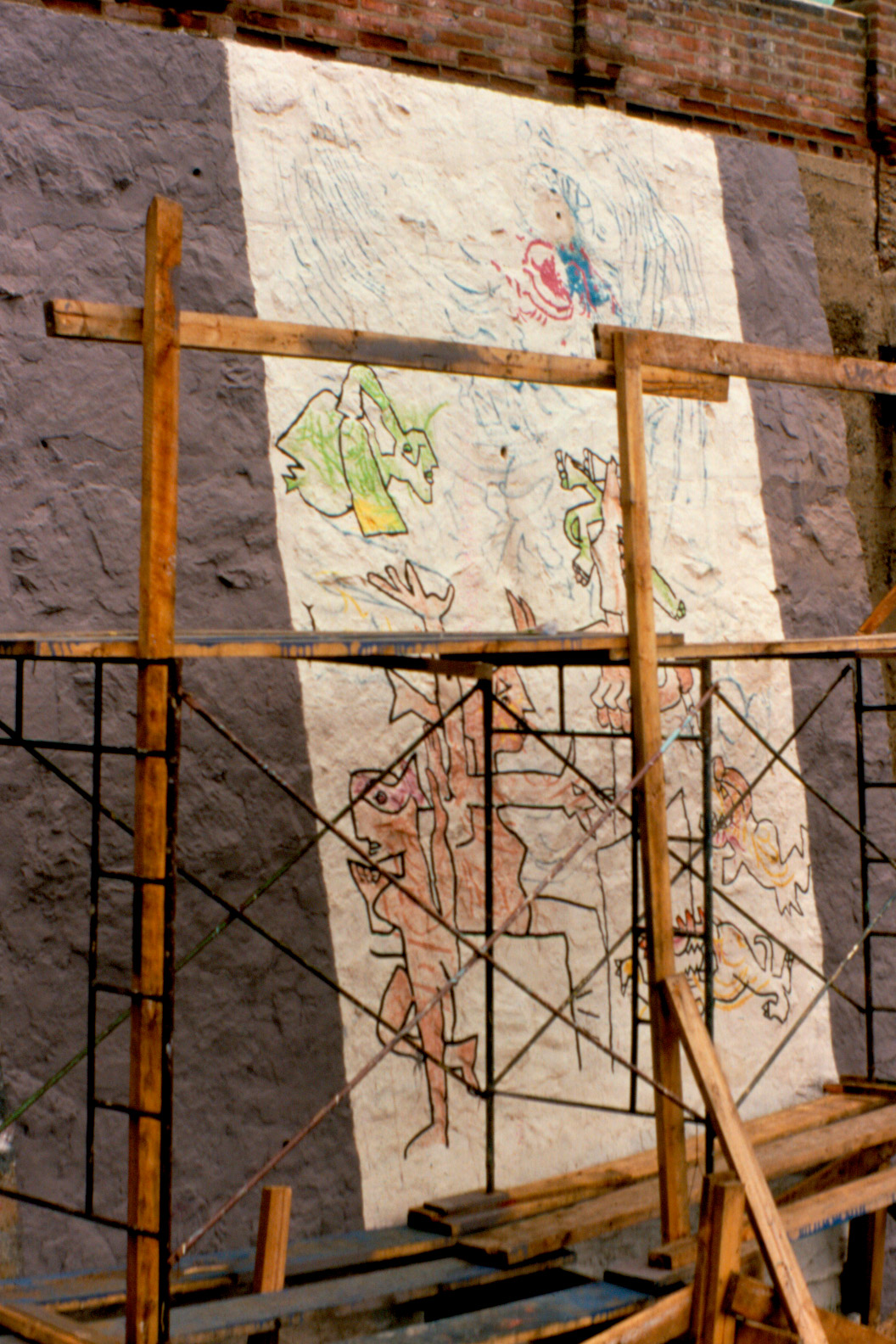
Mural 10 by Roberto Matta
Photograph by Eduardo Pérez, 1992
The relationship that these artists maintained with strategies of art in public spaces was also diverse. Although mural painting was not the usual format for any of them, many of them were familiar with it and had previously practiced it, although none of them had participated in a project of this kind. The work that most of the artists produced within MaCA, is therefore part of a larger trajectory in relation to art in public spaces and not an individual milestone in their careers, even taking into account the specificities of the Valparaíso experience.
Unhoused painting
Both the Mural Workshop and the Open Air Museum are part of Méndez’s questioning of the two-dimensional support of painting, systematized in the notion of Unhoused Painting, central both in his theoretical reflection and in his pictorial work. The concept was understood as “the possibility of being liberated [painting] from all subjection to a spatial organization, predetermined and existing prior to it.”3 Méndez explained that
“These murals, which were painted on the walls of houses, retaining walls and enclosure walls, were placed in the hamlets of the hills surrounding the city. Establishing a dialogue between a pictorial proposal that proposed to look at a fixed and complete image in itself and the gaze that wanders through an architectural space, as spatially rich as the hills of Valparaíso, was a challenge. Through the experience we acquired (around 60 murals were painted) we were able to observe that the paintings formed a place from which the gaze towards the city became more present and, therefore, richer.”4
This proposal is also part of his pictorial-pedagogical exercises. In the subject of that name, taught in 1979, he made, together with his students, kites and other artifacts that dialogued with each other and with space, eliminating the limits of painting, “without pretending to be subject to the implications and laws proposed by the spatial structuring in which it is found.”5 The artist understood this moment as a maturation of the exercises carried out in Valparaíso between 1969 and 1973, which he later resumed between 1991 and 1992. It is also possible to consider other moments in his career as part of this interest in the support, present since he was a student in the 1940s and worked on ephemeral works in theater until the 2000s, when he experimented with digital painting.
In this sense, the radical nature of the proposal lies not only in its public, collective, and participatory character, but also in its connection to a broader concern within Francisco Méndez’s pictorial trajectory. It is one of several experiments in which the artist explored the possibilities and limits of the support itself. Building on Méndez’s notion of “unhoused painting,” I propose the concept of “unhoused murals,” referring both to the problematic status of the support and to the Museum’s lack of institutional stewardship—which has left the works in a state of abandonment—and to the absence of this project from Chilean art history, except in my own research.
MaCA and its integration into the neighborhood
Some examples can more clearly explain the relationship between the murals and the impact they had on their surroundings, transforming the place and the daily lives of its inhabitants.
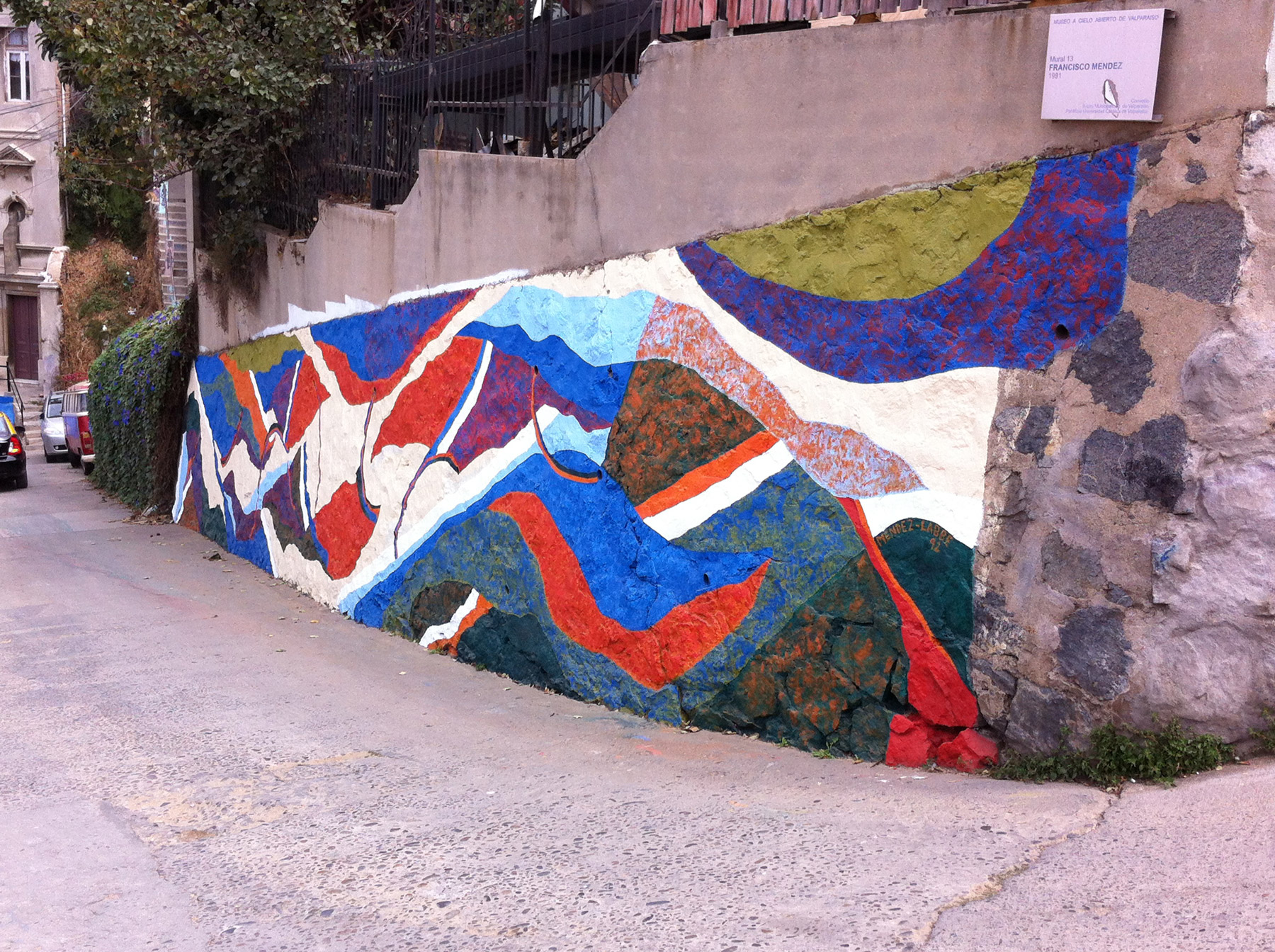
We can observe the mural by Francisco Méndez himself, who was interested in working with the particularities of the medium, playing with the texture of the wall. The streaks of color in the informalist painting are continued in the volumetric differences of the stones on which they are painted. To create this effect, Méndez specifically chose a wall located on a sharp curve, so that its visibility and interpretation would change as one walked by. This created a permanent transformation of the work. In this regard, the painter recalled an anecdote: “A shark! A bird!” shouted the children playing in Rudolf Street, guessing from the movement what was hidden behind the abstraction of the mural. They are the only ones who really appreciated it.”6
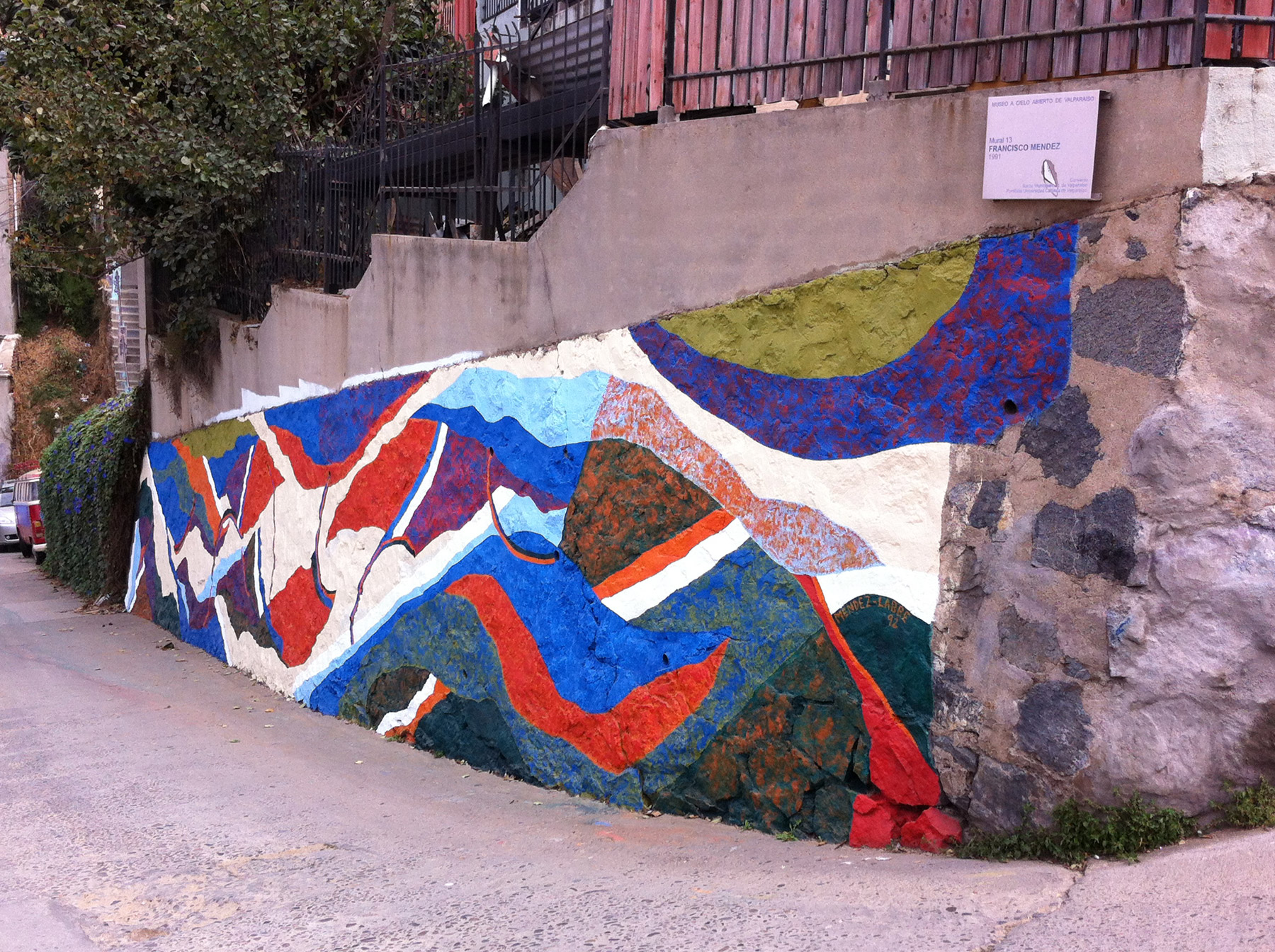
Mural 13 by Francisco Méndez
Photograph by the author, 2015
Another similar example occurred with Eduardo Vilches’ mural. In the years following the museum’s completion, local children used the arch mural to play soccer, taking advantage of both the location and the size and format of the wall. This reinterpretation of the work not only refers to the project’s integration into everyday neighborhood life, but also has to do with the autonomy of the painting and how it acquires new meanings not anticipated in the original project.7 Furthermore, it allows the artist’s proposal to be fulfilled: “Vilches wanted his work to merge with the houses on the hill, and he succeeded. He chose a wall located between two houses, and his work joins with a continuous façade, forming part of the common courtyard of the passageway.8
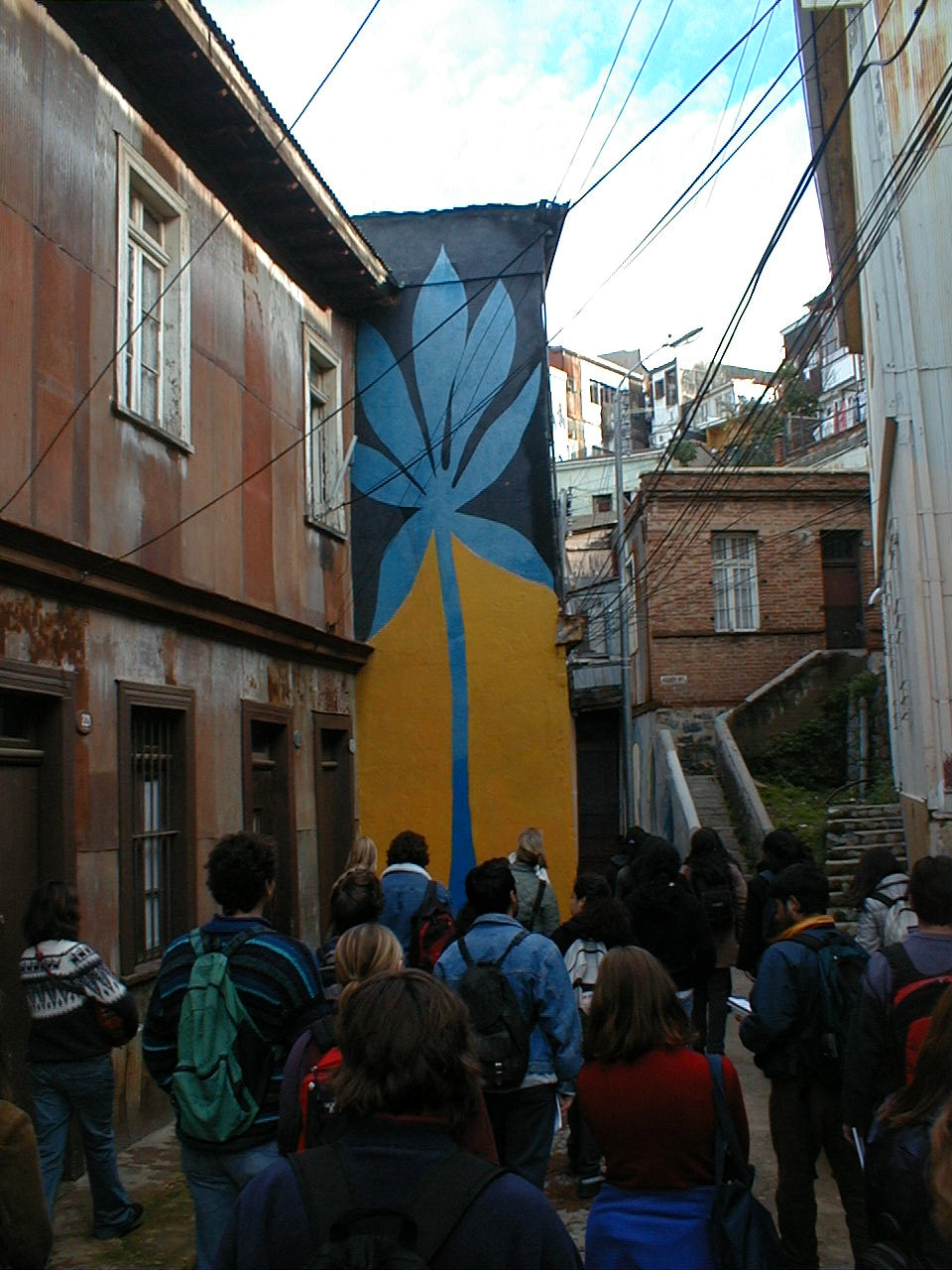
Students visiting Eduardo Vilches’ mural in the early 2000s
Francisco Méndez Archive
We can also mention an experience that occurred in mid-1992, while work was being done on the last murals. A neighbor asked if José Balmes could visit her. When the painter went to her house, she thanked him “for bringing art into her window,” as she could see his work from her bedroom.9 In this case, the impact of the mural was evident in the way it was installed across the space, entering through the window of a house and offering itself freely to the viewer.
These three examples illustrate the gift offered to the community and its projection into the extra-pictorial space, thus also linking it to a pedagogical perspective focused on collective and participatory creation, where the multiplicity of views and interpretations of the works allows for the establishment of specific strategies for connecting with the neighborhood.
Mural No. 17, by José Balmes Parramón (1927–2016, National Prize for Plastic Arts in 1999), offers a particularly clear case of this dynamic. We can take this work as an example of how this group of artists sought to bring their previous experiences with painting into dialogue with a public, participatory, and collective initiative on a hill in Valparaíso. Balmes, a Spanish artist who developed a long career associated with informalism in the Signo group during the 1950s in Chile, was known for incorporating political and social reflection into his work through everyday elements to which he assigned powerful symbolic value.
Among these, the figure of bread stood out, always represented as a marraqueta (a Chilean traditional bread, known in Valparaíso as pan batido) in a series he produced in the early 1990s after returning from exile during the Pinochet dictatorship. The best-known work from this series is Pan territorio (1991), in which Balmes played with figuration and informalism to suggest the particular shape of Chilean bread by relating it to the flag.
In these representations, Balmes metaphorically alluded to both work and the move from his homeland to Chile,10 transforming this food into a critical and dialogical tool: “it is the bread that is made available to the community,”11 thus referring to the social dimension of this pictorial proposal. In this regard, Balmes pointed out: “The simple can take on meaning: like bread, for example, because it can also become a work with a message… bread as territory, humiliated bread, the bread that the people of northern Chile ate in the desert in times of repression and that later burst onto the table…”12
It is not possible to attribute a single interpretation to the bread series. Just as it moves halfway between the figuration and informalism that characterizes the Catalan artist’s work, bread is presented both as an element of symbolic value, with social and political meaning, and as a reference to simplicity and everyday life, which for Francisco Méndez manifests itself as “a symbol of the welcome and hospitality given to him by Chile and its people”13 and which takes on special significance in the mural after the return to democracy.
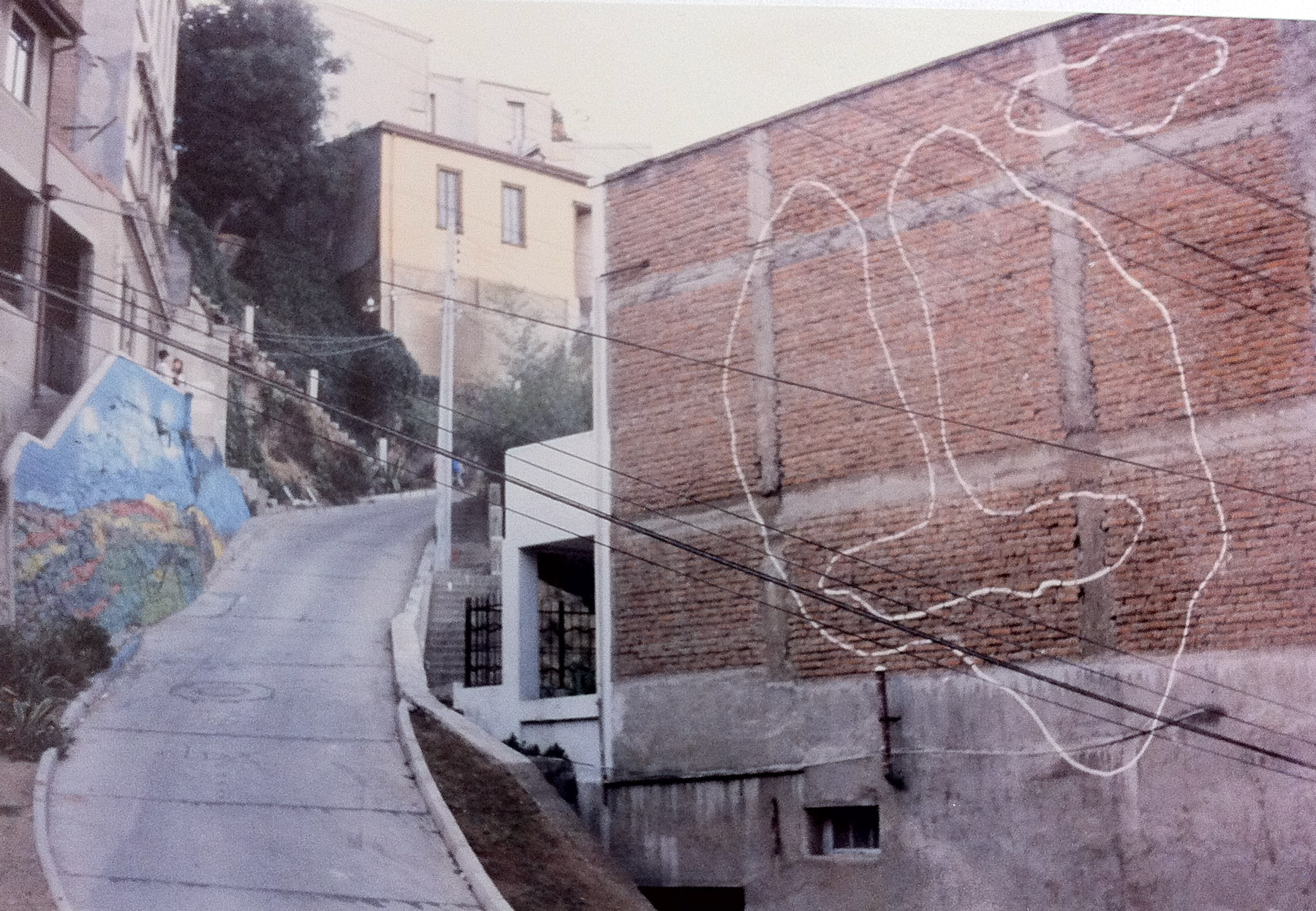
Mural by José Balmes during its creation, 1992
Francisco Méndez Archive
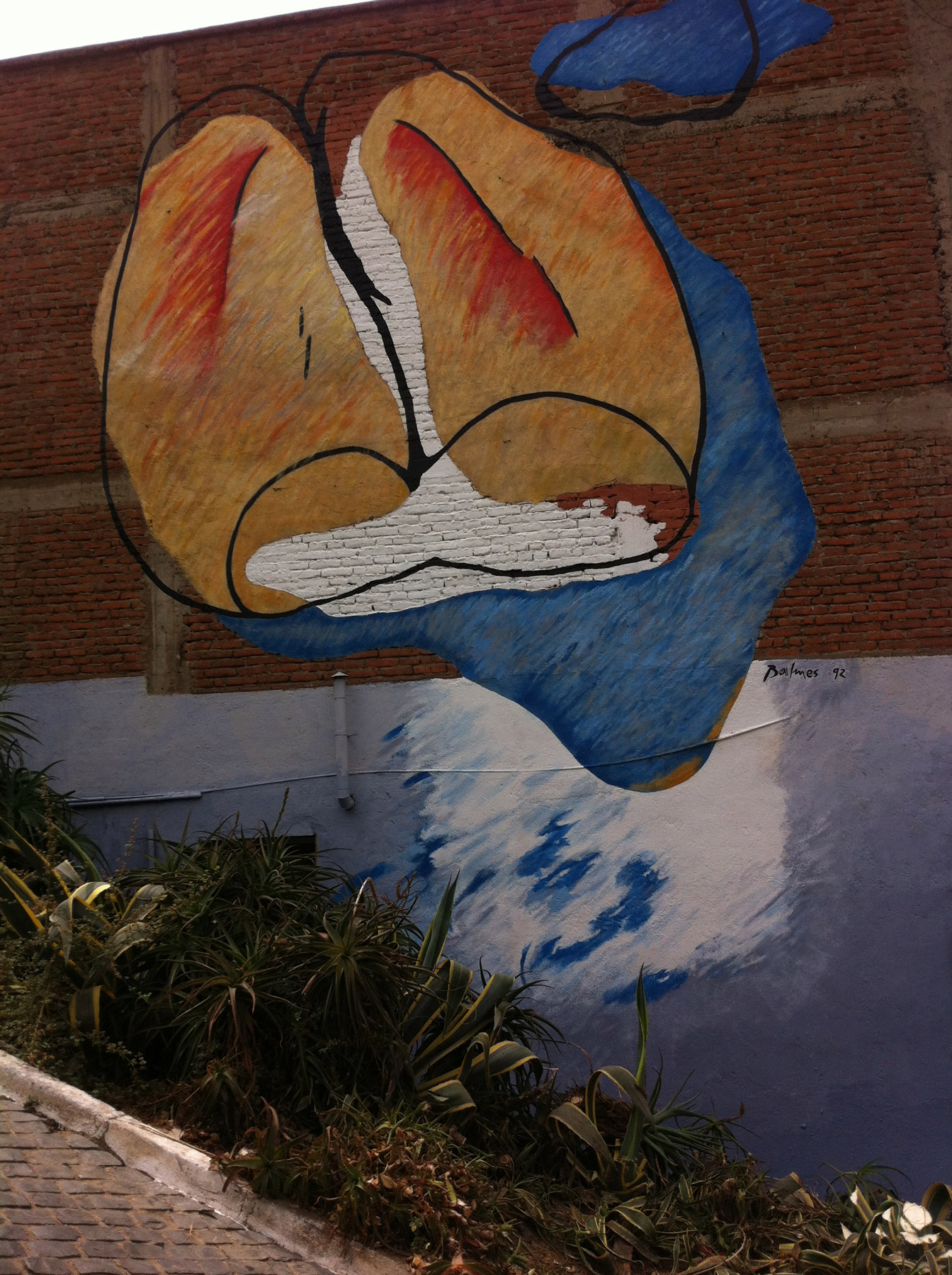
Mural 17 by José Balmes
Photograph by the author, 2015
The tour of the MaCA is transformed by the neighborhood itself, demonstrating that what was fundamental was not the painted walls but the action that took place around them, since the focus is not only on the mural object, but on the process. In this sense, the wall is a permanent record of a much more complete, performative, and interdisciplinary work in which neighbors and students participated, led by the group of artists, guided by a process-oriented approach in which the social and performative dimensions of the project were prioritized over the material outcome.
MaCA did not emerge as a collaborative practice (although it has collaborative aspects), but as a pedagogical practice. The artists, without ceding their authorship to the spectator (an aspect that distances them from the relational practices of the 1990s) led a heterogeneous group, in which both students (as a pedagogical experience) and neighbors of the sector (as a participatory practice) participated. In addition, due to its location and distribution in the urban space – as well as the relationship it has with the environment – it was conceived as an exercise in public art that also functioned as an exercise in collective creation, due to the number of participating artists and the intention of carrying out a joint project rather than a series of individual works.
It was an unprecedented experience and a novel proposal in relation to the museum space and curatorial practices, particularly in the post-dictatorship Chilean context. However, it was developed on the basis of traditional pictorial codes. None of the participants was a muralist, so the language employed was that of easel painting. They used the proposals that modernity had developed at the beginning of the 20th century, which they knew and assumed in the middle of the century and applied in the Museum in the last decade of the century, a period in which all of them had already reached full artistic maturity. From this point of view, the MaCA is an unusual experience that, from painting, managed to reformulate a contemporary practice of public, collective and participatory art, incorporating an unprecedented pedagogical strategy.
Two dialogues were generated through this crossing: the first, between the works and their surroundings, as an inherited objective of the Mural Workshop. The second, between the works and the neighbors, as an unexpected objective of the Workshop and later a fundamental element of MaCA, revalued by the end of the dictatorship. This scenario was enriched with other reminiscences of the Mural Workshop: the incorporation of other artists, including those who had previously participated; the establishment of a route in the same neighborhood where murals had been painted before; the recovery and incorporation of works that survived in the new circuit. These aspects confirm the intention to reinterpret the pictorial experience of the Workshop in the new democratic context and to rethink it thanks to the incorporation of new variables.
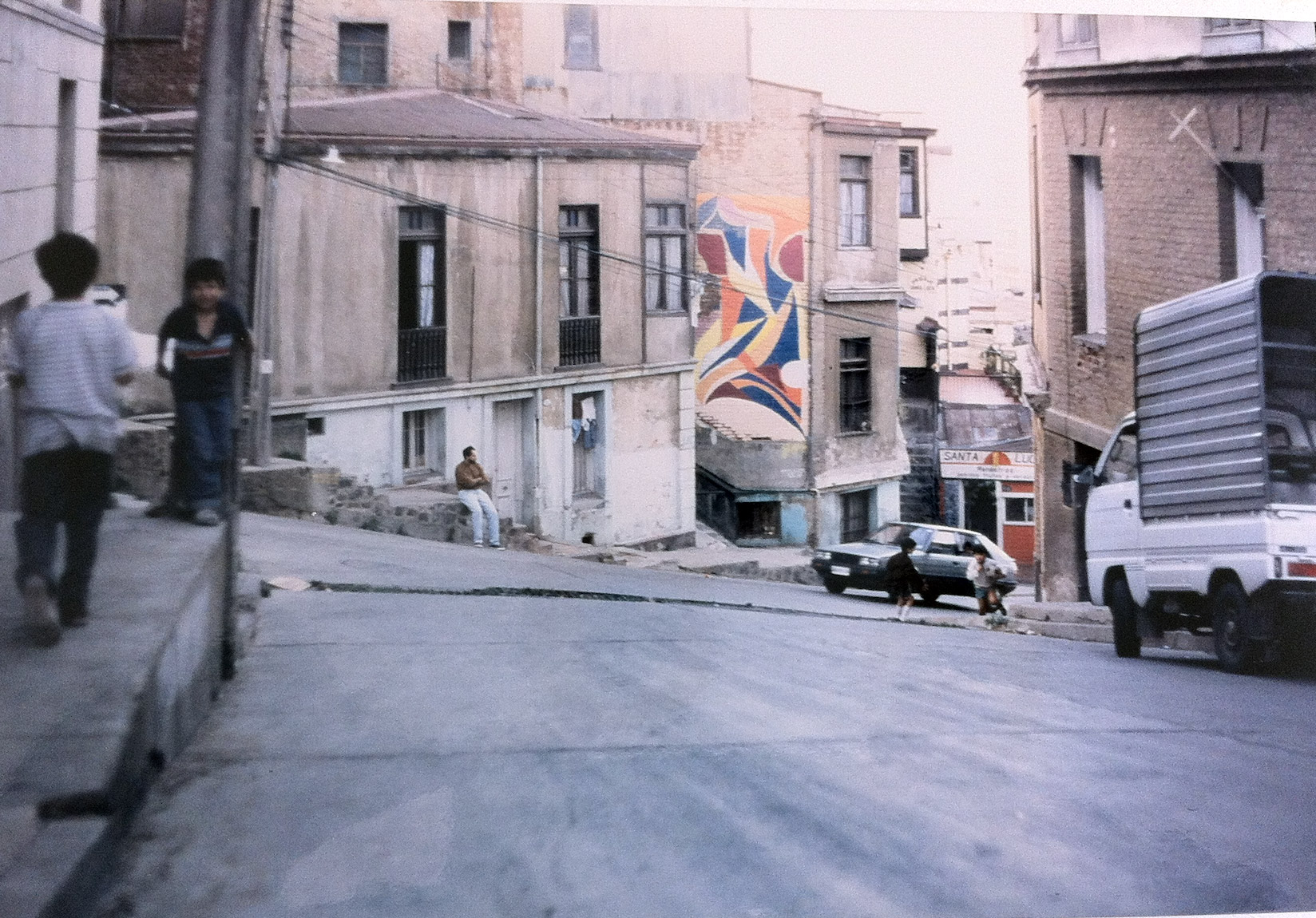
View Mural 20, called “Of the students”
Area before its incorporation into the MaCA tour, 1991
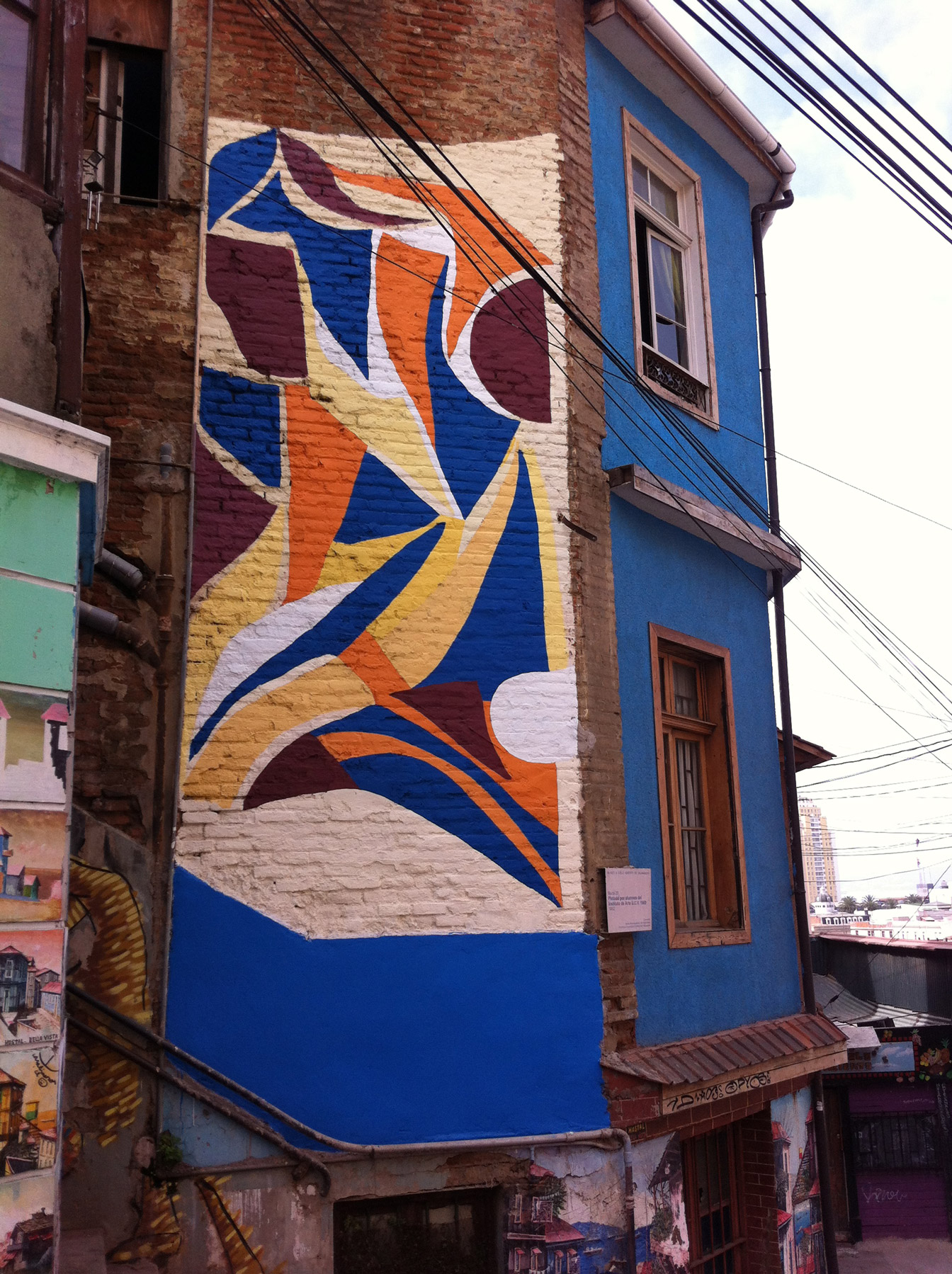
Mural 20, called “Of the students”
It is from the period of the Mural Workshop (1969-1973) and was incorporated into the MaCA circuit as a tribute to that stage and to the students who were part of it
Photograph by the author, 2015
This aspect should be key to the re-signification of this Museum as a cultural heritage of Valparaiso and a landmark in the history of recent Chilean art. Viewing the MaCA as something greater than the murals themselves can work as a starting point to take this project out of its current condition of “not housed” and install it in the circuit and historiography of contemporary Chilean art, recognizing its full value and validity. It means assuming the murals as the visible record of an action carried out in that place, which constituted the main element of the work of art and not as the only strategy. It is a matter of “pointing to a place and sharing its destiny with it,”14 as Méndez said about the non-housed painting.
MaCA is presented as an action whose objective was to intervene and transform the city, rescuing the utopian element of the avant-garde. By incorporating spectators and inviting them to participate in an unusual way, this exercise also included aspects of critical public art, which were manifested in the intention of inviting students and neighbors and, subsequently, those who walk and encounter this landscape on the hill.
The historiography, criticism and theory of national art have not taken into account the dialogues that can be established between the MaCA project and other experiences or theoretical approaches to art in the late twentieth century such as conceptual and process-based practices, site-specific art, and socially engaged or community-oriented artistic methodologies. This exercise is important because it allows the renewal of visions about MaCA, as well as its role in the history of recent Chilean art. The Museum’s proposal aimed at conceptual readings unprecedented in the Chile of the ’90s, being essential to highlight the invisible value of the Museum. It is this that allows it to be introduced into the global artistic logics of the early 1990s, a time when Chile was reinserting itself into the world after the dictatorship. By doing so, it is possible to reconnect the national art scene with what was happening outside the country, in a scenario in which the artistic nuclei had disappeared, characterized by the consolidation of an international art system that manifested itself in the structures more typical of it (contemporary art museums, biennials and art fairs).
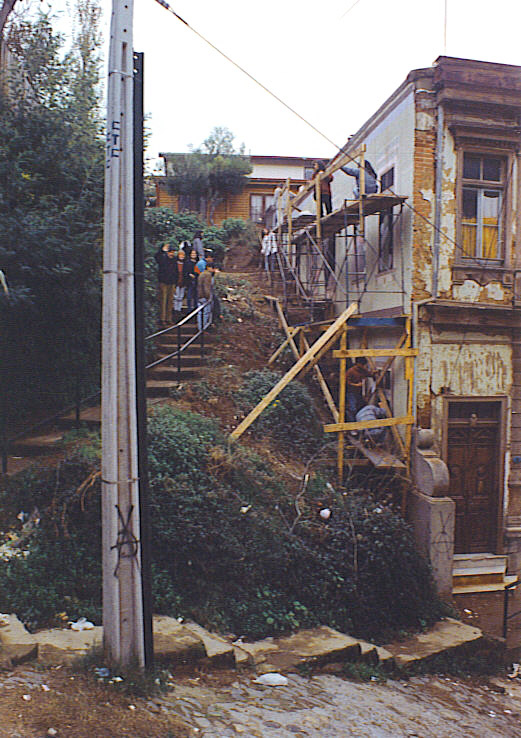
Nemesio Antúnez and students working on mural 16, 1992
Francisco Méndez Archive
The fact that from our country an artistic strategy was developed that was in communion with the most innovative international trends, allows us to install the Museo a Cielo Abierto de Valparaíso as an example of what Andrea Giunta has defined as simultaneous avant-gardes, that is, those works that “are inserted in the global logic of art, but that activate specific situations.”15 MaCA, from a very particular situation (the spatiality of Valparaíso, the pictorial objectives of Méndez, the individual proposals of the artists, post-dictatorial Chile), elaborated a strategy that is in line with other international proposals, placing itself between modern abstract painting and contemporary collaborative, participatory and communitarian practices. The notion of simultaneity makes it possible to situate MaCA as a radical proposal at a global level, manifested in a porteño hill in the early 1990s. Part of the importance of this Museum lies in the group of painters who generated it. What is essential is that they understood art as a gift to the community and offered it to it through participation and on the walls of their own neighborhood. Thus, in the last decade of the twentieth century, they managed to realize the recurring idea inherited from the avant-garde that sought to unite art and life.
1. Francisco Méndez, Museo a Cielo Abierto de Valparaíso (Ediciones Universitarias, 1995), 13.
2. “Universitarios convirtieron al Co Bellavista en museo de arte”, La Estrella de Valparaíso (Valparaíso), 14 de enero de 1992.
3. Francisco Méndez, Cálculo pictórico (QuebecorWorld Chile, 1991), 14.
4. Méndez, Museo a Cielo Abierto de Valparaíso, 12.
5. Méndez, Cálculo pictórico, 115-16.
6. Francisco Méndez, interviewed by Magdalena Dardel, April 24, 2012.
7. Paola Pascual, interviewed by Magdalena Dardel, November 15, 2015.
8. Francisco Méndez, interviewed, April 24, 2012.
9. Paola Pascual, interviewed, November 15, 2015.
10. Jean Lancri, “El pan según Balmes”, Viaje a la pintura, Gonzalo Badal (Ocho Libros, 1995).
11. Rodrigo Zúñiga, “José Balmes: la pintura como cuerpo testimonial”, Arca de Noé. Colección Maestros de la Facultad de Artes de la Universidad de Chile, May 27, 2016.
12. Boris Orellana, “El ‘realismo socialista’ fue irreal y nada tuvo de socialismo”, La Vanguardia, 7 de marzo de 2009, http://www.lavanguardia.com/participacion/20080307/53442835557/el- realismo-socialista-fue-irreal-y-nada-tuvo-de-socialismo.html.
13. Francisco Méndez, interviewed, April 24, 2012.
14. Méndez, Cálculo pictórico, 14.
15. Andrea Giunta, ¿Cuándo empieza el arte contemporáneo? (ArteBA, 2014), 5.
Main image
Mural 13 by Francisco Méndez
Photograph by the author, 2015
Image description
A photo of an outdoor mural painted on a long wall that curves slightly and extends down a sloped street. The mural is abstract, consisting of interlocking organic shapes painted in rich shades of red, blue, white, orange, and green. In the bottom right section of the mural, the words “MENDEZ-LABBE ’92” are painted in orange block letters, and above the top right corner of the mural is a sign which reads “MURAL 13 / FRANCISCO MENDEZ / 1991,” along with other small text. The wall that the mural is painted on is made of stone and concrete, creating an uneven surface. The street in front of the mural is empty, with two cars parked in the distance. Above the mural is more, unpainted concrete wall with short fences on top of it and buildings behind these. Down the hill, near the parked cars, is a flowering bush and leafy trees.