


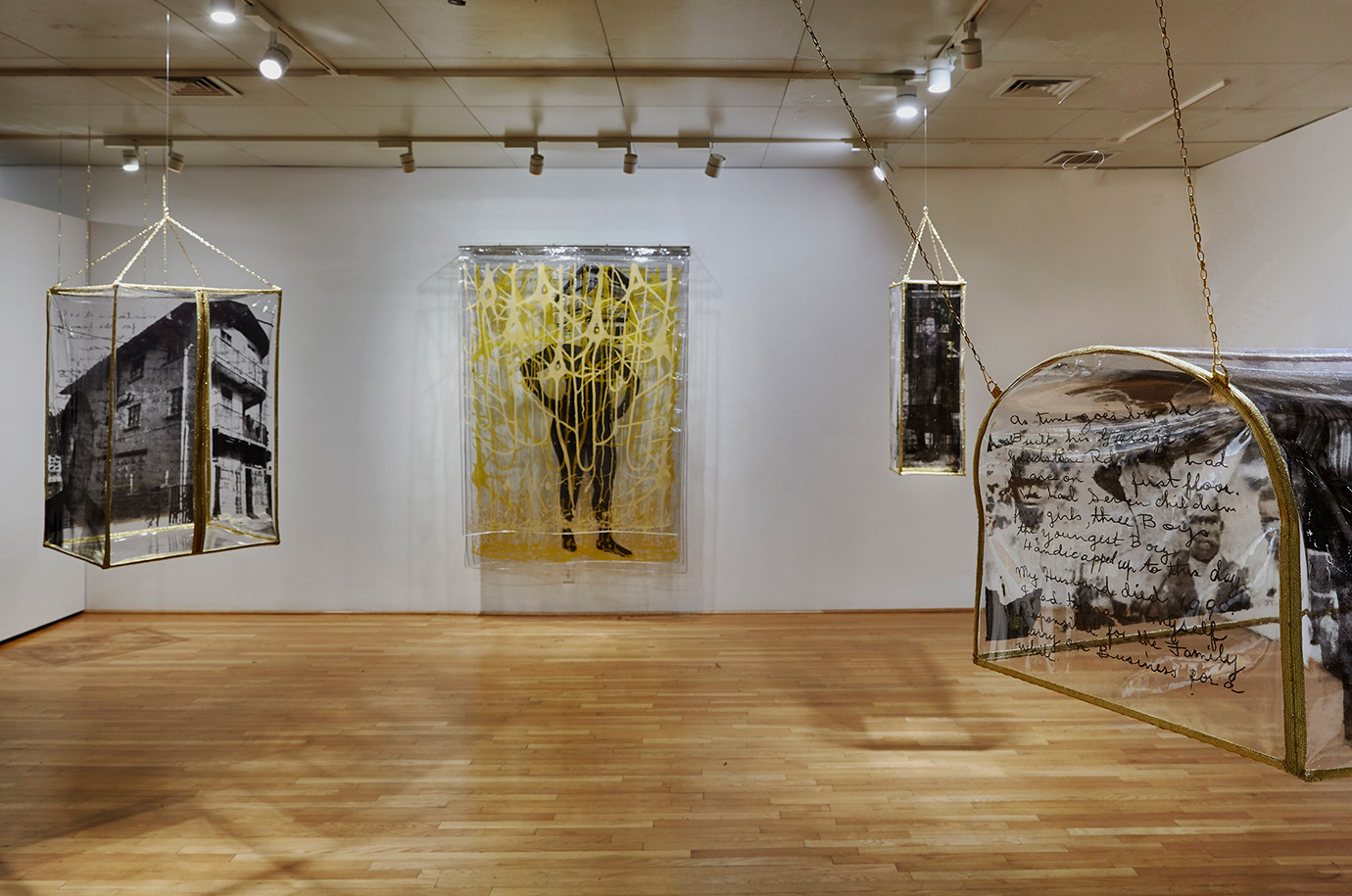
Transparent Repositories
The Work of Shervone Neckles
In February of 2024, conservators Steven O’Banion and Samantha Owens sat down with artist Shervone Neckles in her Jamaica, Queens, studio to speak about her myriad influences, chosen materials, and artistic practice. Presented here is an extended transcript of their discussion, a portion of which was originally published in 2025 in Mary Coughlin’s volume Caring for Plastics in Collections. Focusing on Neckles’s 2019 modular installation Domiciliation: Bless This House, originally created for the 2019 Venice Biennial Grenada Pavilion, this conversation centers on the practical and poetic use of plastics in Neckles’s oeuvre.
Shervone Neckles: A lot of my work draws inspiration from being a first-generation Afro-Caribbean American woman raised in a very densely populated Caribbean pocket of Flatbush, Brooklyn, by two Grenadian parents who migrated to the United States in the late ’70s. My parents were young. They migrated in their late teens and early 20s, settled in New York, and a few months later had me. I like to say that we grew up together. We had to make sense of the world together and create a sense of place and belonging for ourselves.
There are tensions that come with being a first-generation American. While there’s a desire to celebrate and honor my Grenadian heritage, and an urgent need for cultural preservation that I feel deeply, there’s a weight of cultural expectations that I carry as well. There are also tensions between these two places I call home, Grenada and the US. One country is often described as a small island, a small country, a developing country, and sometimes even a third-world country. The other is described as a global world power. There’s a tension there that I want to explore through the work.
When I’m in Grenada, in my ancestral home, my American identity becomes very present. It creates a distance that I feel when I’m there, a feeling of in-betweenness. Many scholars and artists have written and talked about this in-between space. For me, this in-between space is where my ideas really take shape.
At its core, my work is about honoring and celebrating my ancestors and making visible their labor and ingenuity, which might otherwise be lost or forgotten, either because their contributions have intentionally been left out of the historical record, or because of the need to survive man-made and natural disasters, or even migration and the need to settle and integrate into a new place and society. Things get lost along the way. I’m interested in the recovery process, using a range of mediums to explore what it looks like to return, reconnect, restore, remember, and reclaim ancestral wisdom and history. And how can I contribute to expanding that legacy by using history to inform what could be possible in the future?
Steven O’Banion: Something I’ve observed in looking at your work is that it really starts with what you’re trying to explain. Then it seems as though you pair your concept with a different making and craft every time.
Neckles: Yes, yes, absolutely. For instance, in the Domiciliation plastic works series, I was honored to be invited by the Commissioner of the Grenada Pavilion to be part of the 2019 Venice Biennale. Of course, I said yes to join as the fourth artist representing Grenada. While it was an honor, I immediately started thinking, “Oh my goodness, what am I going to say? What do I have to contribute to this conversation? What is the conversation?” The title of our pavilion was Epic Memory, inspired by and named after the Caribbean scholar and writer Derek Walcott’s well-known essay. I was thrilled because the essay’s theme aligns with the notions of ancestral memory that I explore in my work.
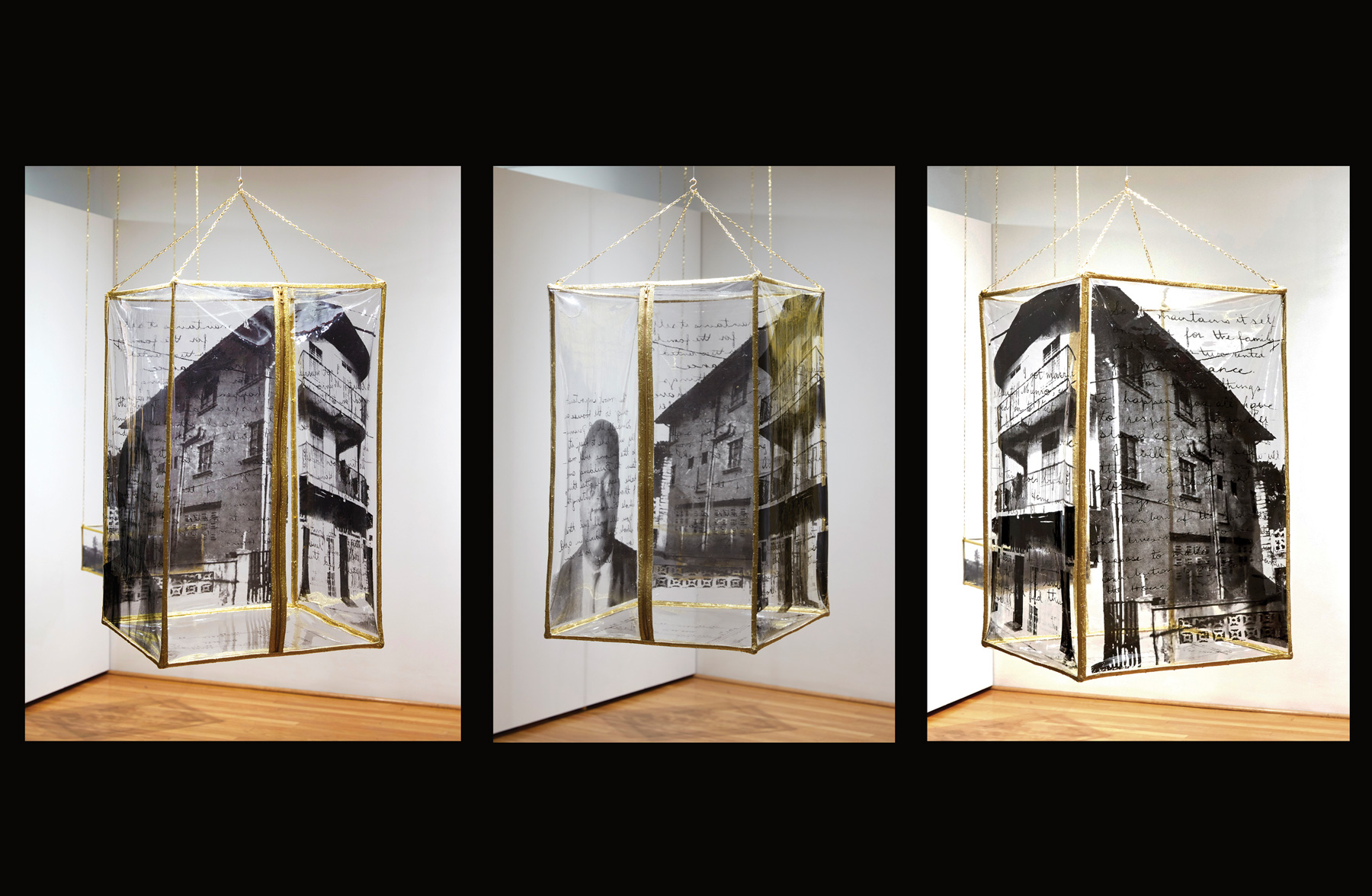
Shervone Neckles, Domiciliation: Repository #1, 2019, from Domiciliation: Bless This House Installation. Mixed media: screen printing on PVC with polypropylene webbing, fabric trimming, and brass zipper, interior frame, and suspension chains. 20in x 20in x 35in Credit: Courtesy of artist, Shervone Neckles. Photo Credit: Yao Zu Lu
Once I was clear about the perspective I would contribute—the voice of a first-generation American-born child whose parents left the island for the US in the late ’70s—the next step was to decide: What’s the story I want to tell? What are my first memories of Grenada? That first memory is of my first visit to the island to help repair my mother’s childhood home right after it was damaged by a house fire in 1986.
My grandparents built that home together. It’s the house my mother and her siblings grew up in. When it burned down, all that was left was the foundation. We lost all the photo albums, documents, and records, the things that can’t be replaced. With what was left, they were able to rebuild the home by 1987, which prompted my mother to return home for the first time since migrating in 1979. It would also be the first time I traveled to my parents’ home country. It was my first international trip, my first introduction to Grenada, and the first time I met my grandfather, aunts, and cousins. Just imagine experiencing all of these firsts at the age of seven. How profound and formative that time was for me. This is the moment I wanted to capture in the work: recalling the memories and feelings and compressing them into these transparent, mixed-media repositories.
I wanted to reference the scents I remember, the sounds I would hear around the house, and the different lush, velvety textures of the furniture and the shiny, smooth fabric curtains with tassel fringe. Those are the types of familiar details I wanted to translate through the work. That’s why it was important to use polyvinyl chloride (PVC) plastic as the core material for the series, because I wanted to use a material that reflects how we preserved the things we cherished in our home.
My grandmother was a seamstress, and she also did a lot of upholstery work with that PVC material, whether it was used to cover the garments she sewed for the folks in the town or [something else]. I knew that using PVC would carry layered meaning for me and for the work.
The title of the work is Domiciliation: Bless this House. “Domiciliation” means making a place your legal home. The subtitle, Bless this House, is my grandmother’s and great-grandmother’s favorite gospel song, specifically the 1957 Mahalia Jackson rendition. It’s become a family heirloom. We would sing it at every family gathering. The title of the song is even inscribed on my grandmother’s headstone. “Bless this House” is a family saying, a family prayer. It holds so much meaning for us. I wanted to make sure the work would resonate with viewers and deeply with my family members.
O’Banion: That’s so well summarized. Thank you.
Neckles: In addition to surviving a house fire, our family home has withstood a number of natural disasters like hurricanes over the years. Grenada is an island continuously affected by climate change and global warming. It is a new reality we’re facing. And again, like the fire, we lose things, rebuild, and recover.
When I was making the series, I wondered what would happen to these pieces [pointing to the artwork] if they were in Grenada during a hurricane? I wanted to make them weatherproof so they could survive a hurricane. All they’d need is the outer surface cleaned to recover. And since the work was installed in Venice, which shares similar climate issues with Grenada, this detail creates a site-specific feature linking the work to the two spaces.
If there were to be a flood, which actually did happen in fall 2019 in Venice during the Biennial, the artwork would just float. They may not be able to survive a fire, but they would survive a flood or a hurricane, both of which are more likely to happen.
O’Banion: Now you’ve settled on a concept. You know you want to be using plastic for its protective qualities, its resistance to water. How do you get from that concept to choosing the specific forms? The hanging square, I’m assuming what we see is a screen print. Can you talk us through some of those decisions?
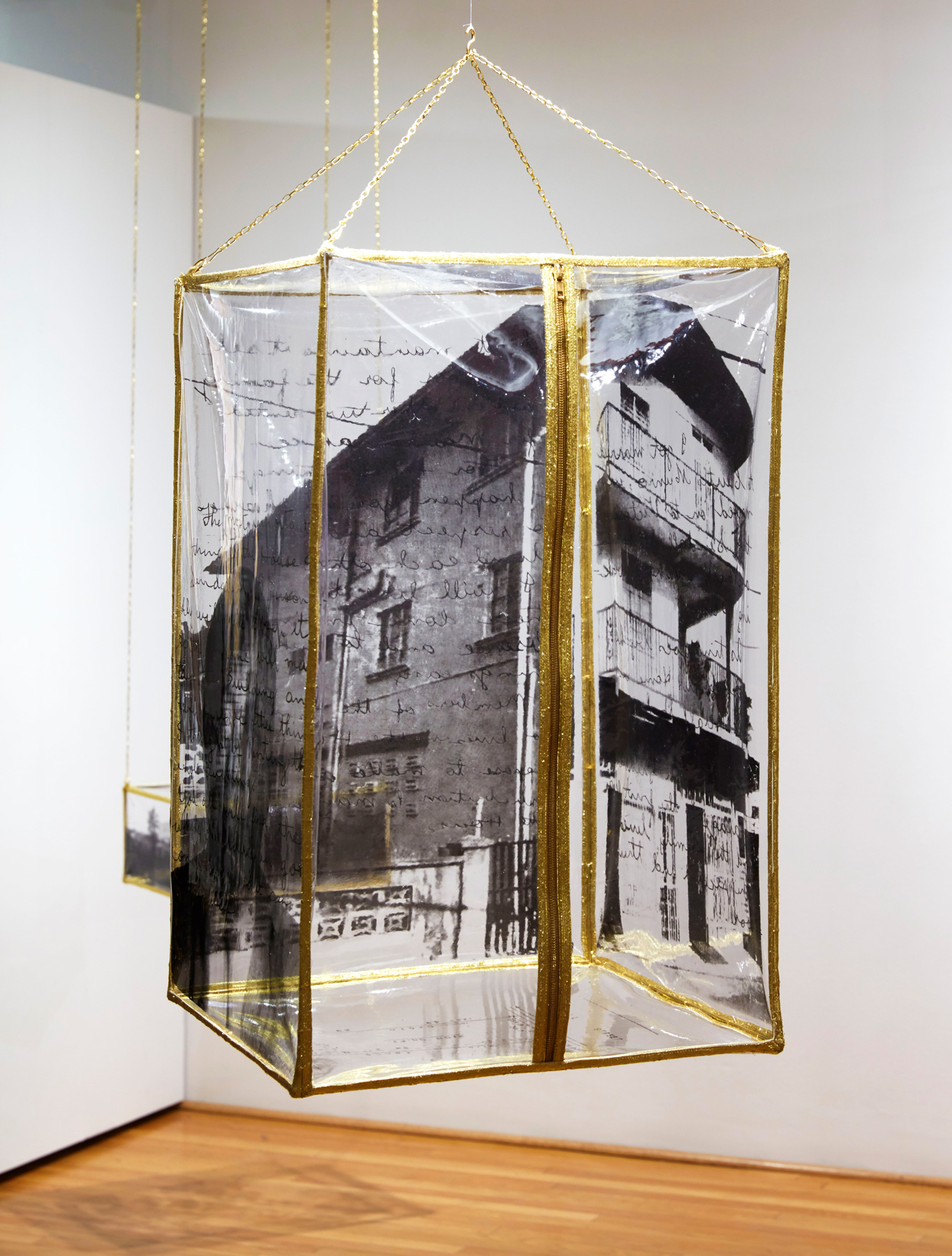
Shervone Neckles, Domiciliation: Repository #1, 2019, from Domiciliation: Bless This House Installation. Mixed media: screen printing on PVC with polypropylene webbing, fabric trimming, and brass zipper, interior frame, and suspension chains. 20in x 20in x 35in Credit: Courtesy of artist, Shervone Neckles. Photo Credit: Yao Zu Lu
Neckles: I was thinking about the types of garment bags and upholstery work my grandmother might have been making at the time. I was interested in replicating the shapes and structures of garment bags and furniture casings, not creating a reproduction, but rather referencing certain elements and features. For instance, you’ll notice I incorporated a zipper in Repository #1. And in all the Repositories, they are made to hang from the ceiling by brass-chain hardware. I don’t know if you remember those… what do they call them? You know the braided cotton cords used to hang potted plants around the home?
O’Banion: Almost like macramé.
Neckles: Yes, macramé. The macramé potted plants that hung outside my grandmother’s sewing room on the veranda and in the kitchen. Incorporating the brass chains also spoke to the opulence of how we would adorn our homes: the rich, lush velvets, the draping curtains with gold-trimmed tassel valances, tied with decorative cords.
O’Banion: The fancy living room for when you’re having company.
Neckles: Yes. Oh, absolutely. The one you didn’t touch until you were entertaining company. That’s right.
Once I decided to use PVC, I knew I needed a specific type. There are different types of PVC. I needed to use high-grade PVC to ensure it could withstand the multistep production process, and I also needed to weatherproof it to protect against natural disasters or water damage. So I chose the 20-gauge PVC. I also knew I wanted to screen print onto the PVC surface, so I worked with the Robert Blackburn Printmaking
Workshop and collaborated with master printer John Andrews. We researched which inks I could use on the plastic surface. We identified the Permaprint brand, which produces a non-toxic screen-printing ink for exterior use. Despite the ink’s weatherproofing, we decided to turn the printed PVC surface inward when constructing the Repositories as an extra protective measure.
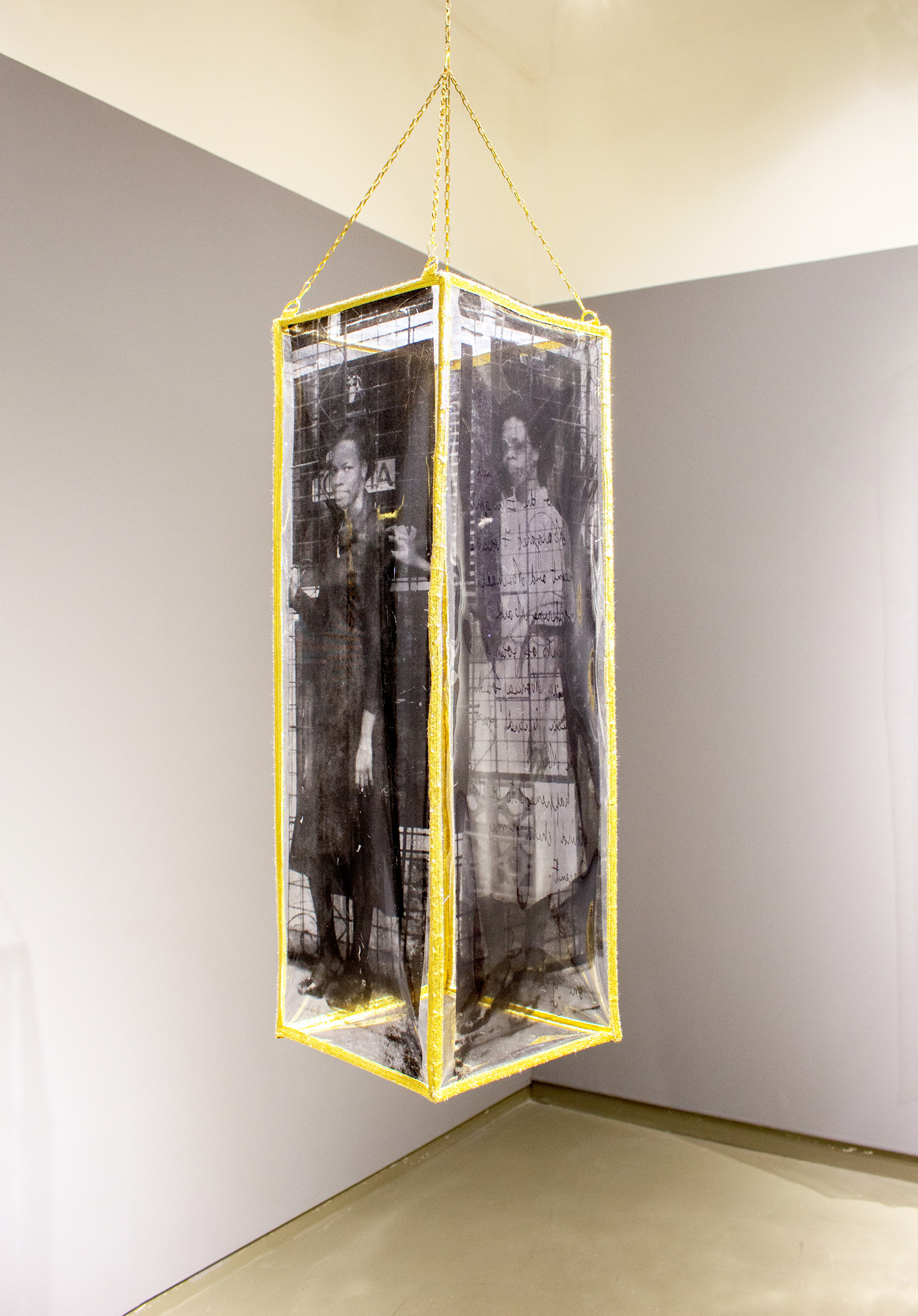
Shervone Neckles, Domiciliation: Bless This House Repository #4, 2019. Mixed media silkscreen print onto 16-gauge clear polymerizing vinyl chloride (PVC) sheets, polypropylene webbing, fabric trimming, and brass chains. 10.5in x 10.5in x 30.5in. Credit: Courtesy of artist, Shervone Neckles. Photo Credit: Yao Zu Lu
O’Banion: Almost like églomisé1 , having the more durable surface on the outside.
Neckles: That’s right. When selecting the images, I already knew I wanted to feature the major influential women in my life, so I referenced a photo from the family album of my mom and aunts here [pointing to Repository #4]. The handwriting you see on the surface is from my grandmother’s journal. I love that she had the audacity to write her own story. In the journal, she writes about her childhood, her role in the family, and how she met and married my grandfather. She even outlines for the family how she wants us to care for the home in her absence. In Repository #1, I wanted to pair my grandmother’s handwriting and words with exterior images of the family home from different vantage points, along with a passport photo of my grandfather. When assembled together, they form what’s foundational to our family.
O’Banion: Here we have the pieces installed in your studio. Can you paint the picture of how you install them and the considerations that go into that?
Neckles: What you’re seeing in the studio is only three of the pieces from the larger multi-part installation. Domiciliation: Bless This House is modular and can be presented in various ways depending on the space and lighting. Proper lighting of the space around the work helps illuminate the shimmer of the inked images and text, and the shine of the brass chains and gold fabric trim featured in each Repository for viewers to peer into.
In the end, I appreciate the challenge of working with difficult materials like transparent PVC, which is tricky to screen print on, sew, and construct into 3D memory boxes that appear ephemeral, delicate, and lightweight yet are structurally sound and durable.
O’Banion: I have a follow-up question about how the installation gets adapted to each of its spaces. Is it a work that can be scaled up or scaled down, where certain elements might be shown on their own? Or in smaller vignettes?
Neckles: Yes, I’ve shown the installation in different iterations and in smaller displays. That’s the beauty of this installation; it can be presented as individual works, in a pair, or as a small grouping. I’ve discovered there are endless ways to display it and how it connects with and presents well alongside other bodies of work, like my Provenance series, in ways I hadn’t realized before.
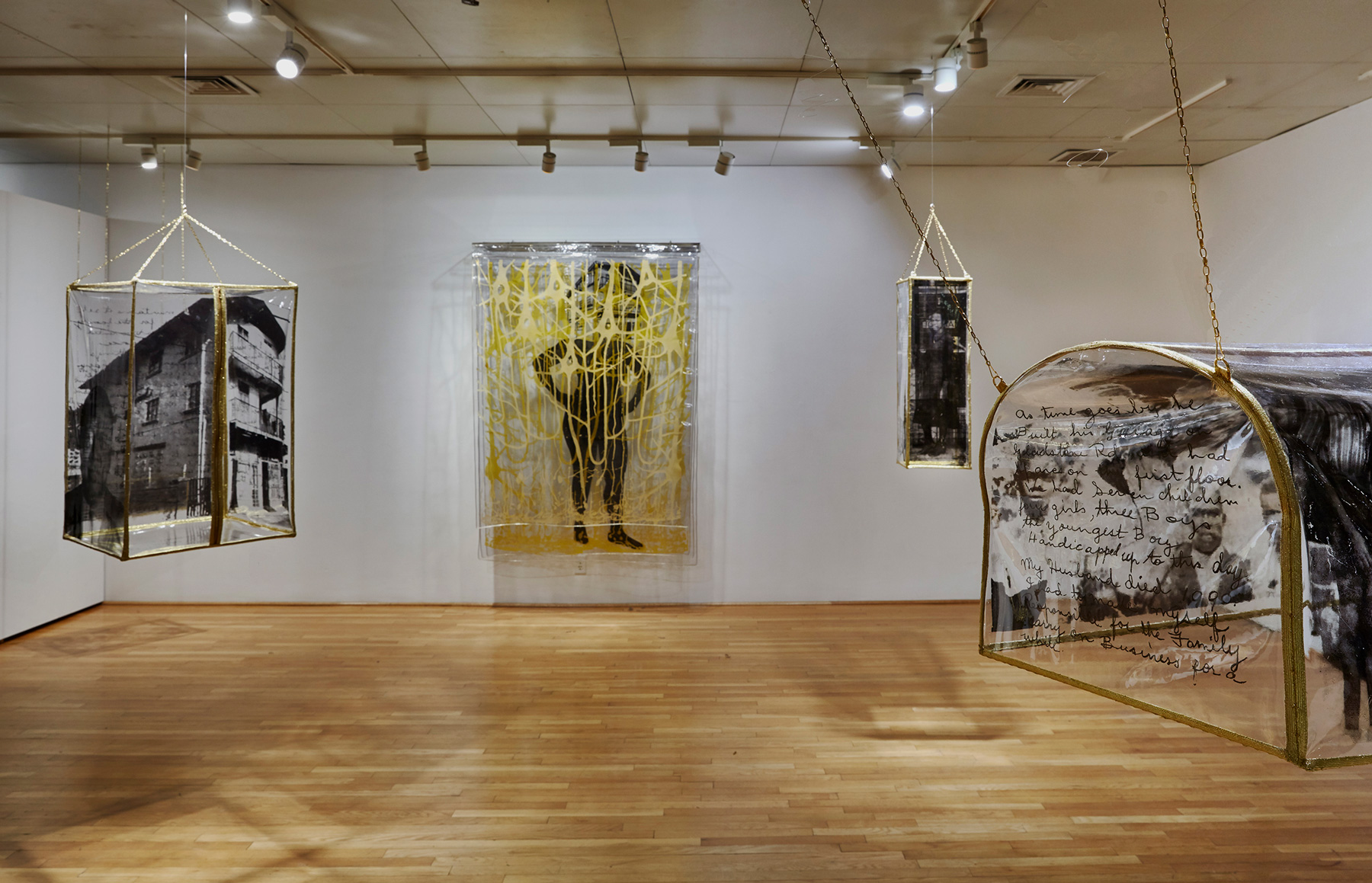
Shervone Neckles, Domiciliation: Bless This House Installation, 2019-2022, on view at York College Arts Gallery, CUNY, York College, Queens, NY, 2019. Credit: Courtesy of artist, Shervone Neckles. Photo Credit: Yao Zu Lu
O’Banion: Have you noticed changes in the artwork since it was originally fabricated?
Neckles: Mostly in Repository #1. This work has taught me a few things about suspending structures, no matter how lightweight they are. I’ve learned a couple of things about hanging malleable materials like plastic, how weight distributes and travels over time, and where to find the tension points to prevent the plastic from warping or stretching. So I’m going to go back in, open up the sides, resew the area, and release the tension where it’s currently stretching the material.
I realize I forgot to mention the sewing and construction part of the fabrication process when we discussed production steps earlier. After screen printing, I worked with a custom needlework and embroidery company to sew and assemble the Repositories. With these artisans, we figured out how to machine-sew boning into the gold fabric trim for added structural support and to incorporate D-ring tabs to suspend the work. Then the screen-printed PVC sheets were hand-sewn and assembled around brass structural frames I created for each repository to ensure the artwork would hold up and not collapse on itself.
Each production step occurred separately. Ideally, when planning, I would prefer to have all my collaborators in the same room, discussing the project together, problem-solving, and anticipating potential challenges. Instead, I had to discover issues like weight distribution and warping and address them along the way.
In terms of yellowing, I don’t anticipate that happening with this body of work, even though yellowing is what normally occurs over time with plastic. But I’m actively controlling that process by protecting the work in custom-made archival boxes and storing them in an environmentally controlled facility. I also intentionally used a high-gauge, high-quality PVC material to ensure the long-term preservation of the work. I don’t foresee yellowing or any signs of deterioration within my lifetime. But even if it begins to show signs of aging, it’s okay because, much like the subjects represented in this body of work, all things age. Just as the paper in my grandmother’s journal ages and my ancestral home continues to age, these pieces will also experience natural changes over time.
My vision for the work is that the installation be acquired and presented thoughtfully, with care and preservation in mind. The pieces are shown frequently but are given considerable breaks. They can be exhibited over a period of months in a dimly lit environment, with the lights turned off when the museum/gallery is not in operation, so the work can rest. After a certain amount of time, they are stored away in complete darkness until the next presentation, with little to no cleaning or maintenance required.
I wanted the work to mimic the practical, resilient, innovative sensibilities I grew up surrounded by, and to reflect the characteristics of the plastic material itself, acknowledging its apparent simplicity and its complexity.
O’Banion: And conceptually that’s a really key fact. The plastic isn’t representing newness; it’s representing durability.
Neckles: Yes, that’s precisely the point I’m trying to make here. Especially given the frequency of hurricanes impacting the Caribbean, preparedness and preservation are always top of mind. That’s why I created a second edition, just in case anything were to ever happen to the first edition. The second edition is slightly different from the first; it features an upholstery trim similar to the kind my grandmother would use to upholster furniture. So essentially, the second edition is designed to serve as a backup.
O’Banion: When you put so much effort into a work that represents you at such an important moment of your career, you must be thinking about where it gets placed in the long term, whether that be with an institution or an individual. Did that play into your considerations when making two separate versions?
Neckles: Absolutely. Because so much of my work is so closely connected to family, this question comes up often for me about where the work will live beyond me and what would serve my family’s continued story. Where would my family, my grandmother, be proud to see our story being told? Where would others who can relate to our story see themselves and feel connected to it? Where and who preserves our stories in our own voices? These are the questions I’m constantly thinking about. I know these are the same questions that will help me decide where I want the work to be placed when that time comes.
O’Banion: That was beautifully stated. Sitting here with us in your studio are so many archival pieces from your family. Can we talk about how you store them? How you reference them? How you want them to live on?
Neckles: It’s a family effort to archive and digitize things like the family album. Many of the materials come from family members, like my grandaunts and cousins, who hold these documents and photos. Given how many of these family records have been lost, they’re very precious items that we handle carefully. I’m more interested in digitizing these rare items for my records and then returning them to the family members they belong to.
My grandmother left me her journals, which is truly an honor. So that’s one of the rare archival objects I’m safeguarding. It’s kept in an archival box in my studio. I like knowing it’s close by and that I can return to it and reference it when she’s on my mind.
O’Banion: What are your views toward, in a future installation or exhibition, showing some of your archive? Sometimes curators want to show some of the supportive materials. Do you have thoughts about that?
Neckles: I’m actually really excited about that idea because it aligns with how my brain works. I’m intrigued by seeing someone’s process and thinking patterns. I also see it as an opportunity to engage with new audiences who may not necessarily be familiar with art but, through these personal items, find an entry point or make a connection with the artist and their process. I appreciate curators who integrate the artist’s archive into the exhibition experience. It’s common to see museums do this, but I’ve noticed galleries are doing it too.
Actually, I’ve recently started digitizing my notes and drawings from sketchbooks connected to exhibitions and other projects, so I can declutter the studio by putting the filled ones in storage and also document the full scope of projects from inception to completion. I find it satisfying to revisit projects. I enjoy seeing my mind map of thoughts, notes, and planning all come together. It’s a good reminder to appreciate all that’s been achieved and how much I enjoy the work I do, which can be hard to remember when the focus is always on the next project.
1. Églomisé is decorative technique in which an image is painted or gilded on the back of a piece of glass.
Main image
Shervone Neckles, Domiciliation: Bless This House Installation, 2019-2022, on view at York College Arts Gallery, CUNY, York College, Queens, NY, 2019. Credit: Courtesy of artist, Shervone Neckles. Photo Credit: Yao Zu Lu
Image description
An installation view of an art exhibition, showing four artworks: three suspended from the ceiling, and one that hangs at a slight distance from the wall behind it. Each work is made of clear plastic, with golden elements and black and gray screen-printed images on the surfaces. The three suspended works show screen-printed portraits, an image of a house, and handwritten text, and the edges of the forms are golden. The remaining work is installed on the back wall of the room and features layered, rectangular sheets of plastic. Each sheet has screen-printed elements, including organic shapes and lines, a person with their hands on their hips, and a home, the layering causing each image to impact the appearance of the next.