


The asterisk in-between, a deaf* biography
Scene 1: Introducing “L but”
The Deaf teacher has assigned a new sign name to me: “L but”
The sign begins with the fingerspelling of L, then a twist of the index finger—an interruption, a hesitation, a possible question.
We are practicing conversational BSL (British Sign Language) to revive the years of signing in school. I tap my index finger against my chest, near my shoulder.
“Why name?”
“You are always asking questions.”
A sign name, unlike a given name, is an embodiment—a movement, a gesture that holds reference to the person it names. “L but” is a humorous commentary on my resistance to finishing thoughts: there is always a but coming. The interruption is built into the sign itself—an invitation to speak, a call to reply, or perhaps a pause long enough to hesitate.
*
I was a teenager during the 1990s; my time was divided between the Deaf Club and a ‘mainstream’ school in Manchester, where the hearing-impaired Unit at school was relegated to a dark corridor in the basement. I signed at high school and the Deaf Youth Club; at home with my family, I did not. This familiar pattern mirrored a broader reality, where d/Deaf and hearing cultures have an uneasy co-existence and one that has yet to reckon with intersectionality. Being deaf and disabled is another uneasy alliance, where historically, the d/Deaf community have distanced themselves from disability to assert that “we are not disabled”.
At the age of 16, being deaf and “not really disabled” was an identity that became further fragmented when the educational psychologist at the college for disabled students decided I was ‘more disabled than deaf’ and advised that I stop signing. I learned to embrace another identity, where disability pride (and the independent living movement) created another community and signing slipped into the background. Does being deaf with an asterisk speak to these in-between spaces? Between the deaf and disabled community? It seems, on these terms, that the grammar of the asterisk does move in the in-between spaces of disability and being d/Deaf. It is far from being static and holds ongoing dialogue with technology, speech therapists, and the histories of Deaf Studies and Critical Disability Studies. Can the asterisk serve as a catalyst, opening an in-between space that unsettles the fixed politics of big and little D/deaf?
I asked Kevin Gotkin, a friend trained in media theory, their understanding of the asterisk. They referred me to a short essay by Danilo Machado, “On asterisks (*for the stars)”. Machado poses a series of questions on the placement of the asterisk, they write, “When does the asterisk’s distance—it’s pointing elsewhere—facilitate closeness to language? When do writers specifically use the symbol to cite, emphasize, or correct? How does its presence transform a text’s visual and rhetorical impact?” The figure of the asterisk can be annotated from the margins of the texts, to redirect readers to different use of language and meanings. It is also a function that can include and exclude.
I consider Machado’s piece alongside the work of other researchers, writers, and artists to explore how Rachel Kolb and Christine Sun Kim push and flex the boundaries of the asterisk in multiple directions. In Sun Kim’s earlier work, the grammar of the asterisk is found through the materiality of sounds moving objects she interacts with. Perhaps in this instance, the asterisk focuses on the doing (practice) of deafness and its relationship to sound. In my work, I’ve been concerned with phonetics*—specifically when used as a form of digital shorthand to provide accessibility.
To reconsider the 1990s is to revisit a paradox. This was the decade when the first generations of deaf and disabled students in the UK entered mainstream education under the promise of inclusion, yet integration did not equate to equity. I was among them, navigating a system that spoke the language of access while failing to dismantle the structures that made access necessary. The decade’s neoliberal reforms framed inclusion as a policy achievement, but at what cost? The passage of the Disability Discrimination Act (1995) signaled progress, yet it also marked the beginning of a fragmented grammar of activism—one that split between cultures, institutions, and the shifting lexicon of rights, accommodations, and the realities of lived experience.
*
Scene 2: Speech Therapy
CITY OF MANCHESTER: EDUCATION COMMITTEE
On the left, in thick black ink: “Bring back to school Monday morning.” The instruction sits above the familiar pages of my Sound Blending/Speech Therapy Book, 1989—a relic of an education that sought to discipline the mouth as much as the mind.
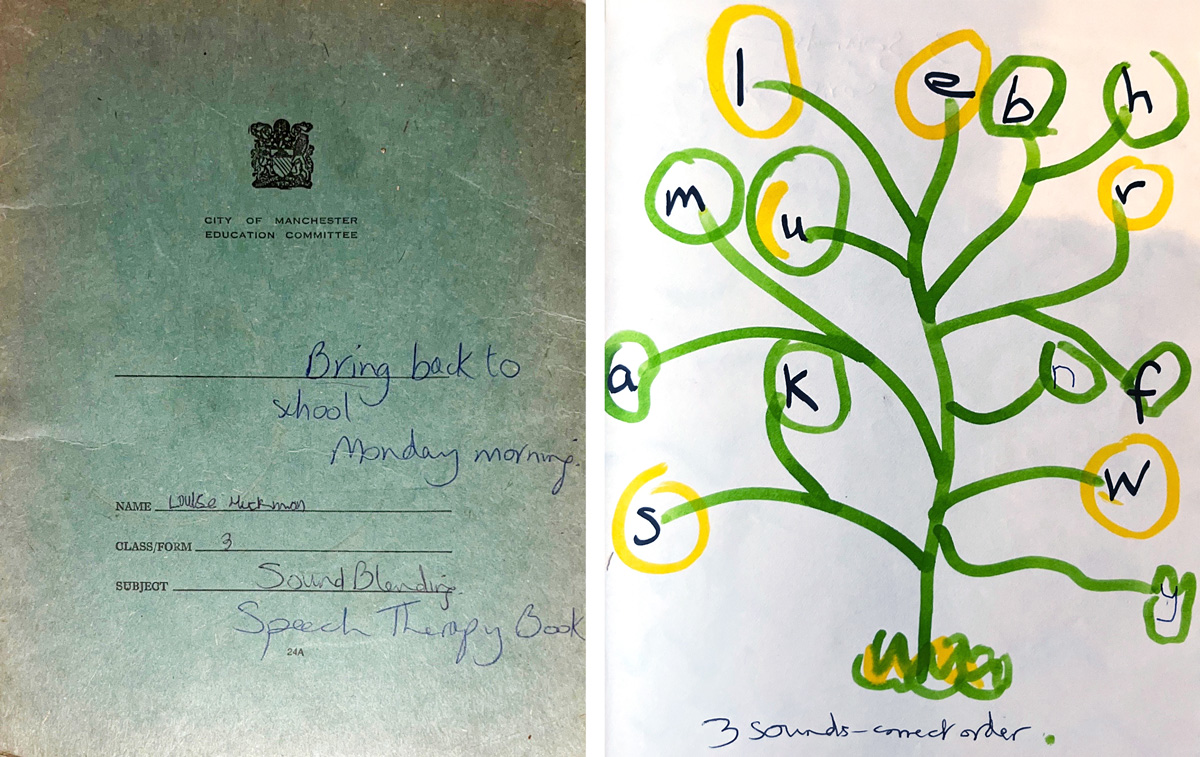
Page 14.
Church. Chip. Chicken. Cherry. Chop. Chair. China. Chocolate. Chubby. Children.
Ch
Ch
Ch
Ch
Page 15.
Two letters, one sound.
Shell. Ship. Shower. Shoulder. Shed. Shark. Shine. Sheep. Shop.
Sh
Sh
Sh
Sh
Sh
Sh
Two letters, one sound.
Two letters, one sound.
Two letters, one sound, is a repetitive exercise completed weekly in speech therapy. The task at hand is clear: Ch and Sh must remain separate, distinct, and controlled sound.
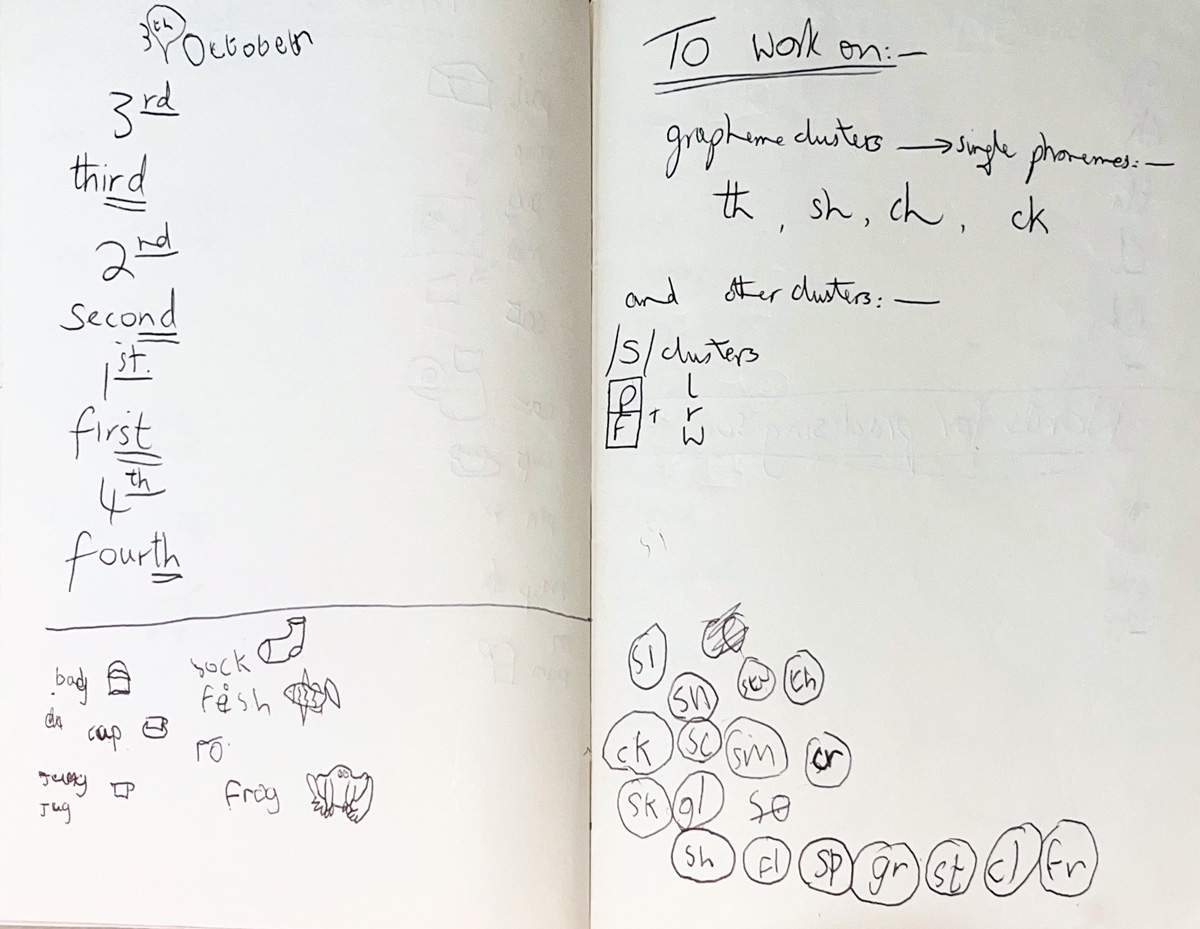
In repeating these sounds to the therapist, I recalled the shame of failing to separate the sounds.
Later at dinner, I asked for “shicken and ships”
The words collapsed in my mouth, becoming more disobedient the more I tried.
In coffee shops, I order a flat white and never a cappuccino.
The choreography of speech is not just about articulation but about anticipation—preempting the stumble, and sidestepping the words that are difficult to pronounce. Food and drink options get eliminated.
*
I use knitting metaphors to describe the process of hearing, which in many ways relies on familiarity with the speaker—their rhythms, tendencies, and the spaces between their words. Their hands gesture too. I loop their intonations with my understanding of them, pulling the threads tight and hoping for a coherent sentence. The results are always mixed and imperfect, and the pattern remains incomplete.
I compare the incompleteness of speech-making with phonetic mishaps.
The asterisk functions as a footnote to conversations. Its incompleteness resists closure. It holds space for contradiction, for the in-between—between deafness and disability, between sounds, spoken words and the words that are missed. A strange choreography between lip-reading and signing, where the asterisk functions less as an addendum than as a form of punctuation that acknowledges uncertainty.
In the classroom, the unseen architecture of access shapes how words appear and to whom. In speech therapy, it hovers over syllables that must be trained into obedience, over letters that must remain in their assigned lanes. In the act of listening—through captions, through voice notes, through the partial and the inferred—it is the silent notation of everything that does not fully translate. The asterisk is a hesitation, a point of contingency, an unspoken but.
If an asterisk is a footnote, then deaf*—with its refusal to settle—offers its own kind of annotation to identity. It complicates easy distinctions between hearing and Deaf, between disabled and not, between inclusion and true belonging. It is both a bridge and a barrier, a marker of access and of exclusion. It reminds us that understanding is not always immediate, that language—whether spoken, signed, captioned, or written—always carries with it gaps and ellipses.
The asterisk lingers, an invitation to reconsider, to revise, to remain open to the spaces in-between.
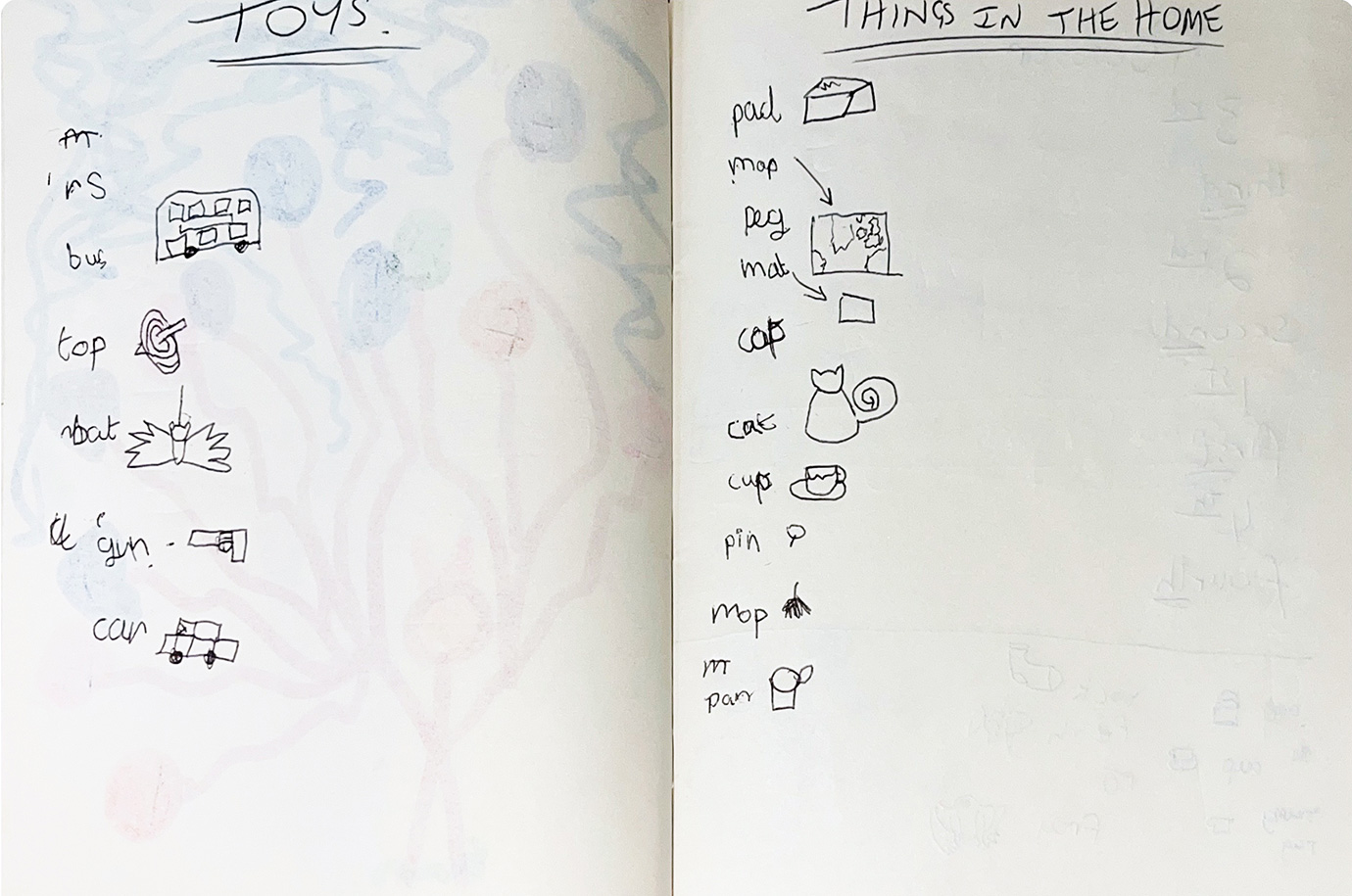
Main image
An image of two open pages in a notebook, with the binding seam running down the middle of the image. The paper is white and features various handwriting and drawings done in black ink. “TOYS,” underlined twice, is written at the top of the page, followed by “M” and “‘RS,” then a vertical list of toys, each with a drawing of the item to the right of each word. This includes: “BUS,” “TOP,” “BAT,” “GUN,” and “CAR.” The right page of the notebook has “THINGS IN THE HOME” underlined at the top of the page. Below this is another list, with more accompanying drawings. From top to bottom, the listed items are: “PAD,” “MAP,” “PEG,” MAT,” “CAP,” “CAT,” “CUP,” “PIN,” “MOP,” and “PAN.” “Cap” and “peg” are the only words without accompanying drawings, and “M” is written just above the last word in the list. Additionally, drawings and writing done in pen and marker on the previous and subsequent pages are faintly visible through the thin paper.