


My Mind’s Ear
Technological Shifts, Soundworld Shocks
“It wasn’t really wailing,” my mom says.
We’re talking about a sound I made as a toddler. Soon after mastering the art of sitting upright, I developed a practice of vocalizing to myself. Photos show me sitting or playing, stopped my tracks; or multitasking as I rifle through objects at the bottom of a baker’s rack.
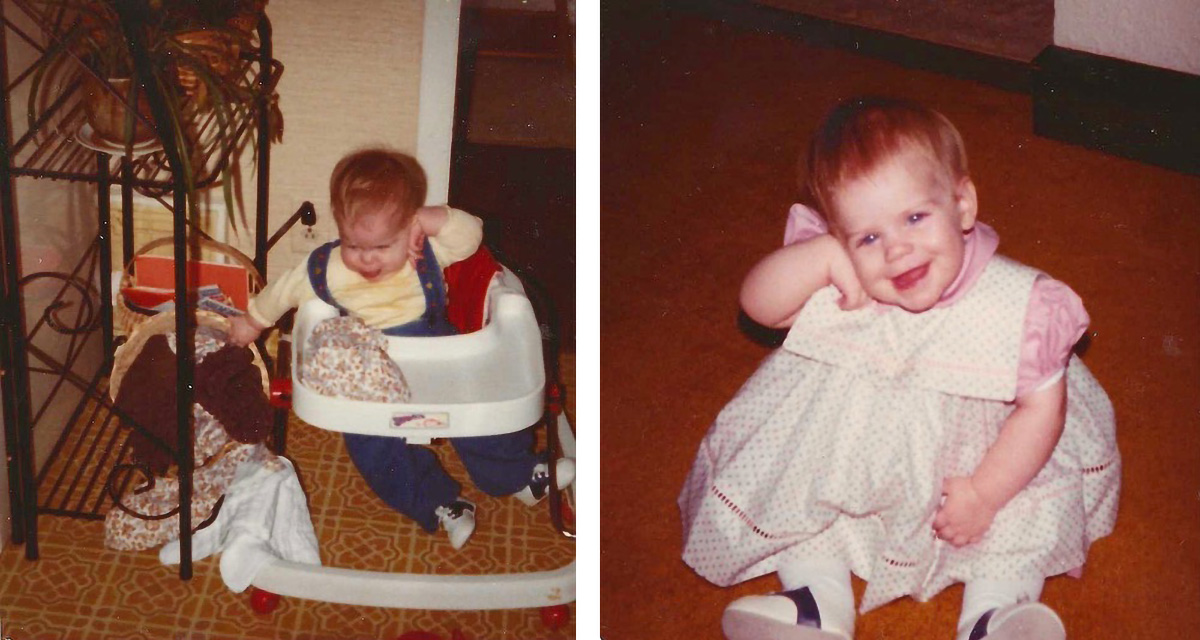
Left: “Margaret and the Baker’s Rack, 7 months,” personal photograph from the author’s collection, date unknown (April 1983).
Right: “Margaret, 7 months,” personal photograph from the author’s collection, date unknown (April 1983).
My right hand is raised to my head, bent sharply at the wrist, the top of my hand pressed against the shell of my ear. I sound an ahhhhhhhhhhhhhhhhhhhhhhhhhhhhhh through my torso. I used to pull the cushion off of a bay window seat in our house, hoisting myself up to an especially resonant spot. Singing to myself. Stimming. I trailed a wail through the aisles of the Piggly Wiggly in our neighborhood, where we became well-known. My sense of this sound doesn’t come from my own hearing or my own memory, but from how my mom narrated these baby stories, mimicking the sound. She’s right: a wail is more full voice, it may crescendo, it may change in pitch. This sound is a steadier stream of open-mouthed hum, it might start with a tone I hit higher up, like the beginning of a sigh, or just hover mid-tone, like a wandering whole note.
Though I was so vocal, my parents realized I was deaf when I hadn’t learned many words. I only knew “no,” “hot!” and “up?,” words they would say loudly or while leaning down toward me, near my ear. After a few afternoons in a sound booth for hearing tests, I was diagnosed with a profound bilateral sensorineural hearing loss.
My parents started learning American Sign Language, and I got my first pair of hearing aids— Phonak Picofortes, which I wore with the volume turned all the way up. My self-serenading seems to have stopped at this point. Now, sound was located not in my body but in the environment around me. With my new hearing aids, suddenly, I could hear the squeaks and rattles our red Radio Flyer wagon made as we took trips around the neighborhood: the resonant ahhhhhhs were replaced by the huh! of surprise and interest.
I started working with a speech therapist, and I caught on to using speech and sound to communicate. My family, teachers, and audiologists have always narrated my relationship to sound and to speech as unusual, an incoherence at the kernel of my experience. The way I navigate sound and communication, put together with my profound deafness, has been either deeply confusing, illegible; or it has been perceived as a wonder and a miracle. These narratives, with their enthusiasm for how I approximated hearing ways of functioning, despite, set up expectations that have been impossible to live up to.
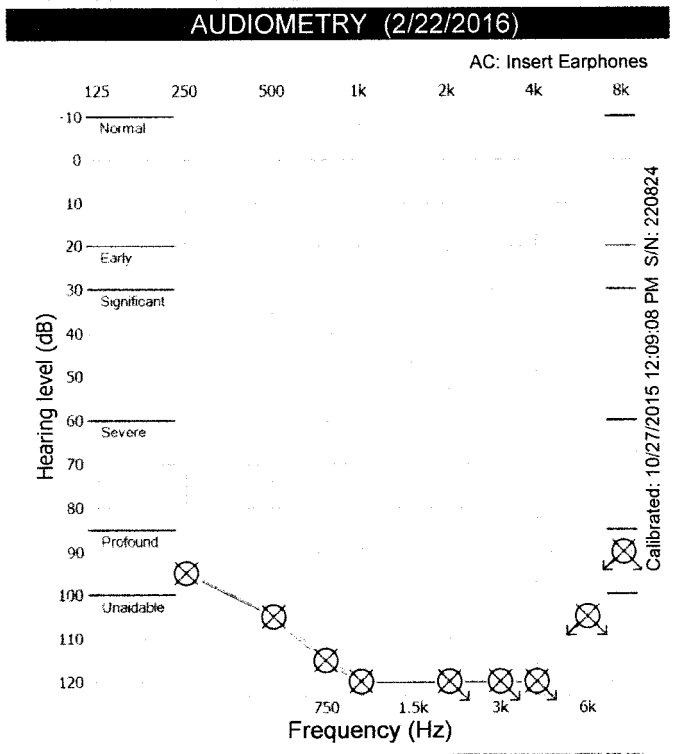
I find an audiogram in my email, the x’s and o’s bridging a track through a realm that is labeled “unaidable.” But, again, with my hearing aids, I heard things. I did become someone who uses speech to communicate. “Somehow,” I was able to take what is apparently not a lot of sound information and make sense of it. I love music. I have intensely happy memories of listening to cassette tapes narrating children’s books from the public library. I sang along with songs on repeat from Mr. Rogers; Sunday school; Zubilee Zoo; and Sharon, Lois, and Bram.
With these developments, my parents stopped learning sign language, though we kept a few signs around, like the sign for “bathroom,” which is a useful note from across a room. Going to the bathroom! The way we signed it, I now recognize, was a little off, with a strong hearing accent: “t,” a little too high, a little too slowly, a rotating wrist rather than one that wiggles from side to side. It’s a home sign inspired by ASL, or something mis-taken, language use separate from a Deaf community of signers.
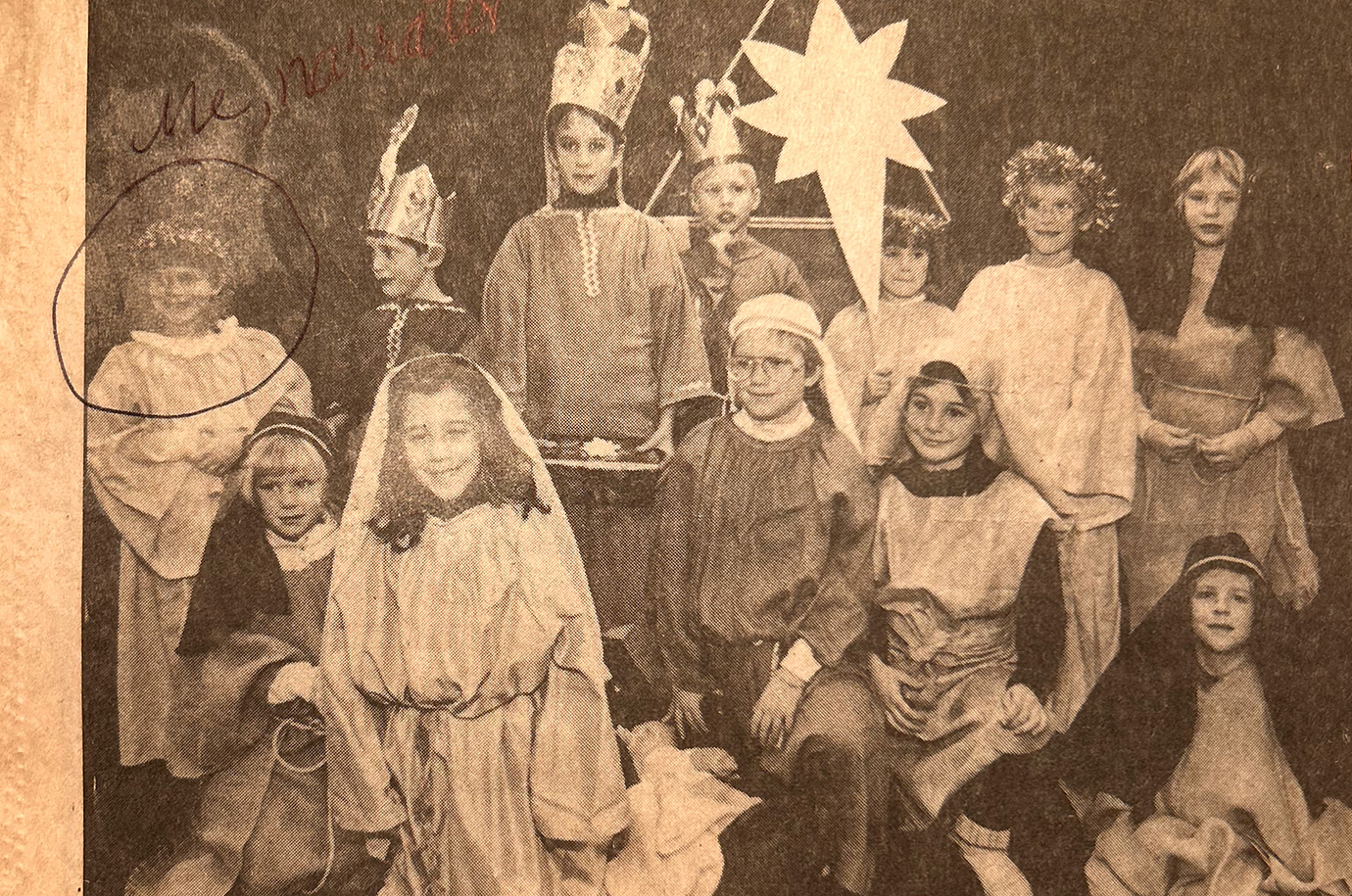
When I was a child, my parents made an effort to connect me with other deaf kids; I think they got a lot out of building community with other hearing parents of deaf children. But I really didn’t communicate with ASL, and I experienced this group of people—with kids’ energy and a whole signed language system I didn’t understand at all—as chaotic, a show to take in without really knowing what was going on. For the group’s nativity play one Christmas, I was the narrator, because as someone who communicated with spoken language, I could read the story aloud; I remember being proud, and receiving praise for being a good reader. It was a role of distinction—as in, it was a mark of being separate from my deaf peers. Were people praising me, a little bit, for not being as deaf? Or was it a consolation for being oral, not knowing sign?
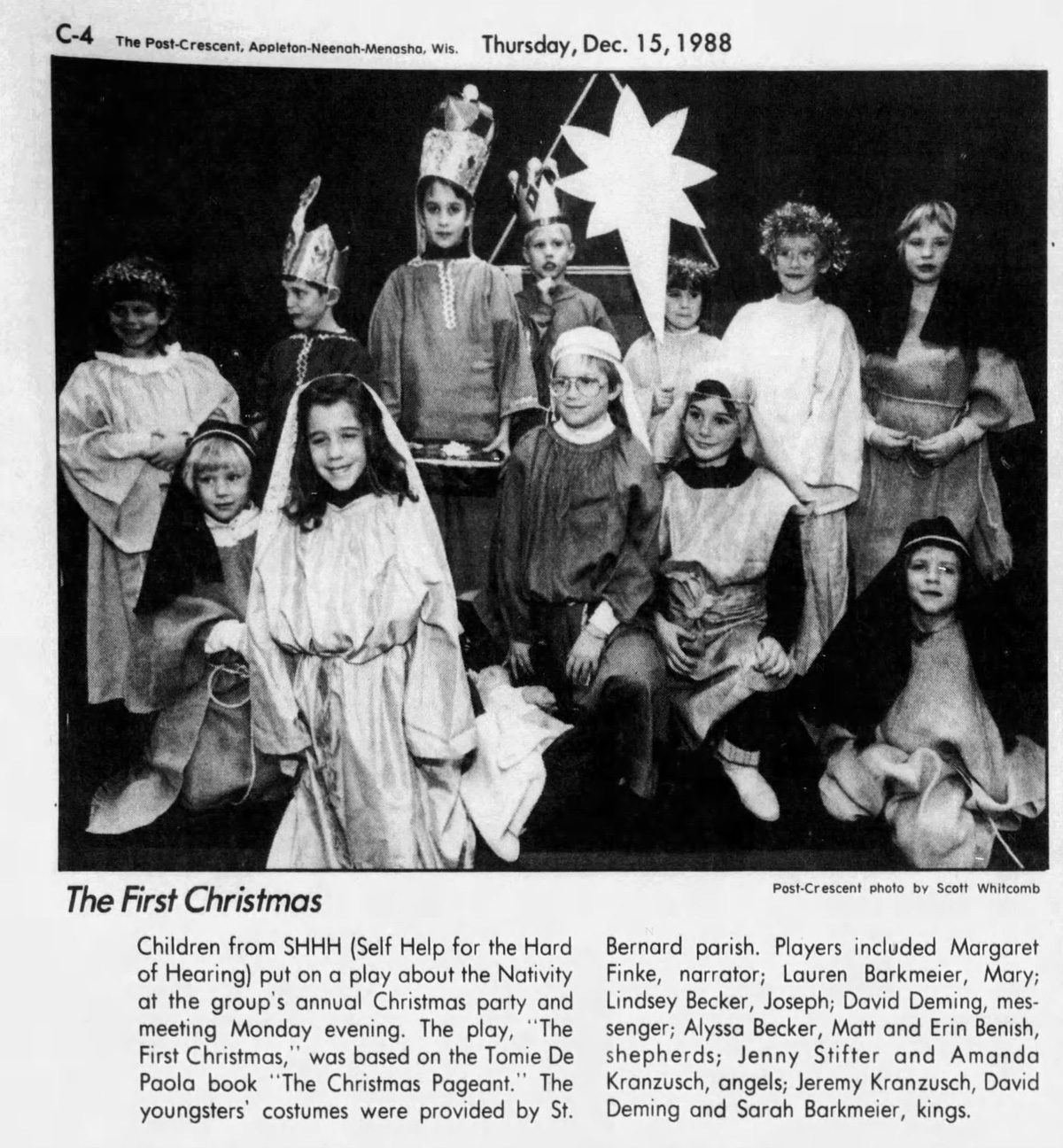
“The First Christmas,” The Post-Crescent (Appleton-Neenah-Menasha, WI), 15 December 1988.
At this point in my life, I understood that we were together because we were all deaf, but being together was mainly an experience of feeling unlike the group, of misfitting.1
In elementary school, I was mainstreamed with hearing students and wore an FM system—it was a box strapped to my chest with a beige, Velcro, X harness, and beige wires twining up to my hearing aids. The teacher wore a microphone and their voice was channeled directly into my ears. The FM system, along with a good spot in the classroom and visual-aid-oriented teaching, meant that I heard what I needed to hear to learn. I excelled. The FM system came after a whole period in the first grade that I barely remember— my memories are diffuse and unfocused—where shockingly, I got a D in handwriting. Not because my penmanship was particularly bad, but because I spent the entire morning coloring the top page of our handwriting worksheet packets without venturing into the exercises. Apparently, giving me low-but-passing marks made more sense than explaining to me that I needed to do the worksheets.2
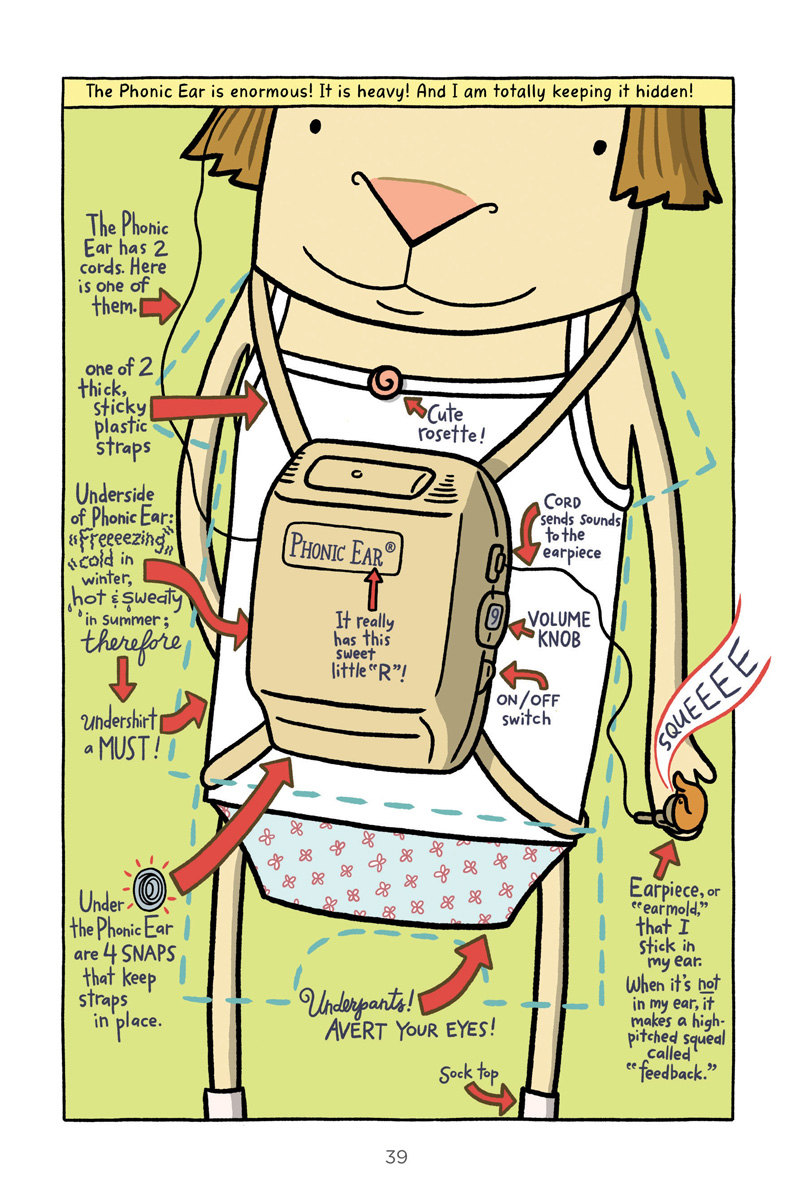
From Cece Bell, El Deafo (New York: Amulet Books, 2014), p. 39.
With the FM system came some adventures in sound and even superpowers: Ms. Robbins, my third grade teacher, who had nails so long she struggled to turn the lights on and off, would step out of the room and forget to turn off her mic; I narrated her break peregrinations to my classmates, much to their delight (now she’s talking to someone in the hall! now she’s going to the bathroom! now she’s coming back!).
The mic-focused FM experience also meant that I really missed anything that was off-mic. The teacher would give an answer, but I had missed the question. My classmates would erupt in giggles, but I had missed the joke. It actually felt like I’d be able to hear more with my plain hearing aids. When I told the Deaf and Hard of Hearing Services person from the school district that I didn’t want to wear my FM because I couldn’t hear things well, she dismissed my complaints, and told me I was embarrassed. She warned me about a deaf girl (the girl seemed really bratty in this story) who had flushed her hearing aids down the toilet. I reacted with appropriate consternation, examining my motivations with concern that perhaps I was a bad kid, behaving in ways consonant with this deaf girl who flushed her aids. At the same time, I knew I couldn’t hear well, and while it was a bit cumbersome, it genuinely hadn’t occurred to me to feel badly about wearing an FM system, certainly not to the point of destroying it. In retrospect, the layers of misrecognition astound me: this fantasmatic deaf girl’s refusal to be wedged into a sound-using, oralist existence was narrated to me as a cautionary tale: she was an ungrateful kid with questionable moral fiber, harming expensive tech for trivial reasons. Her actions were only imaginable as an expression of shame about wearing hearing aids, shame about being different from hearing people. The school district person couldn’t conceive of the cast-off hearing aids as representing so many hearing expectations. Tech was not imaginable, in this hearing context, as something that forced you out of your own soft experience of silence into a probably chaotic, tiring, and frustrating experience of being mainstreamed.
When my parents got involved, they quickly figured out that because I was small, the omnidirectional mics on the chest-mounted part of my FM system sat under a hollow, metal tank of a desk where they couldn’t pick up my classmates. In the end, my efforts to communicate my experience of sound were confirmed rather than dismissed, and what I was explaining about my reality was finally being heard. At the same time, this was my first major lesson that I couldn’t claim a common, or normal, or hearing relationship to sound. I was taught that my relationship to sound was questionable, less legitimate. I was also being taught that tech—and the deafness it visually indicates—could or should be a source of shame.
I continued using the FM system through middle and high school, dropping the mic off with my teachers before settling into my seat. I was now fully steeped in overcoming narratives that my deafness didn’t matter because I was “doing so well.” I was a mainstreaming success story: mayor of my 5th grade classroom city, regional spelling bee champ, second clarinet, Honors Society, editor in chief of the newspaper, valedictorian, and so on. And I participated in minimizing how my deafness showed up: I avoided saying words with “s” or other deaf accent difficulties, and I wore my hair down to cover my ears and hearing aids. As I worked to approximate hearing ways of functioning, I also assumed that everyone understood that I was definitely deaf. I was caught by surprise when others experienced any kind of category confusion, like when Becky Kowalski3 , after having called after me a few times in the hall before school, finally caught up to me and said, “Geez, you really are deaf, aren’t you?”
In college, finally, I didn’t have to bother with an FM system or IEP meetings. I shunned the accommodations office, got myself good seats, read along on my friends’ notes, and fell asleep in most of the large lectures I didn’t skip outright. I was a strong writer, I did all of the readings, I expended considerable energy to keep up with discussion in seminars, and I continued to excel. When I applied to graduate schools, my recommenders shared their letters with me: without fail, they mentioned my “significant hearing impairment” but also its status as something one stops noticing or forgets, an obstacle I had successfully surmounted.
It was also in college that had my first brush with disability studies when I signed up to be a peer writing tutor for an early Disability Studies 101 course (“I’m deaf,” I thought, “this could be interesting”). It was interesting, and the insights I encountered—the social model of disability, and disability as a political, social position, would later become lifelines.
In many ways, my story’s rubber really hits the road when my trusty Picoforte hearing aids finally pooped out, and analog aids weren’t being made anymore. This happened, for me, when I was starting my PhD. But earlier than that, during my Master’s program, the process of breaking from the narratives I’d grown up with had begun picking up speed: my usual strategies for navigating hearing environments had been failing, and I was confronted with the reality that accessibility doesn’t work well when the onus is on the disabled person to do all of the adapting. The technoableist fantasy had begun to crack: powerful hearing aids had not, in fact, made me hearing, and no matter how much I focused, and no matter my lipreading skill, I was missing things.4
After a couple of weeks into my Masters, I took stock, met with the Dean (my ‘elite’ university had no disability services office), and arranged to have captioning in my classes. The president of the captioning company and two other people came in to fuss over the set-up on the first day, a new contract at a fancy school. They started signing with me, and I had to explain that I didn’t know ASL; they continued with the dreaded over-enunciation that is more difficult to lipread. I waited patiently as my classmates trickled in, and once set up, they exited. The captioner was remote, listening via Skype call with audio that was easily compromised. Even if the mics were working well, the captions weren’t able to keep up with the fast pace and the specialized diction of the seminar. If I was looking at a laptop to read the captions, it meant that I wasn’t looking around to lipread, so I ended up missing a lot more than usual. My professor, who had a knack for telling stories about growing up in California, or being a boxing coach, and tying them into insights about modern European poetics, observed the setup kerfuffle with raised eyebrows. After class, he asked me, simply: “how’s your spirit?” Tearfully, I responded, “it’s not good.”
This moment has stuck with me for a long time, and it’s legible to me now as an unlikely experience of what Mia Mingus has called access intimacy, “that elusive, hard to describe feeling when someone else ‘gets’ your access needs.”5 While our conversation didn’t really address my access needs, someone was seeing and intuiting my deaf experience: seething at subpar access that was all the more frustrating because the apparatus was so complex. (A counterpoint: while reading in a student lounge, a student from the same class addressed me. Because I had been focused on Paul Celan, I missed what he said. Rather than repeating, he remarked: “you need that captioning set up!” I was pissed. His approach framed any divergence from being hearing as something that made communication a total no-go.) As I encountered situations in which my deafness was not irrelevant or forgettable, the narratives of my childhood were caving under the pressure of audism and inaccessible environments. I began to adopt the audacious perspective that being deaf was not the primary problem, and that a technological supplement was not the primary solution or “fix.”
To return to where the rubber hits the road: as my Picofortes began dying, I needed to replace them, but similar analog hearing aids were being phased out in favor of new digital technology. While my audiologists seemed relieved and grateful to be working with an “experienced hearing aid user” (as opposed to adults using hearing aids for the first time), the transition from analog to digital sound was, for me, a deep, even world-threatening shock. I have never been hearing, so I don’t generally identify with “hearing loss” labels, but this period is an exception. I experienced these technologically-mediated changes to my hearing as loss—of sound, and of auditory contact with the world I knew and the people in it.
Hearing aids have aggressive advertising campaigns: images of people sitting alone in their living rooms transform into sun-dappled family parties full of play, hugs, and meaningful glances. In the switch to digital, I was drawn in, and as I embarked on the process of getting new devices, I had gotten my hopes up, particularly about hearing the high frequencies of consonants in speech, hopes still attached to functioning as a hearing person (not a sound-using deaf person).6 In my audiologist’s office, I sat listening intently to a quiet room, focusing on how their voice sounded as they assured me that there’s always an adjustment period. I became well-versed in how difficult it was to articulate what I was hearing, grasping at metaphors: it’s like I’m wearing a really thick hat over my ears, I try to explain. I venture into downtown Chicago and everything is noise, but muffled. I go to the grocery store and the muzak (which I never heard before) dominates the soundscape, but I can’t make out what the cashier is saying to me. I slam doors that make no sound. I go to the Chicago Public Library and a children’s choir is singing holiday songs in the rotunda. My mind’s ear imagines resonant high notes, searching to recognize a familiar tune echoing through the marble-clad space, but it’s formless noise. I replay favorite songs, craving their melodies, but they just sound flat. I try to be patient and open-minded, explaining what sounds wrong to facilitate adjustments, going back time and time again, wearing on the audiologists’ patience. The audiologist explains that digital aids are programmed to amplify soft sounds or high frequencies, dampening very loud sounds. He shows me graphs of the how the instrument processes sound input. There’s a great deal of possibility and control, as promised in the glowy scenes of connection and contentment that play in the waiting room. But because I am actually quite deaf, the sensitive gradations that digital sound can capture are mostly lost on me.
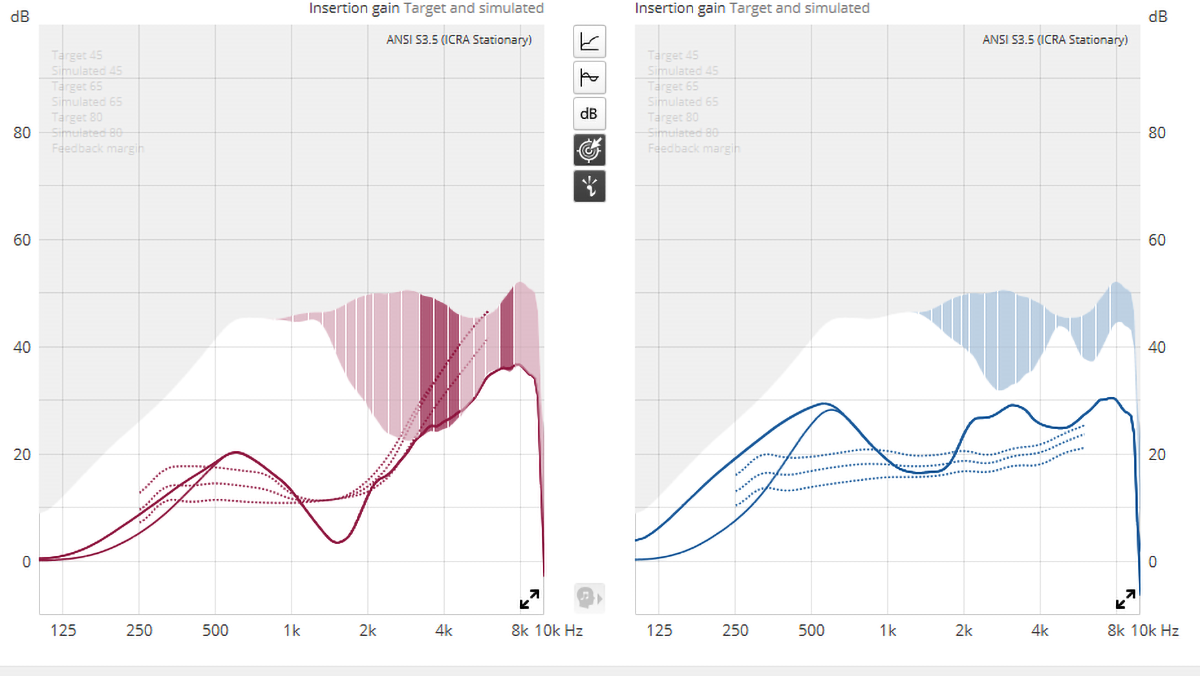
From e1405, Re: “Programming Hearing Aids for Music,” Hearing Aid Forum (message board), 6 December 2022.
Available at: forum.hearingtracker.com/t/programming-hearing-aids-for-music
This shift to an unfamiliar sensorium was deeply disorienting and came with no small amount of panic and dread. I was thrown into a constant desire to turn up my hearing aids, but louder didn’t mean I heard better. Digital hearing aids’ supposedly better, more advanced tether to a soundworld introduced a jarring discrepancy between what I knew things sounded like and what I was actually hearing. Most distressingly, this shift in sound experience made it even harder to understand other people. It required even more focus and lipreading, and the realization made me very, very tired. I was realizing how much I had been carrying the weight of my participation in the world. I began digesting the possibility that my valiant efforts, on which so much of my worth had been balanced, could not possibly suffice to bridge the gap between what and how I hear and the hearing world I operate in. Existential shock and retrospective access fatigue, felt in my bones, led to a period of depression.7
During this period, I spent a lot of time—a lot of time—watching reality TV. With captions, I could much less effortfully access other people through their stories, experiencing their day-to-day activities, their interactions, and their reflections.
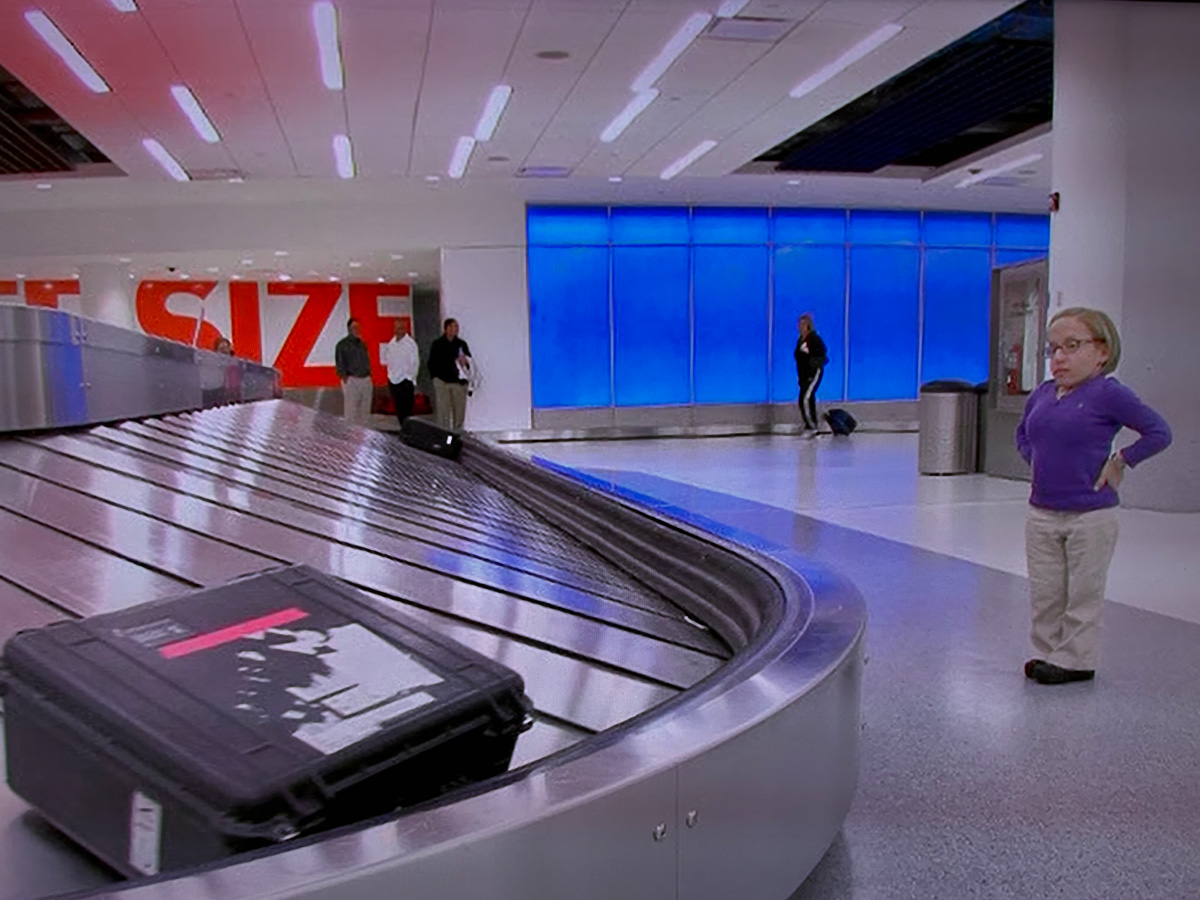
The Little Couple, season 1, episode 1, “Bill Moves to Houston,” aired on 26 May 2009. DVD.
Beyond shows like Jersey Shore and The Real Housewives, so many reality TV shows of the late aughts and early 2010s were disability stories or stories about non-normative embodiment, troubled belonging: Pit Boss, The Little Couple, TRANSform Me, The Biggest Loser, Rehab with Dr. Drew. These shows soothed a craving I had for connection and community, and even in the fog of a depression, I found my attention pricked and my interest engaged. (I later designed and taught a class on the topic: “Retailing Bodies: Anomalous Embodiment in American Reality TV.”) In this period, too, my audiologist tried programming my digital aid’s swooping curves into something more linear, mimicking the sound of an analog hearing aid. It’s punchier, he explained. It wasn’t the same, but it was closer to home, and I found myself adjusting.
The transition to digital hearing aids was trying but it released me from any illusions I was still holding onto that functionally, I was more or less like a hearing person, except I could turn off sound by taking out my hearing aids. With my roughly concurrent initiation to disability studies perspectives, I had already begun prying at, loosening, and turning away from internalized ideas that I should function as a hearing person. I had also begun experiencing cross-disability disability community and disability culture, which were nothing short of transformational.
Being around other disabled people was novel and unfamiliar, because I was so used to feeling like the odd one out. Unlike my Christmas pageant experiences from childhood, being around other disabled people in my 20s was an experience of identifying-with rather than disidentifying-from. Disability studies, the critical kind that came out of disabled lived experience and disability organizing, equipped us with a common, politicized understanding of disability, a way to recognize internalized stigma and shame, and an imperative to demand better social and built environments. This contact started with disabled poet Jim Ferris, who taught the Intro to Disability Studies course I worked with in college; it continued at conferences like the Society for Disability Studies, and in organizing with other disabled students at my university. Meeting and befriending disabled people with a range of access needs was a powerful disruption to the way I’d been taught to worry over maximizing others’ convenience and minimizing my own needs. It was a process of noticing that other people’s access needs weren’t something I experienced as a bother or a burden: in fact, I was really motivated, based on my own experiences, to participate in creating access. I gladly described the options on a big food spread, let conversation slow to give my friend time to say what they were saying, or offered a heads up about a stack of chairs blocking a restroom. In turn, I experienced being with people who knew I was deaf without dismissing it, avoiding it, or expecting me to bridge communication alone. They made sure I could see them if they were talking, checked in about the best spots for me to sit, recapped and repeated things I missed. And even when things went awry, when the captions were set up on the opposite end of a ballroom from the speakers (necessitating a ping-ponging gaze), the organizers noticed too, and checked in on me: that was not okay, we’ll make sure that doesn’t happen again (“how’s your spirit?”).
In these ways, disability culture offered me a possibility model for ease and self-acceptance, for letting go of the lower-frequency anxiety that I might show up in a space as “other”, and for making my access needs known so they could be better met—and having expectations for how others would respond. I began to wonder about how well I had actually been getting by previously. I’d always thought I was falling asleep in class because I was a tired college student; but I now recognized it also likely had a lot to do with not being able to easily follow the lecture. That seems stunningly obvious, but it was a revelation to me. Had my work been so excellent, actually, or had it been “inspiring” because I’m deaf? As I reflected on my past through this different lens, I also settled into understandings that the world was often not built for me (or my disabled kin). While this perspective lent itself to a fair amount of crip rage, it also grounded a deeper self-acceptance and a willingness to operate in ways aligned to what I needed.
I started pre-typing my orders for coffee, etc., into my phone’s notes app with a “hi! I’m deaf” when I didn’t want to deal with inaccessible interactions. I stopped going to events that I knew would have crappy access or be inaccessible. I started, pretty slowly, learning ASL.
In my 20s, a technologically-mediated break from the soundworld I grew up with prompted a series of reorientations to my sense of myself and to the spaces I was moving through. As my relationship to sound shifted, so too did my ability to function in an assimilative register. Leaving that behind of necessity, I was also engaging with disabled ways of knowing and disabled ways of operating that encouraged me to reject assimilation as a matter of principle. The shocks of shifting to different devices—from my particular identity as a sound-using deaf person—sparked a process of decathecting from a hearing ideal I’d always fail to approximate, a process that I experienced as a sort of cripistemological awakening.
Twenty more years later, I’m in the midst of another technologically-mediated transition in my relationship to sound. Five years ago, I shifted from wearing digital hearing aids to being a cochlear implant wearer, and it’s been another process of reorienting to a soundworld and reorienting to the (mostly hearing) social spaces I move through. As someone now embedded in disability culture, it’s also been an experience of cultural dissonance, as my relationship to sound now aligns more closely to the expectations of the hearing world I’ve spent such energy letting go of.
I was incredibly resistant to the idea of a undergoing the surgery to become a cochlear implant user, particularly because cochlear implant (CI) technology is advertised as a kind of magical cure, a narrative that is reinscribed through widely-circulated, emotionally charged videos of deaf people hearing sound for the first time. But after years and years of wearing a powerful hearing aid, the lining of my left ear became worn thin by sound waves, and it tore. Suddenly, any amplified sound going into my ear made me become incredibly dizzy, and I stopped wearing my hearing aid on that side entirely. Having just one ear of sound meant I was hearing less, but this was relatively tolerable since I had already adjusted a lot of my life to be less reliant on sound, and more responsive to my accessibility needs. Even so, as a sound-using deaf person, the lack of access to sound information still felt like a lack of access to the world. Despite some Deaf friends’ caution that CIs could cause migraines or balance issues, I thought I’d give a cochlear a try and reasoned that I could just not wear it if I hated it. I sat in Ear Nose Throat waiting rooms whose TVs didn’t have the captions on, and I dealt with other more potentially serious nondisabled ironies: though I was a patient getting medical intervention because I was deaf, I nearly missed a required meningitis shot because the doctor’s office only contacted me via phone (despite repeated requests to add a note that I’m not a phone user). In December of 2020, at the age of 38, I underwent cochlear implant surgery.
Because I had already spent considerable energy decoupling my hearing from my worth as a human being, having my implant turned on felt more like fun experiment than a high-stakes, YouTube-worthy revelation. Everything sounded like a squeak toy at first, hilariously enough. This was temporary; because I have had an ongoing, relatively data-rich relationship to sound, the process of learning to hear with my cochlear implant is something my brain really took to. At the same time that I felt acutely aware that my doctors would be inordinately excited, the sounds I started hearing as my brain adjusted seemed, at times, egregious and silly: light switches turning on with a click, my car’s turn signal sounding jauntily, and unnecessarily loud birds in the bushes below our living room windows.
With this, though, came some gains I cared quite a lot about: now, I could now make out speech behind a face mask if the conditions were right, though previously, it had been completely out of the question. Because my mom’s voice is familiar and because I’ve learned her patterns of speaking over four decades, now I can talk to her on the phone in the car. I can listen to podcasts. Now, my experience of music sounds right, and I can send it straight to my head with Bluetooth. I value and even cherish these reconnections to my sensorium, even as I struggle with the ableist and oralist narratives of cochlear implant companies, audiologists, and speech-language pathologists. I remember going for a CI checkup and glowering at a poster of a small blond toddler in a grassy field, with its implied message that having a cochlear is the only way a kid can have a lovely childhood. I know from my own shifting relationships to sound that this narrative is oversimplified and false. As the battery of hearing tests confirms significant, measurable gains in my hearing, I hear echoes of “you do so well” praise in the audiologist’s glowing tone, in her question about when I’ll want to implant the other side. Against the pull of this current, I feel anchored by the knowledge that while I do hear a lot more sound, I’m not a hearing person. I take comfort in opting out of trying to approximate a hearing existence, in understanding the difference between using sound and being hearing.
The technological shifts I’ve experienced over the course of my life have been impactful on what feels like an existential level—this is because shifting relationships to the world of sound are also, in an aural and oral hearing world, shifting relationships to communication and sociality. As I’ve come into my identity as a sound-using deaf person, a part of disability community, I’ve become much more invested in the transformative social technologies of disability culture: things like giving permission to show up as we are, and things like sharing access needs in order to facilitate a shared project of building spaces—worlds, even—rooted in interdependence and community care.
1. For more on misfitting, refer to Rosemarie Garland Thompson, “Misfits: A Feminist Materialist Disability Concept,” hypatia 26.3 (Summer 2011): 591-609.
2. Even giving the packet the actually-merited zero, or F, would have been less insulting.
3. A pseudonym.
4. Ashley Shew, Against Technoableism: Rethinking Who Needs Improvement (New York: W.W. Norton, 2023).
5. Mia Mingus, “Access Intimacy: The Missing Link,” Leaving Evidence (blog), 5 May 2011. Available at: https://leavingevidence.wordpress.com/2011/05/05/access-intimacy-the-missing-link/
6. “Sound-using deaf person” is a riff on hearing deaf people, an idea introduced to me by my friend, medical anthropologist Michele Friedner. For a critique of clean deaf-hearing dichotomies, refer to Michele Friedner and Stefan Helmreich, “Sound Studies Meets Deaf Studies,” Senses and Society 7.1: 72-86.
7. For more on access fatigue, refer to Annika Konrad, “Access Fatigue: The Rhetorical Work of Disability in Everyday Life” College English 83.3 (January 2021): 179-199.
Main image
“The First Christmas,” The Post-Crescent (Appleton-Neenah-Menasha, WI), 15 December 1988.
Image description
A black and white photograph of twelve children. The are gathered closely, posing for the photo, all facing forward with their faces turned in different directions. Seven of them stand in the back, and five kneel in the foreground. They are all dressed in costumes, resembling the nativity scene, as if for a performance or event. One child, in the back, holds a large star. There is one circle on the photograph, drawn in pen, around one child’s face. This child has light skin and dark hair and is standing in the back on the far left. They wear a white dress, a tinsel headband, and clasp their hands together, smiling. Handwritten text above this child reads, “ME, NARRATOR.”