


Mother Tongue
Mama!! Mamaaaaaaaa! We were going to play that game!?
Oh yes, you’re right. Okay.
I spy with my little eye something green!
The candle! Oh no, wait, the pencil. No.
That vase? No.
Um, the plant? No, but very close!
The window of the mousehouse? Almost!
Okay, mama, I don’t like it anymore. I’ve now invented a new game.
I spy with my little ear something you don’t hear!
She doesn’t like losing and knows she will win this game. She hides, makes a sound somewhere in the house, and I have to find it.
I cannot find her because I don’t hear anything. Sound always hides. Without a hearing aid, I hear a little something, a noise without a fixed form in one ear. In the other ear, I hear nothing.
After childbirth, my already minimal hearing suddenly disappeared. At first, I thought it was sleep deprivation, stress, fatigue.
What what what? I said all day.
I didn’t wake up before the baby did, as described in the good-mother books and blogs. There was no mother instinct that set the alarm before the baby woke up. Instead, there were leaking breasts that woke me, a wet pajama that told me the baby was awake.
How can it be, I asked the audiologist at the academic hospital?
How can it be, I asked the specialized neurologist who examined my brain and hearing.
How can it be? So suddenly? No idea, but we see it remarkably often: women who experience severe hearing loss after childbirth. It probably has something to do with hormones/bones/iron/blood pressure, but we don’t know exactly. The reason is still unclear, they said one by one.
This was in the middle of the pandemic, and many people wore face masks, and I couldn’t lip-read; I didn’t see mouths, the skills I had refined and relied on to navigate spoken were suddenly worthless. Previously, I could patch together entire sentences ___________few words______________context______________________lip________________________.
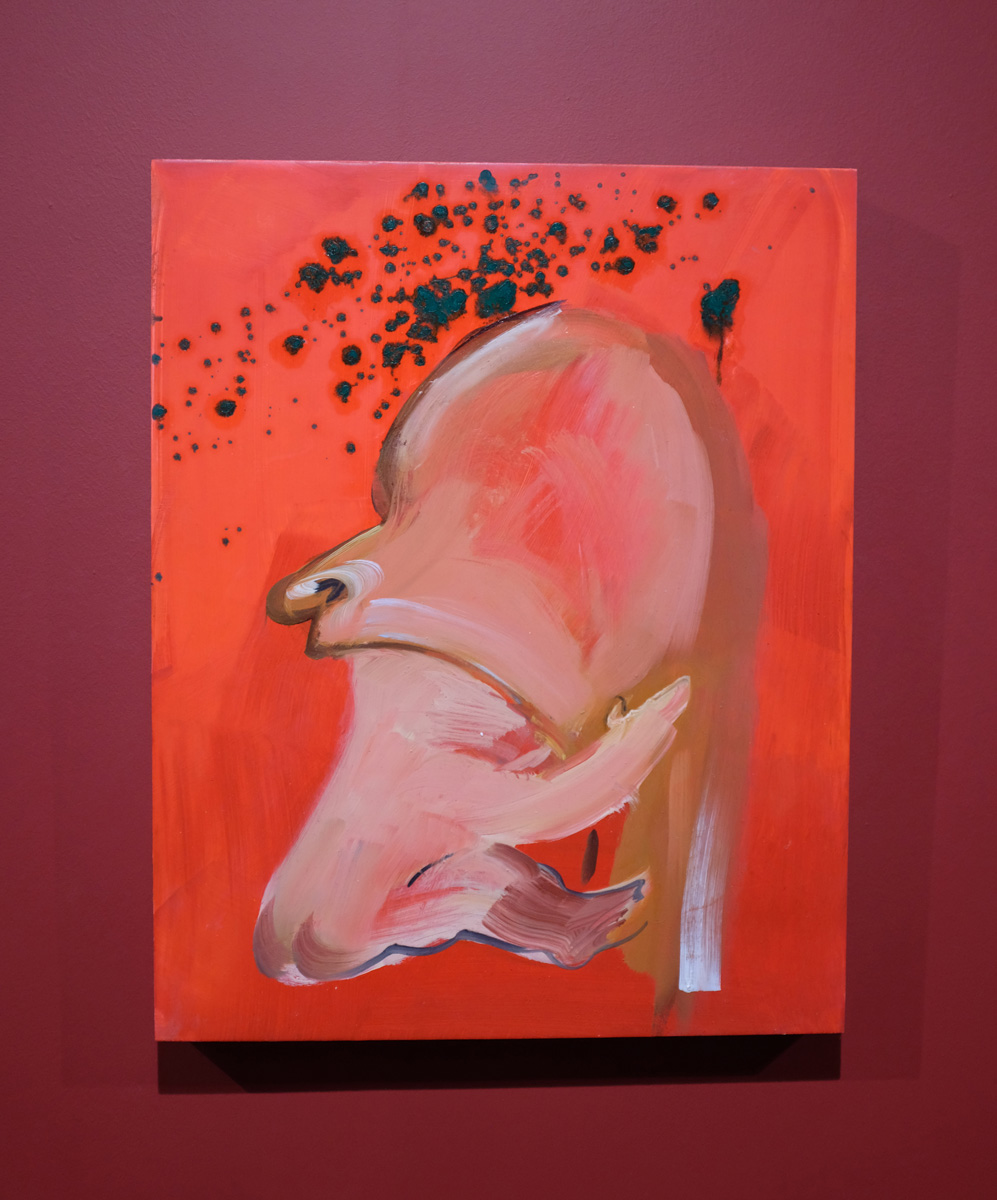
What did U say (2019), by Camille Henrot – watercolor on paper, 30 × 22″.
From the series “System of Attachment,” 2019–21
(© courtesy of the artist, Hauser & Wirth and Mennour, Paris)
I am attached to the breast pump while staring at images of my baby on my phone.
My sweet little baby cooing into the camera. Her little head, soft nose.
Zzzzt zzttt zzztttt goes the machine.
The harder she coos, the harder the milk sprays from my nipples.
The device makes it possible for me to work, to write, to participate in the life I had before I became a mother. I sit on endless amounts of toilets, listening to the pumping machine. Rhythmically, the vacuum inflates and deflates. I hear zzzzt zzttt zzztttt because my hearing aid catches the sound in the microphone and sends electrical impulses to my brain. The machine makes me possible in this intermediate form, between hearing and deaf, between human and machine, between present and absent mother, between growling animal and leaking human. I am a cyborg, a living rejection of rigid boundaries and fixed frameworks.
Language transcends the boundaries of mouths, tongues, and countries. In French, artist Camille Henrot told me that the words for ‘tongue’ and ‘language’ are the same – langue. The mother’s body, taken into the baby’s mouth, is a language, a mother tongue. In her work, the fluidity of identities is central; in ‘What Did U Say’ (2019), she painted a baby reaching its arms towards the mother’s face, the mother has her eyes closed while opening her mouth wide, seemingly swallowing the baby’s head. The child seems to slurp the language from its mother’s mouth.
There was no doubt that the language of my child had to come from my body. During pregnancy, the outer boundaries of my body shifted at a rapid pace. I needed a language that could keep up. A language that called for my physical experience, for big and small. High and low. Straight and crooked and round and right and tight and soft. A language that did the same as my body: that forced me to take up space in order to expand the boundaries of my world. Pregnancy was the end of my hearing life, a liberation from language. I had reached limit of the languages I grew up with. I had no words for the contradiction of simultaneous loss and expansion. No language for the noise, the intermediate space.
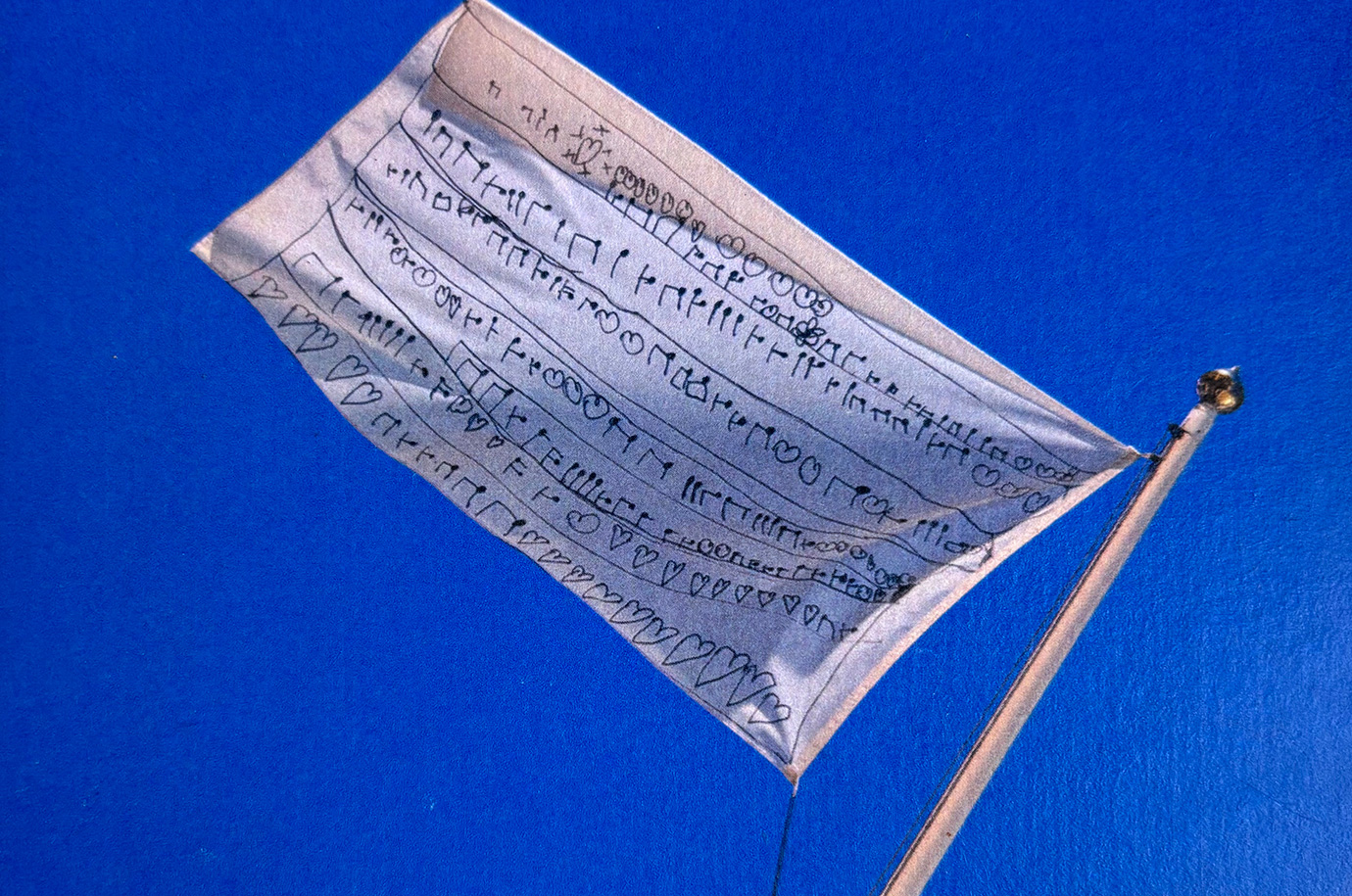
Language binds you to the past. Language is transmission and tradition. ‘A Song About Family,’ says the postcard from London. On the card are four white flags flag full of black lines and scribbled drawings that look like handwriting. It is a work of art made by the daughter of artists Christine Sun Kim and Thomas Mader. Their family mother-tongues are American Sign Language and spoken German, and this flag represents their own private language, of self-invented symbolism. The silent music that echoes the song of their family over the rooftops of London.
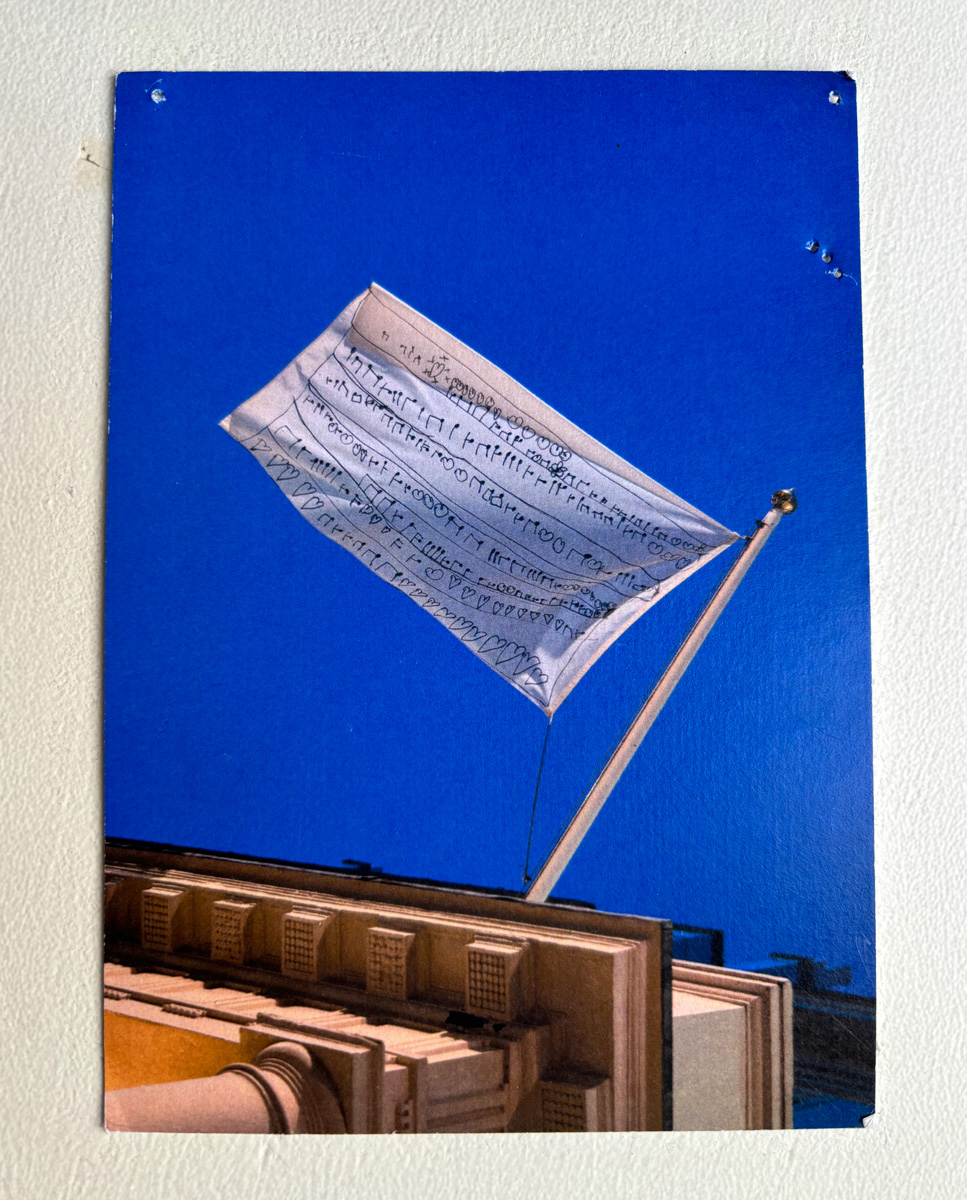
A Song About Family (2023), by Roux, with Christine Sun Kim and Thomas Mader,
Somerset House London (postcard send to author)
Until I became a mother, I only knew spoken language. I didn’t know that sign language was an option for me. That there was a whole world where I could go live. During this time of transitions, of repetition, and of rewriting and relearning, I found myself in a café with a group of people who all spoke sign language. Hearing, deaf, hard of hearing, and from various countries, so we spoke a mix of American, German, Australian, Italian, Iranian, and international sign language. The hands and face of my conversation partner across the table asked if I was “okay.” My hands told him emotionally that it was my first time in a café where I felt that I could comprehend and participate instead of simply enacting a social facade. I explained that I still needed to improve my “silent talking,” as my daughter calls it, but that I felt so relieved and a sense of belonging. He moves his fist in a circular motion over his heart, “Sorry”. Moves his face into a sad-friendly mode: facial grammar. Then moves his index finger to the side of his head “I understand”.
Through sign language I could fly. Talk in silence, shout, be loud without decibels. There is enormous freedom in a language that is not written, not limited by black-and-white letters, or confined to dashes of truth. Signed language exists in the presence of bodies and expressions. The space between people is where grammar is formed. Syntax, subject and pronouns are notes in the air. You cannot gesture alone; you need people, community, mass to become language.
I fear the time when my daughter’s language becomes formalized by rules and grammar, by dogmas and teachers. That’s why I spoon the signs inside her. Porridge and play, escape and horizon. I open my mouth, my hands, and leak the language into her, a game of power and habit. I tell her about words as resistance, about words that put down, about cause and effect. I tell her that the loudest voices do not have the most value, that silence is invented by the hearing. Every day we learn more signs. The world we want, we will build ourselves.
Main image
A Song About Family (2023) (detail), by Roux, with Christine Sun Kim and Thomas Mader,
Somerset House London (postcard send to author)