


Material and Memory
in Carlos Rolón’s Tarp Works
Puerto Rico’s history is inextricably tied to the threat and aftermath of major weather events. Positioned directly in the Atlantic hurricane corridor, the archipelago endures frequent hurricanes and tropical storms. In 2017, this vulnerability became undeniable when Hurricanes Irma and Maria struck in rapid succession.
Hurricane Irma, a Category 5 storm, weakened Puerto Rico’s already fragile infrastructure with torrential rain causing widespread power and water outages. Less than two weeks later, Maria made landfall as a high-end Category 4 hurricane, unleashing devastating winds and rain across the archipelago and bringing catastrophic destruction.1 The resultant humanitarian crisis was compounded by preexisting economic challenges, a fragile healthcare system, and an insufficient federal response, which would amplify the storm’s impact for years to come.2 These challenges remain deeply embedded in everyday life and have become a driving force in contemporary cultural production, where artists and musicians do more than register the crisis; they challenge dominant narratives by foregrounding resilience, resistance, and a renewed sense of Puerto Rican identity on a global stage.
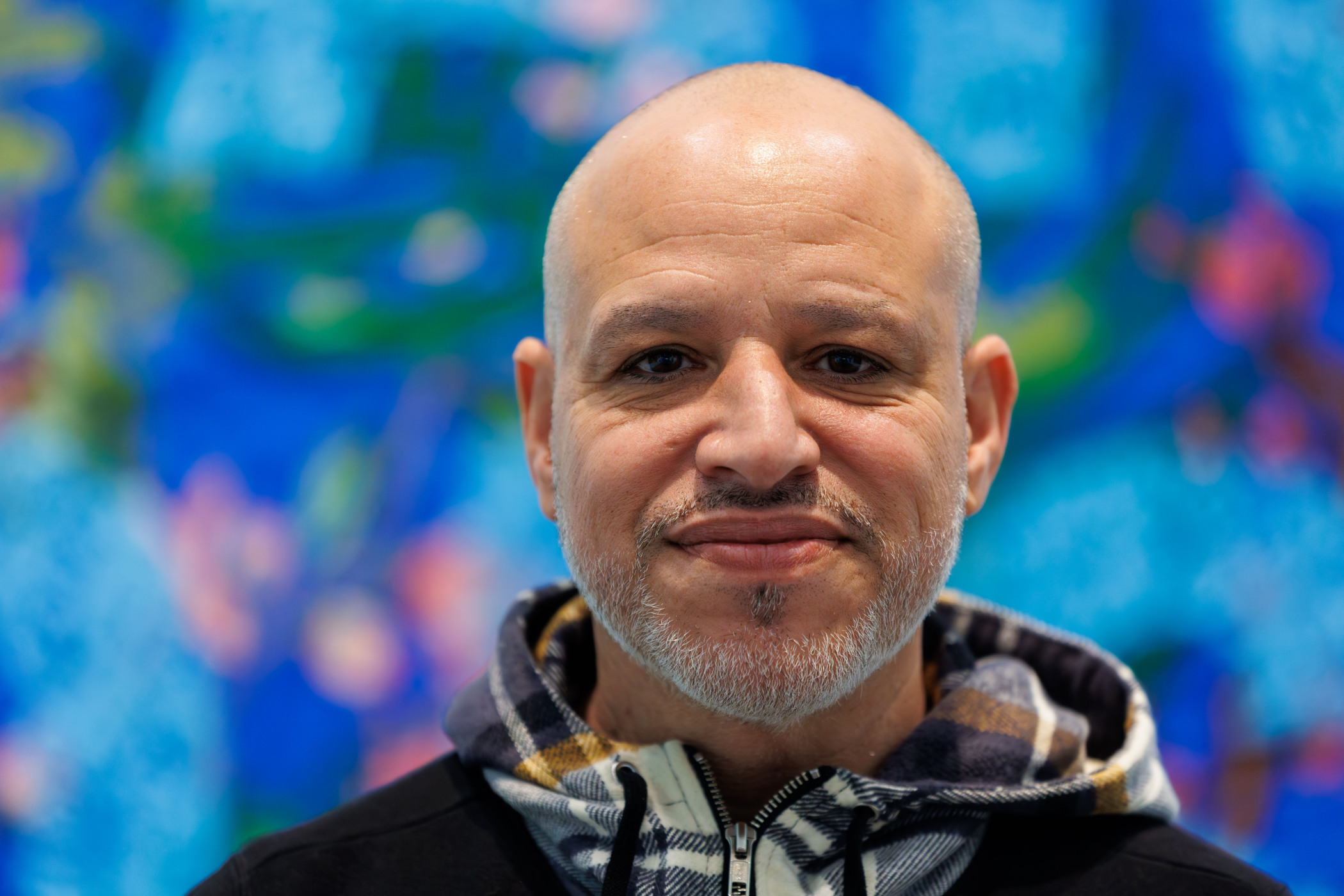
Portrait of Carlos Rolón. Courtesy of Newfields.
One such artist, Carlos Rolón, has created a moving series of tarp works, born out of a determination to bring awareness to the decades long neglect of Puerto Rico by federal and local governments in the wake of climate disaster. Rolón is an artist of Puerto Rican descent born and raised in Chicago, Illinois, where he currently lives and works. His oeuvre defies genre, spanning a range of media from painting, drawing, and sculpture to installation and digital work. Throughout his artistic career, Rolón has always drawn upon his personal history and experience, incorporating themes of cultural identity, inclusion, and aspiration. These themes resonate powerfully in his ongoing series of tarp works which embody a profound interplay between material and memory, transforming utilitarian objects associated with survival into intricate works that carry deep personal, cultural, and historical resonances. Though he lives and works in Chicago, Rolón has a deep personal connection to the island. His immediate family immigrated to Chicago in the 1970s, and much of his extended family remains in Puerto Rico along with many friends who he visits frequently. On a recent visit, Rolón remarked on the desire to use his artistic practice to bring awareness to this issue of Puerto Rico’s neglect. It was then that a friend suggested utilizing the tarps that had become a ubiquitous symbol for the destruction of communities in the wake of ecological disaster. This idea grew and developed into a relationship with PRoTechos, a non-profit that works with communities in Puerto Rico to replace temporary tarp roofs with more robust tin roofs while also teaching community members basic carpentry skills.3 The tarps that PRoTechos replace become the literal foundation for Rolón’s artistic constructions.
Rolón’s choice of material is both pragmatic and symbolic. When the tarps arrive from PRoTechos, they are exactly as they were when they left the site of their use. The tarps come to Rolón’s studio in varying conditions depending on how long they have been used for shelter and under what conditions. Some have been used for months whereas others have been used for over a decade, well beyond the stated three-to-nine-month manufacturer recommended lifespan. Regardless of their timespan of use, the tarps bear evidence of their initial purpose with traces of dirt, faded patches, tears, holes, and even logos of the distributing aid organizations. Rolón does not see these as blemishes to be fixed, but rather as symbols for the people who once used these tarps as shelter; people whose stories he wishes to amplify through his artworks. In this way, Rolón treats the tarps as what Andrew Jones, scholar of material culture and memory, calls “artefacts [that] act as aids to remembrance” by bearing physical traces of past events that are “amenable to the process of reading.”4 Rolón himself has stated that he feels these works are both artefact and artwork. In this way, these damaged yet enduring surfaces become mnemonic devices, precipitating remembrance through their very materiality. To this end, Rolón has developed a process for cleaning and repurposing the tarps that calls attention to and celebrates the lives of those impacted by climate disaster in Puerto Rico.
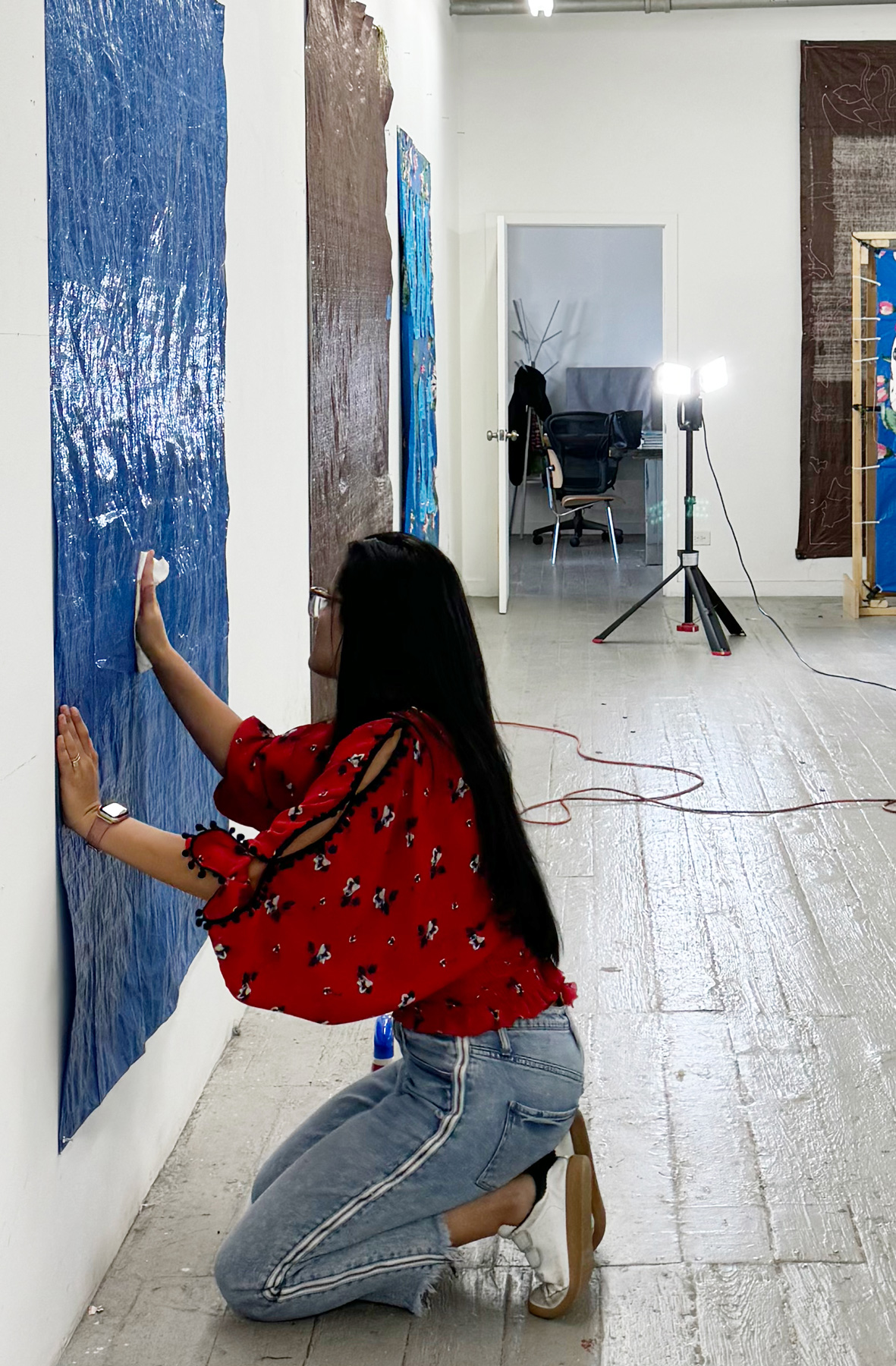
A tarp being cleaned. Courtesy of the artist.
The laborious process of preparing the tarps to become artworks is done with care through a thoughtful routine that Rolón has stated feels spiritual to him.5 When the tarps come to Rolón’s studio they arrive folded and boxed as they were collected. Each tarp has also been labelled with the name of the homeowner it was collected from. They are first unfolded on the studio floor, where they are mopped with water to remove dirt and dust. After this first cleanse, the tarps are then treated to remove any remaining dirt and neutralize pests. For Rolón, this act of cleaning is not just a necessity; it also serves as an act of healing and restoration for the artist. Once cleaned, Rolón then examines each tarp, assessing their marks and tears, and begins to think how these might be incorporated and even magnified into the artwork design. The tarps are then cut into the desired size and hung on the studio wall where Rolón begins the process of rebuilding what was removed.
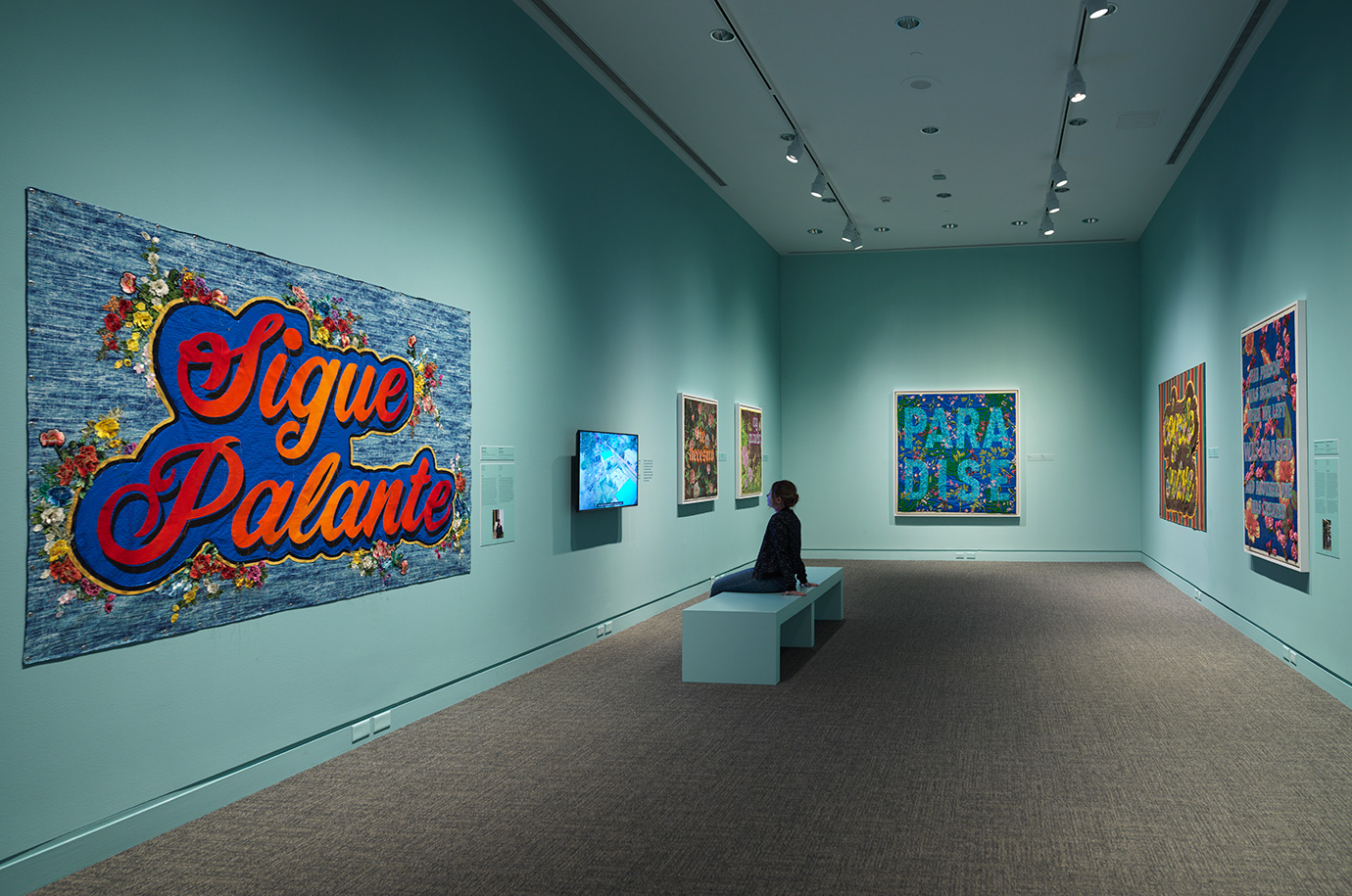
The resultant works turn the blue and brown tarps that have become synonymous with disaster relief into beautiful tapestries representing the communities from which they are sourced. The tarps serve as the canvas on top of which Rolón draws, stitches, and embroiders colorful and intricate floral designs. In early iterations of this series, tropical leaves and flowers were painted and hand stitched to the tarp directly. In more recent iterations, Rolón has expanded his process to include both handmade and store-bought appliques, as well as digitally painted flora that is then printed onto pleather, cut out and hand sewn to the tarp base layer. Carefully integrated into these complex designs are colloquial phrases from Puerto Rico and its diaspora such as “te necesito,” “sigue palante,” and “ay bendito.” These phrases are emphasized through choices of typeface and layering of materials. Some phrases are represented in all uppercase lettering, simple fonts that are laser cut from dyed lace and stitched onto backing layers to form a commanding textual presence. Others present a cooler style rendered in flowing cursive fonts and bright colors recalling the artist’s roots in graffiti art. These phrases give stronger meaning to the works and give an idea of the stories of the people behind them. While some of Rolón’s works are mounted and framed, most of his larger tarp works are meant to hang directly on the wall from gromet hardware, a callback to their original use. The intricate layers and details in these works hold a striking presence that draws the viewer in and rewards them for spending time exploring every detail. Rolón’s process of creating can be seen as an act of reconstruction honoring the tarps’ past while envisioning a more hopeful future.
Museum and heritage scholars Colin Sterling and Jamie Larkin, whose work argues for a practice of reparative museology, give us a foundation for Rolón’s practice in what they and many in their field term “restorative labor,” an act of physical repair coupled with symbolic and cultural reimagining.6 The transformation continues through the application of intricate stitching, appliqués, and carefully chosen text, a method that resonates with global traditions of repair, from Japanese kintsugi to contemporary practices of visible mending. These promote the practice of mending damaged clothing or objects that would otherwise be thrown away with creative designs and varied textures, turning visible mends into personal style statements that buck the trends of fast fashion. Like these, Rolón’s practice insists on the visibility of damage as part of the object’s story, reinforcing the notion that repair is not a return to an original state, but the creation of a new, meaningful form.
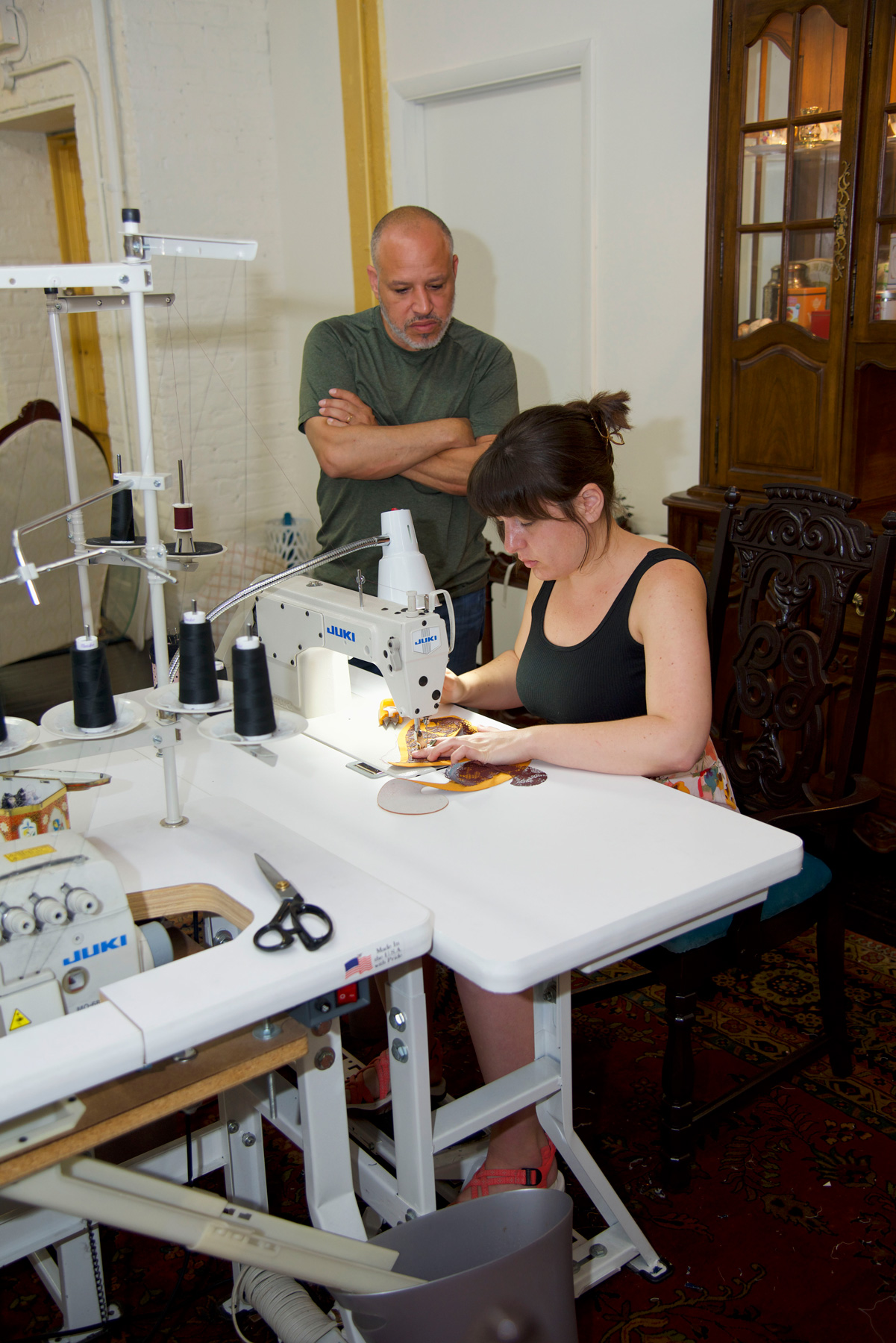
Working on tarp. Courtesy of the artist.
Rolón’s emphasis on the careful acts of cleaning, stitching, and layering also resonates with the legacy of process art, a movement that foregrounded material transformation and the unfolding of time over the production of a finished, pristine object. Artists such as Eva Hesse, Richard Serra, and Lynda Benglis embraced impermanence, tactility, and the traces of labor as central to meaning.7 In a similar vein, Rolón’s tarp works make the processes of care and repair inseparable from the final form. The stitches, appliqués, and layered interventions remain visible as evidence of an ongoing dialogue between damage and repair. Yet Rolón’s contribution pushes beyond the formalist concerns of 1960s and 1970s process art, embedding his labor within social and cultural histories. The process itself becomes restorative not just to the material, but to the narratives of the people who once relied on the tarps for shelter. In this sense, Rolón expands the language of process art into an ethics of care, where transformation is not an abstract exploration of material behavior, but a deliberate engagement with memory, survival, and resilience.
To more fully appreciate the use of found and weathered materials in Rolón’s work, one might look to new materialist perspectives in contemporary philosophy, as articulated by theorists such as Christopher Gamble, Joshua Hanan, and Thomas Nail.8 In their writings on new materialism, Gamble et al. view matter as active and entangled in the world rather than static. For these scholars, an essential part of new materialism is the recognition that materials are not inert, but rather possess trajectories shaped by environmental forces, human touch, and historical circumstance: “new materialism embraces a non-anthropocentric realism grounded in a shift from epistemology to ontology and the recognition of matter’s intrinsic activity.”9 Rolón’s tarps embody these trajectories in their weathered surfaces and traces of prolonged use. When encountered in the gallery, the vibrant colors, ornate designs, and large, inviting scale of these works offer what scholar Nicholas Leonard might describe as an initial “ethical invitation,” a way for the object to open a dialogue with the viewer. 10 Upon closer inspection, the rips, tears, fading, and stains emerge, revealing the truth and resilience of the people who used them. This layered experience exemplifies Leonard’s notion of ethical engagement, where material presence shapes emotional response, moving the viewer from aesthetic delight to deeper reflection.
Rather than emphasizing narratives of loss and destruction, Rolón’s works encourage recognition of persistence, adaptation, and joy in the face of hardship. The agency of the tarps lies not only in their capacity to bear witness to past events, but also in their ability to generate new, hopeful encounters in the present. In this sense, the tarps act as co-authors of the artwork’s meaning, guiding the viewer’s emotional journey from immediate visual pleasure to an awareness of the histories embedded in the material. This dynamic aligns with new materialism’s assertion that matter participates in meaning-making processes and that our ethical task, as Leonard suggests, is to respond to these invitations with care, respect, and a readiness to acknowledge resilience alongside vulnerability.11
The use of used tarps and other found objects in these pieces situates Rolón within a long tradition of found object art, or objet trouvé, that began with Marcel Duchamp’s radical recontextualization of everyday objects in the early twentieth century. Over the decades, artists have expanded on this lineage, using salvaged and repurposed materials to challenge definitions of art, confront histories, and embed material culture with new layers of meaning. Rolón treats his chosen materials not as inert matter but as active participants in the narrative, and carriers of a history whose meaning is reshaped through artistic intervention. These works demonstrate how found materials can bridge past and present, transforming symbols of neglect into conduits for resilience, dialogue, and cultural continuity.
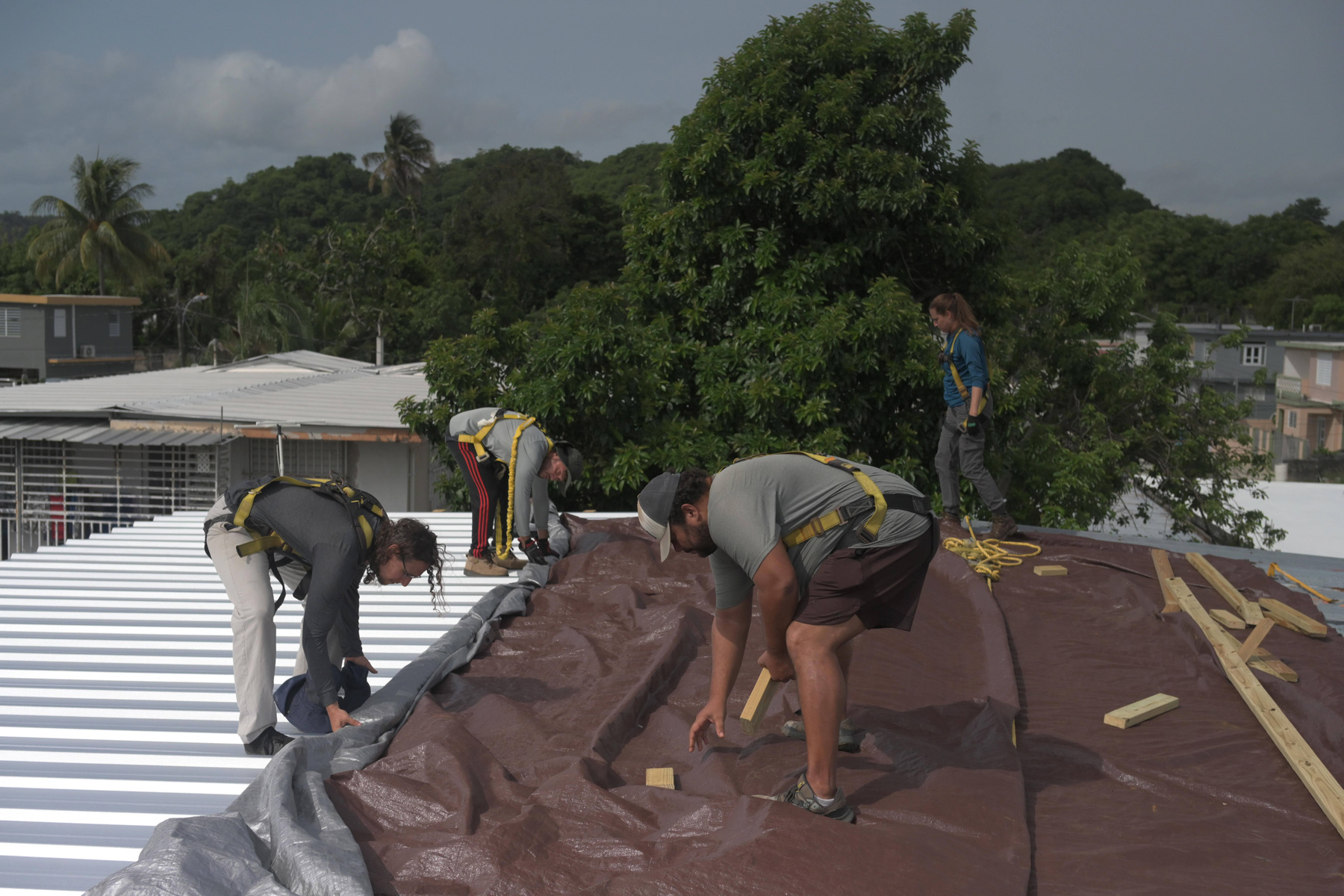
Photo of PRoTechos working on roof. Courtesy of Pablo N. Rodriguez Diaz.
Rolón’s involvement does not end with the creation of the pieces. Rolón and his team make frequent visits to Puerto Rico to work with PRoTechos directly. They build relationships with the families that PRoTechos assists, documenting their stories and their homes before, during, and after reconstruction. For the works in the exhibition Hilos de resurgimiento at the Indianapolis Museum of Art in 2024-2025, Rolón and his wife, Melissa, spent time in Puerto Rico working with ProTechos. On these trips, they participated in the removal and rebuilding of roofs and structures, building relationships with the people whose tarps would eventually be used in artworks. Rolón interviewed community members about their lives, photographed their families and homes, and filmed project progress in communities. All of this documentation was integral to informing the final works, but also in communicating individual stories in the resulting exhibition. Two of the works in the exhibition were accompanied by photographs of the people who lived under the tarps that were used in the work as well as text outlining their stories. In addition to this, Rolón and ProTechos created a video documenting ProTechos’s work in communities including interviews from many people with whom they have worked.
For Rolón, this is a necessary element to his process. His works are shaped by the people he meets, drawing on the history and everyday acts of care that he’s witnessed in the communities he’s connected with. As an artist of Puerto Rican descent whose life has been shaped by displacement and migration, his goal with his tarp works is to honor the survival and collective memory represented by the tarps, and to honor the people who used them for shelter. The response from the communities has been a positive one. When shown photos of the artworks that their tarps have become, they’re proud to have their stories represented in this way. People often comment on the phrases, recognizing themselves in the artwork.12 Rolón had the opportunity to sit down with Keith Gonzalez, a community member whose tarp was used in the piece Sigue palante. In this conversation, Gonzalez expressed pride in being involved in Rolón’s practice and was happy to make a difference with his story.13 Keith said in relation to working with ProTechos, “I never had help… and then Tao Baja recommended ProTechos and since that happened my life has changed…. Now I feel that my voice has been heard and I’m grateful for what you guys have done for me… I had lost hope and when they called me to tell me you guys were going to start, I got so happy. It’s been so many years that I haven’t felt happy, like really happy.”14 Rolón has also pledged that a percentage of the sale price of each tarp piece will be given to PRoTechos to support their continuing work.
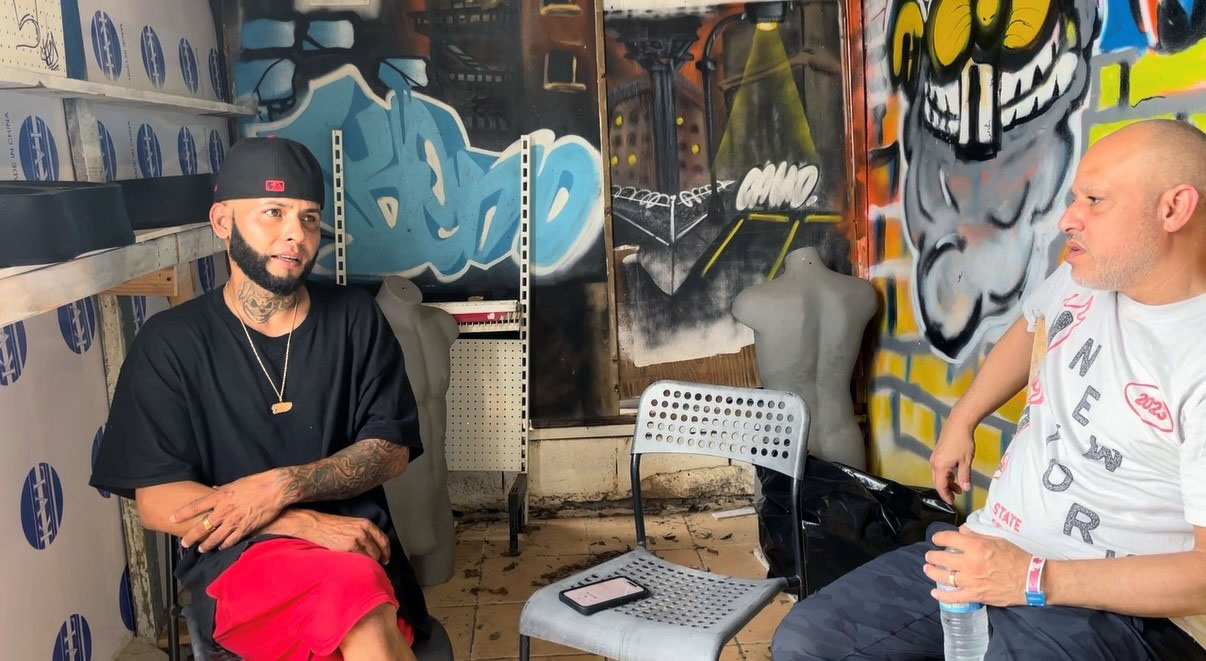
Keith Gonzalez and Carlos Rolón. [Need credit info!]
Rolón’s collaboration with PRoTechos situates his practice within the realm of socially engaged art, as articulated by art historian Grant Kester. Kester emphasizes that such practices move away from the notion of art as a vehicle for the artist’s individual self-expression. Instead, artistic meaning emerges through an unfolding, improvisational process shared among multiple collaborators.15 Rolón’s tarp works exemplify this model, as they emerge not solely from his own authorship but from a dialogue with the people who once relied on these tarps, the PRoTechos workers who removed them, his studio who works on the tarps, and the wider Puerto Rican community whose resilience they represent. The meaning of the works unfolds collectively, grounded in shared histories and the ethical acknowledgment of interdependence. In this sense, Rolón’s practice bridges aesthetic form with social relationship, enacting a collaborative testimony that complicates distinctions between art object and social practice. The interplay between subject and object so integral to Rolón’s tarp works can be best demonstrated in his piece The Person I was Becoming, which was recently acquired and included in the exhibition Hilos de Resurgimiento at the Indianapolis Museum of Art.
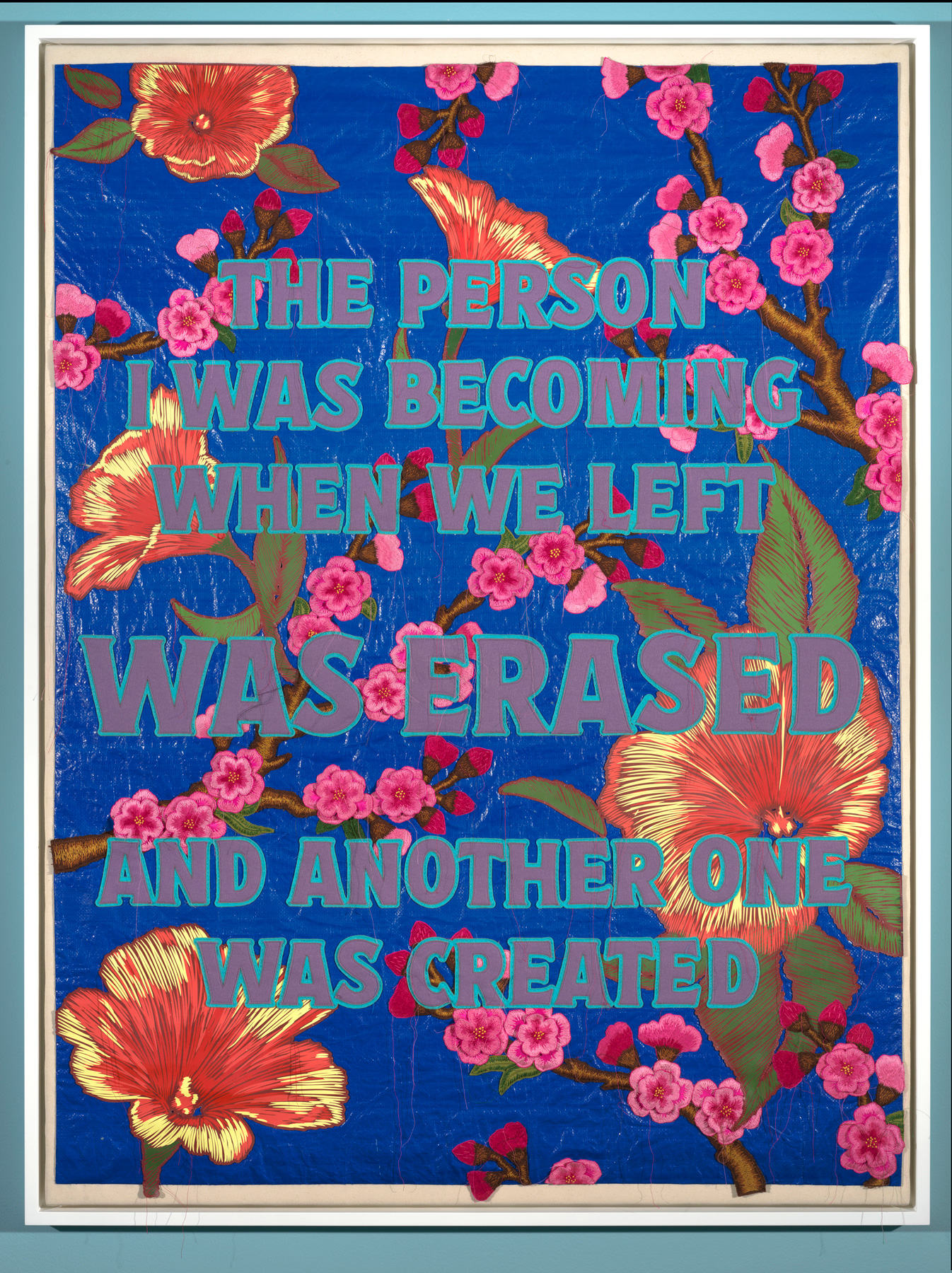
Carlos Rolón, The Person I Was Becoming, 2024, fabric, hand-embroidered and painted appliqués on repurposed tarpaulin, mounted on muslin with wood panel, 65 x 48 in. (tarpaulin); 70 x 55 x ¾ in. (framed). Indianapolis Museum of Art at Newfields, Frank Curtis Springer & Irving Moxley Springer Purchase Fund, 2025.1. © Carlos Rolón. Courtesy of Jamie Stukenberg and the artist. Photo: Jamie Stukenberg
Situated amongst the vibrantly painted and appliquéd florals of this piece are the words of celebrated Puerto Rican author Esmeralda Santiago, “The person I was becoming when we left was erased and another one was created.”16 This quote from Santiago’s Memoir When I was Puerto Rican conveys the complex emotions she felt in an abrupt departure from her homeland of Puerto Rico to an unknown life New York City. She is mourning the life she had, while anticipating the new life she would begin in that moment. This quote embellishes a tarp that was used by Ilia Flores and Rosa Velez, whose family home in Guamá, San Germán had suffered losses during both Hurricane George in 1998 as well as Maria in 2017. After living under tarps for nearly two decades, PRoTechos rebuilt the family home and renewed not only their quality of life, but also their sense of hope. A panel with Ilia and Rosa’s story, including a photograph of the mother and daughter pair, accompanied the artwork in the exhibition. The panel also included an explanation of the text from Santiago’s memoir, uniting both stories through their shared experiences of grief, survival, transformation, and most importantly hope. With this pairing, the work becomes a site of layered meaning, resonant with grief, survival, and transformation. Rolón’s engagement with the family through his partnership with PRoTechos and his inclusion of their stories extends the scope of his artwork from aesthetic object to collaborative testimony. The physical presence of these artefacts, deeply entangled with personal histories, evokes what art historian Helen Hughes describes as “spiral memory”: objects that recall the site at which and the person from whom they were acquired.17
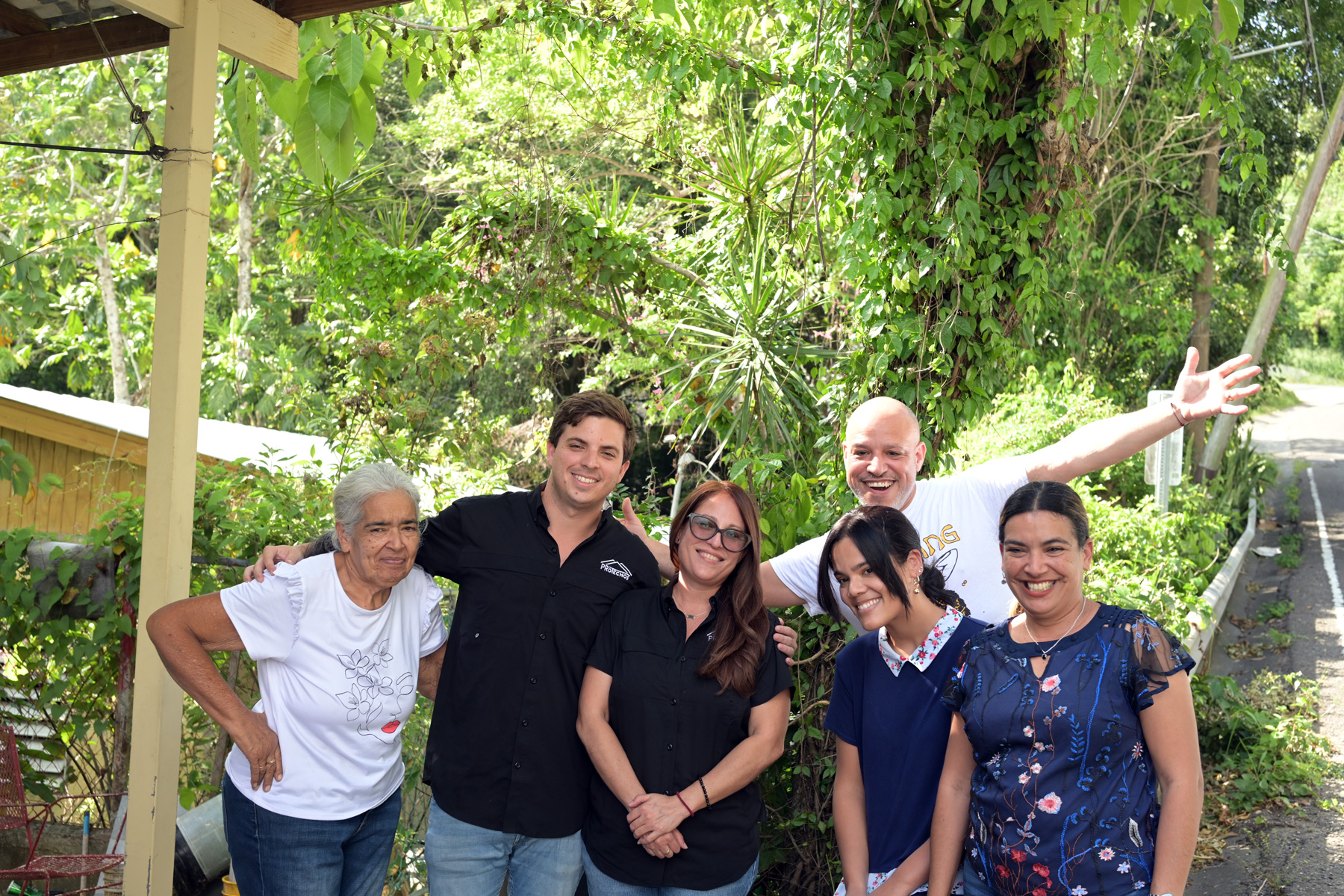
Photo of Carlos and Melissa with Ilia, Rosa, and PRoTechos team. Courtesy of Pablo N. Rodriguez Diaz.
Rolón’s tarp works also embody what Leonard terms an “artistic entanglement” that offers “actualization of better becomings” through the generous exchange of painful memory for shared understanding.18 These entanglements are not solely about the past but are forward-looking, making space for mercy, grace, and hope. They invite an ethical engagement with the material world and a reconsideration of the ways memory, labor, and art intersect in the face of ecological grief and cultural loss.
Working with ProTechos has evolved into a meaningful, ongoing relationship for Rolón. Members of the ProTechos team are planning to visit Rolón and his studio in Chicago to connect with local non-profits and cultural institutions. Rolón plans to continue working on the tarp series, which has been widely lauded and included in many major showings since the exhibition at the Indianapolis Museum of Art, including a solo artist booth at Untitled Miami in 2025 and upcoming exhibitions at both the Nerman Museum of Contemporary Art in Overland Park, KS and Charlie James Gallery in Los Angeles. Through the convergence of material culture, restorative labor, and new materialist theory, Carlos Rolón’s tarp works demonstrate how contemporary art can operate as both a site of remembrance and an agent of transformation. These pieces do more than preserve the physical remnants of disaster; they activate them, creating spaces where personal histories, cultural identity, and environmental realities are interwoven. By engaging deeply with the physicality and agency of his materials, and by honoring the communities connected to them, Rolón challenges traditional institutional models. His tarp works stand as enduring reminders of the potential for art to mend what has been broken, to preserve the presence of lived histories, and to imagine futures shaped by resilience, care, and the shared responsibility to remember.
Bibliography
Gamble, Christopher N., Joshua S. Hanan, and Thomas Nail. “What Is New Materialism?” Angelaki 24, no. 6 (2019): 111–34. https://doi.org/10.1080/0969725X.2019.1684704
Grant, Kim. All About Process: The Theory and Discourse of Modern Artistic Labor. University Park: Pennsylvania State University Press, 2017.
Hayward, John A. “Art and Things: Narratives of Material Culture.” Journal of Visual Art Practice, November 2024, 1–20. https://doi.org/10.1080/14702029.2024.2393503
Hughes, Helen. “Spiral Memory: Mike Nelson’s The Coral Reef (2000), The Cosmic Legend of the Uroboros Serpent (2001), and The Amnesiacs (1996–).” In Critical Memory Studies: New Approaches, edited by Brett Ashley Kaplan, 167–84. London: Bloomsbury, 2023.
Jones, Andrew. Memory and Material Culture. Cambridge: Cambridge University Press, 2007.
Kester, Grant H. The One and the Many: Contemporary Collaborative Art in a Global Context. Durham, NC: Duke University Press, 2011.
Leonard, Nicholas. “The Arts and New Materialism: A Call to Stewardship through Mercy, Grace, and Hope.” Humanities 9, no. 3 (2020): 84. https://doi.org/10.3390/h9030084
PRoTechos. “Our Approach.” Accessed July 2025. https://www.PRoTechos.org/our-approach/
RAND Homeland Security Research Division. “Hurricanes Irma and Maria: Impact and Aftermath.” Accessed July 2025. https://www.rand.org/hsrd/hsoac/projects/puerto-rico-recovery/hurricanes-irma-and-maria.html
Santiago, Esmeralda. When I Was Puerto Rican. New York: Grand Central Publishing, 2006.
Sterling, Colin, and Jamie Larkin. “Towards Reparative Museology.” Museums & Social Issues 15, no. 1–2 (2021): 1–3. https://doi.org/10.1080/15596893.2021.2151728
1. RAND Homeland Security Research Division, “Hurricanes Irma and Maria: Impact and Aftermath,” accessed July 2025, https://www.rand.org/hsrd/hsoac/projects/puerto-rico-recovery/hurricanes-irma-and-maria.html.
2. For further reading and context regarding Puerto Rico’s political status, colonialism, and interrelated crises as they relate to climate disasters, see Aftershocks of Disaster: Puerto Rico Before and After the Storm (2019), edited by Yarimar Bonilla and Marisol LeBrón.
3. PRoTechos. “Our Approach.” Accessed July 2025. https://www.PRoTechos.org/our-approach/
4. Jones, Memory and Material Culture, 19.
5. Carlos Rolón in conversation with the author, 2024.
6. Sterling and Larkin, “Towards Reparative Museology,” 2.
7. Kim Grant, All About Process: The Theory and Discourse of Modern Artistic Labor (University Park: Pennsylvania State University Press, 2017), 192.
8. New materialism is defined as a 21st-century, interdisciplinary theoretical shift that challenges traditional anthropocentric views by treating matter as an active, “vibrant” force with agency, rather than a passive substance. It rejects nature-culture, mind-matter, and subject-object binaries, arguing that nonhuman actors, technologies, and ecological processes shape social and political reality.
9. Gamble, Hanan, and Nail, “What Is New Materialism?,” 118.
10. Leonard, “The Arts and New Materialism,” 19.
11. Leonard, “The Arts and New Materialism,” 19.
12. M. Santiago in an email to the author, October 10, 2025.
13. M. Santiago in an email to the author, October 10, 2025.
14. M. Santiago, personal video recording, March 21, 2024.
15. Grant H. Kester, The One and the Many: Contemporary Collaborative Art in a Global Context (Durham, NC: Duke University Press, 2011), 115.
16. Esmeralda Santiago, When I Was Puerto Rican (New York: Grand Central Publishing, 2006), 209.
17. Helen Hughes, “Spiral Memory: Mike Nelson’s The Coral Reef (2000), The Cosmic Legend of the Uroboros Serpent (2001), and The Amnesiacs (1996–),” in Critical Memory Studies: New Approaches, ed. Brett Ashley Kaplan (London: Bloomsbury, 2023), 167–84., 172.
18. Leonard, “The Arts and New Materialism,” 24.
Main image
Installation view of Hilos de resurgimiento at the Indianapolis Museum of Art at Newfields, August 23, 2024 – March 30, 2025. © Carlos Rolón, Rolón Studio, LLC. Courtesy of Jamie Stukenberg and the artist.
Image description
A photo of an art exhibition within an indoor gallery space. The room is long and rectangular, with gray floors. pale blue walls, and a bench. Large artworks hang on the three visible walls, including four framed works, two works hung directly on the wall, and one monitor installed on the left that shows a video. All of the works, aside from the video, are multicolored, with various motifs and large text. The work closest to the foreground reads “SIGUE PALANTE” in red and orange cursive lettering on a blue background, surrounded by flowers; and the work on the far wall reads “PARA / DISE” in bright blue block letters on a dark blue background, surrounded by flowers.