


MAPPING STORIES, MAKING CONNECTION
A Conversation with Yu-Wen Wu
A version of this interview was previously published in Two Artists Talking, a limited-edition artist book edited by McCall Hollister, Eva Lundsager, and Cassidy Westjohn. The publication explores the studios, creative processes, and lives of established Boston-area artists. Learn more on Instagram @two.artists.talking.
Yu-Wen Wu (she/her) is an interdisciplinary artist living and working in Boston. Born in Taipei, Taiwan, her experiences as an immigrant have shaped her work in areas of migration, examining issues of displacement, assimilation, and the shape of identity in a new country. At the intersection of art, science, social and culture issues, and the natural world, her wide range of projects include drawings, site-specific installations, community-engaged practices, and public art.
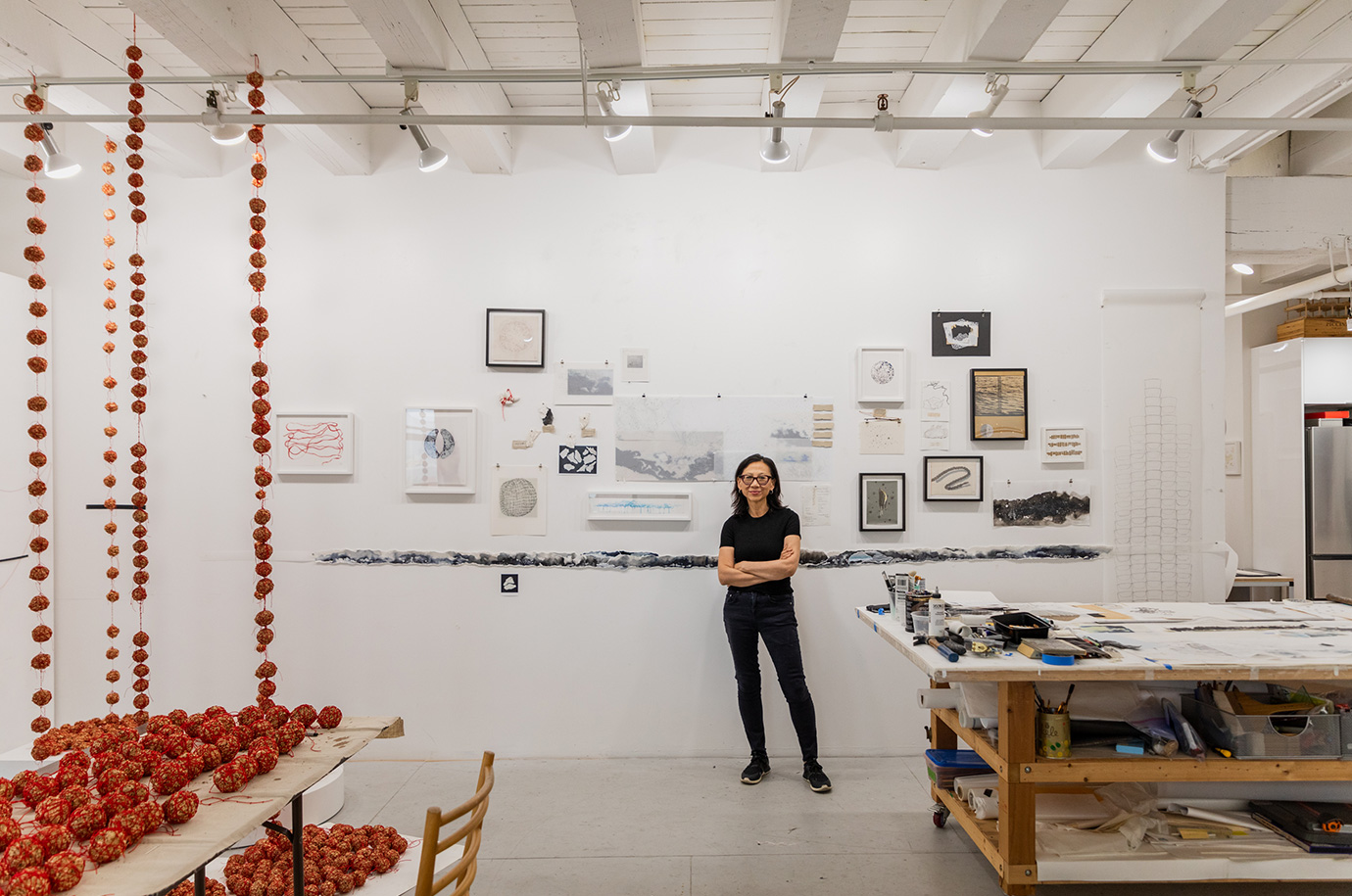
On a bright March afternoon, Wu welcomed me into her studio at Fort Point, Boston. The walls were adorned with maps, written notes, and framed work. It was bright and quiet, a perfect place for making. After offering me tea, Yu-Wen and I settled into conversation, where we spoke about the ideas grounding her work’s process and research.
Elizabeth Blessing: I understand that your experience of immigrating from Taiwan and assimilating into US culture is something that inspires your studio and public art practice.
Yu-Wen Wu: The stories come from my immediate family, from circles of communities that are Asian, and other communities that have touched my life. Hearing their stories of the struggle to assimilate, and to keep one’s culture while trying to belong to another—small and large narratives are gathered over time. How can I talk about these important and inherited stories?
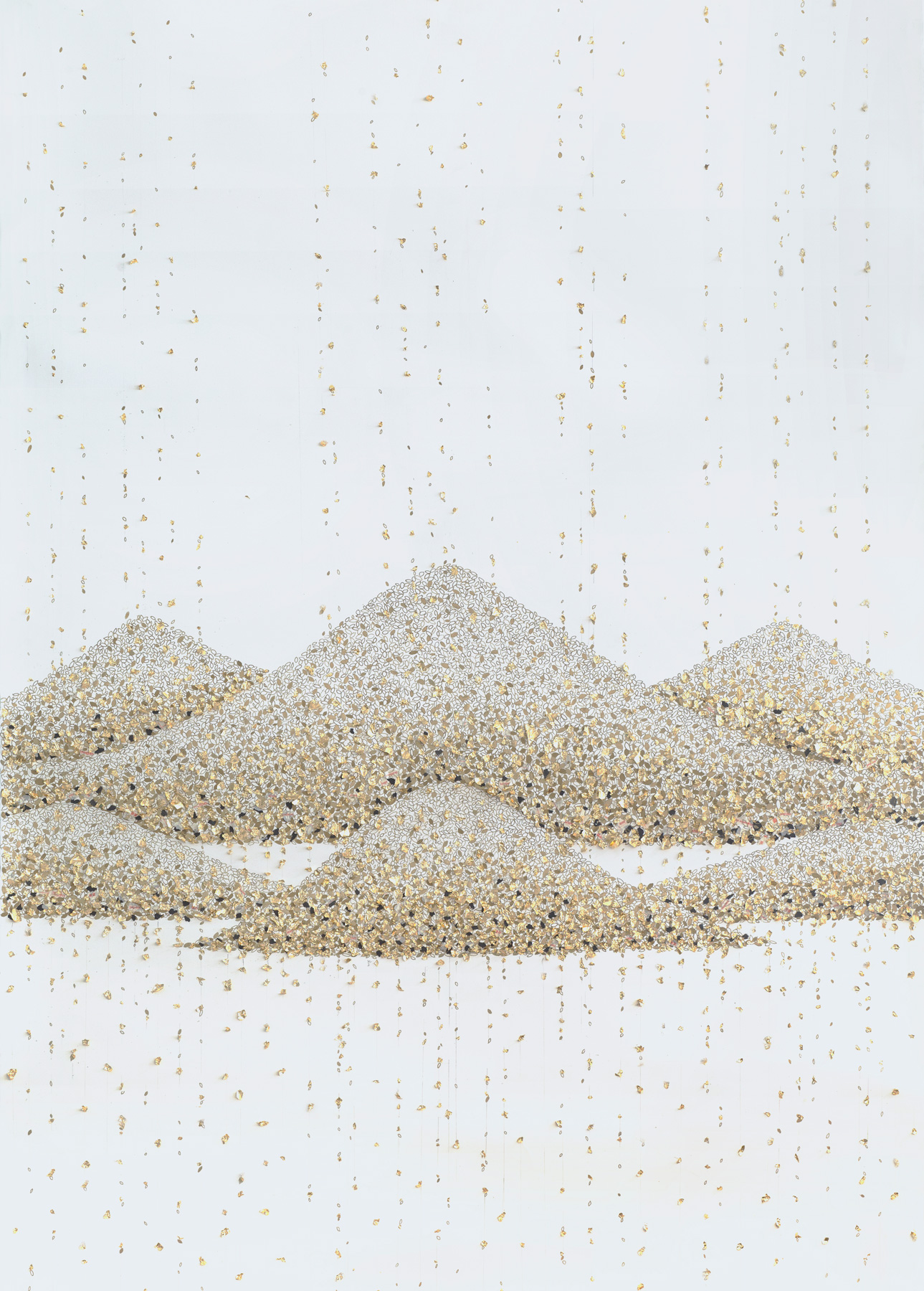
Yu-Wen Wu, Accumulation of Dreams VIII, 2023, Graphite, gold ink, 18 carat gold leaf on Arches paper, 45 x 68 inches. Image by Will Howcroft, courtesy the artist.
One story is reflective of a larger history. Sometimes it’s triggered from a national consciousness, such as the violence and aggression against Asians brought on by the pandemic. The invisible Asian in America is now hypervisible. I question again, as I have questioned all my life, my identity, my presence, or rather lack thereof, as an Asian in America, and being Asian American. And what does this complicated political term mean on different levels? The incredible narratives of loss, resilience, and survival became drawings, maps, sculptures, and a video. Sometimes it’s a daily event right in front of me; for instance, tea. With my family, we sit together drinking a beautiful Taiwanese tea that grows on the tallest mountain, Alishan. My mother gets together with her community of friends to socialize with tea as the center; it is natural to try to tell a story through that. Immigration and tea is a really important metaphor for me on a personal level, but also as a global discussion of migration and colonization. I have been developing an entire body of work around tea.
Nature is such an inspiration for me, and so it’s important to acknowledge its care. Climate change and displacement due to climate change is another subject that matters to me. The public installation With/Out Water is about this. And sometimes the story is about the beauty of just being human—that we all belong, living under the same sky and guided by the same sun, moon, and stars.
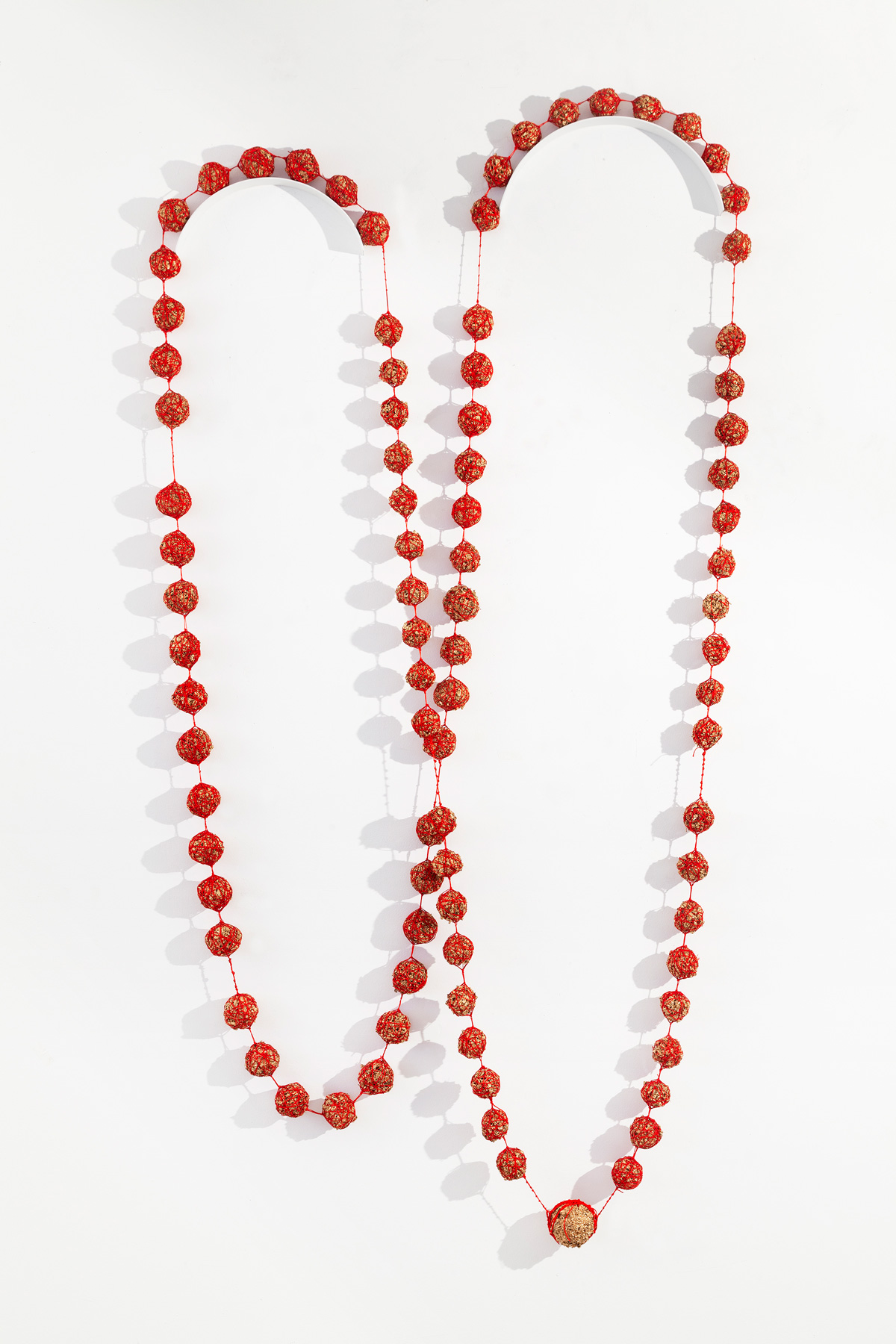
Yu-Wen Wu, Infinity IX, 2022, gilded tea leaves, red thread, 87 x 45 inches. Image by Will Howcroft, courtesy the artist.
Blessing: What does your practice typically involve? What sort of questions drive your inquiry?
Wu: When I decide specifically on a topic, research takes on many forms—reading from various sources, drawing, and investigating materials. So I’ll play with physical materials to determine what I’m going to use and how this material can be expressive and convey intent. Depending on the topic, one question inevitably leads to many more.
Blessing: How does collecting research, regarding material, differ between your studio practice and your public art practice?
Wu: Well, it’s very different. It has to live in different spaces. Eighty percent of the public artwork projects I’ve been commissioned to do are for outdoor spaces. You need to look at the life of the material in geographic locations and its weather conditions—how will the material last in this kind of public space? For example, Lantern Stories is a temporary outdoor piece in a public plaza, whereas Terrain, commissioned for the Harvard Business School, was meant to be a permanent indoor artwork. Simultaneously, I am working on content. So for Lantern Stories, it was illuminating Chinatown stories with light… that is a different subject and physical material than Terrain.
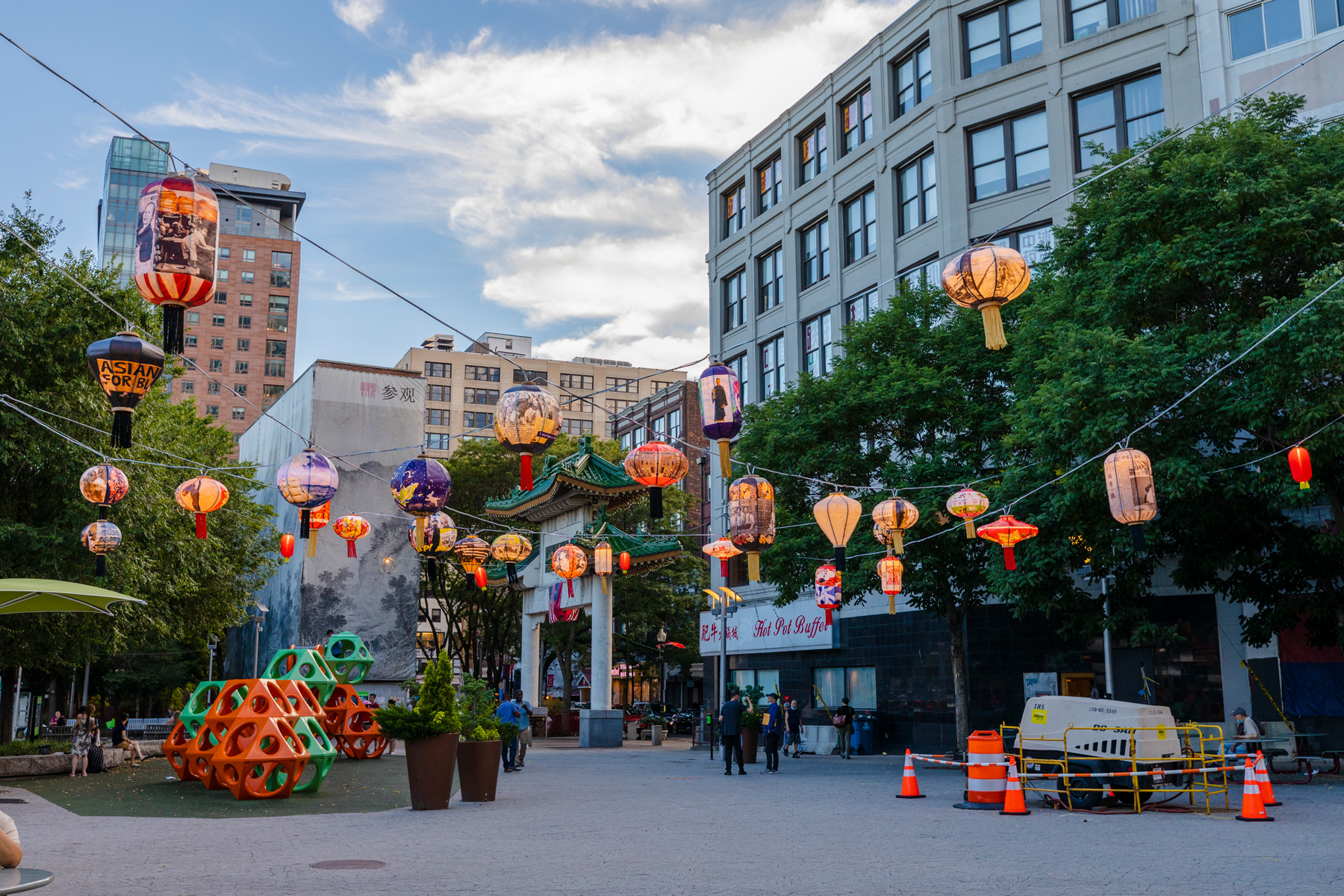
Yu-Wen Wu, Lantern Stories, Boston, 2022. Commissioned by the Rose Kennedy Greenway Conservancy in 2020. Image by Mel Taing, courtesy the artist.
Blessing: I wonder whether you’ve always looked to materials in helping you translate and communicate the stories you’re thinking about or whether it’s something that’s developed over time.
Wu: It’s something that’s evolved over time. I started as a studio artist; I’m still a studio artist. The studio portion of my work is so important. It’s where I’m really playing and investigating material and methodology and figuring out if a project is going to work. It’s where I start formulating if this work has a social engagement. Does involving the community in a certain way make sense to the ultimate goal?
A lot of my practice, in terms of social engagement, really involves listening to the community because these are the residents and viewers that are going to experience the work.
Blessing: I feel like your work, especially your public works, embrace this relationship between art and activism. I wonder how you balance these two roles of artist and activist?
Wu: It’s important for me to speak to the times. So, for instance, with Lantern Stories it was the perfect opportunity to speak about social justice issues in America for Asians and Asian Americans, not only currently but historically. The aggression and violence towards Asians during the pandemic brought up so many questions of Asian and Asian American identity. It has also brought out the fractures. But I think it’s really important to build across cultural communities among Asian Americans, and also bridges between Asian, Black, Latino, and Indigenous communities. There is a long way to go, but I think Lantern Stories started this conversation.
Blessing: You said this really beautiful quote in a video for With/Out Water that I absolutely loved, “Art has the capacity to talk about really large issues. . . art can tell a lot of stories where language is a barrier.” How does your work create space for connection, discussion, and inquiry?
Wu: I feel lucky that we have a visual vocabulary. With the written word, for instance, if you don’t know the language in which it’s written, that’s a world lost to you. In the Leavings/Belongings project, I fear I cannot accurately convey the participants’ words—connotations are lost in translation. For myself, I’m not very good with words. I’m better, perhaps, at writing but I am a visual thinker, so it’s really difficult for me to articulate ideas. Our language is a visual language.
I’ve designed my social engagement projects to give a platform for participants to amplify voices and stories that aren’t usually told. There are many participants that have no outlet to express or are too afraid to do so. It makes me and them feel really good to be able to have an opportunity to say what they need to. So with the Leavings/Belongings project we have conversations that are very difficult. Leavings/Belongings held sessions that shared the immigration journey. We’re all immigrants; we all have that story from our families! You know with Smith College (Belonging: A Voice at the Table), I’m working on the concept of belonging. What does that mean when we’re excluded, and what does it mean when we’re included? And does that definition change throughout your life?
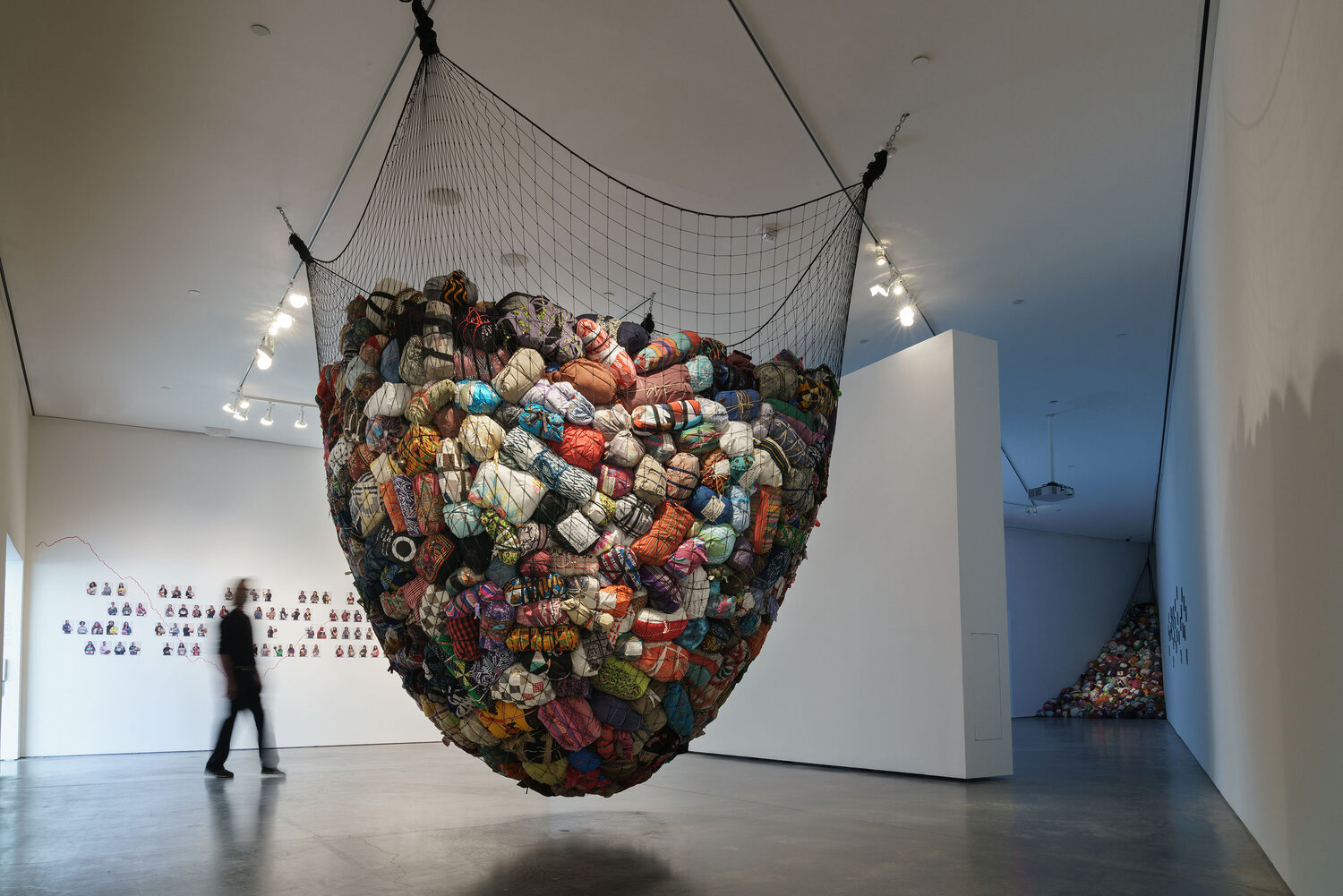
Yu-Wen Wu, Suspended, 2020, approximately 14 x 12 x 12 feet. From the series Leavings/Belongings on view SITE Santa Fe, NM. Courtesy the artist.
Blessing: In hearing you speak about the experience of listening to people’s stories, how do you take care of your emotional and mental self throughout this process?
Wu: I’ve held over fifty sessions for the Leavings/Belongings project. Some of them are incredibly fun just because there’s joy in our conversations, but many of them are also very, very difficult because they’re so traumatic. I really appreciate that people want to share this. And it’s hard at times . . . I can’t always leave it at the table. It comes home with me; it stays with me for days and weeks.
Blessing: You address big ideas on migration, displacement, assimilation, and identity in both your studio practice and public work. What do you think is added in creating an experience for viewers to investigate rather than, say, a depiction or object for viewers to analyze?
Wu: I hope my work provokes self-reflection, inquiries, and discussion. I think the audiences are somewhat different. Public art and social engagement have a different audience than people who are going to museums and galleries. I love that public art reaches such a wide audience and that I can affect people in small ways.
Blessing: What lays the foundation for your work?
Wu: It’s drawing. I think that drawing is really, really key because the way we see our world, right now, is so virtual and media-driven in the context of social media and such. Drawing just gets down to the essence. . . of our body, our hand. So it’s using our body and linking it directly to our thoughts. I love drawing because I love the line. The line is beautiful. And we do it in different ways. I’m creating connections, that’s what lines do . . . they map connections, direction, and create movement.
Mapping can go beyond data because it’s also . . . for instance, mapping my walks. And that’s the body involved in an action of spatial movement—turning that action into a drawing, you’ve now turned it into a readable thought.
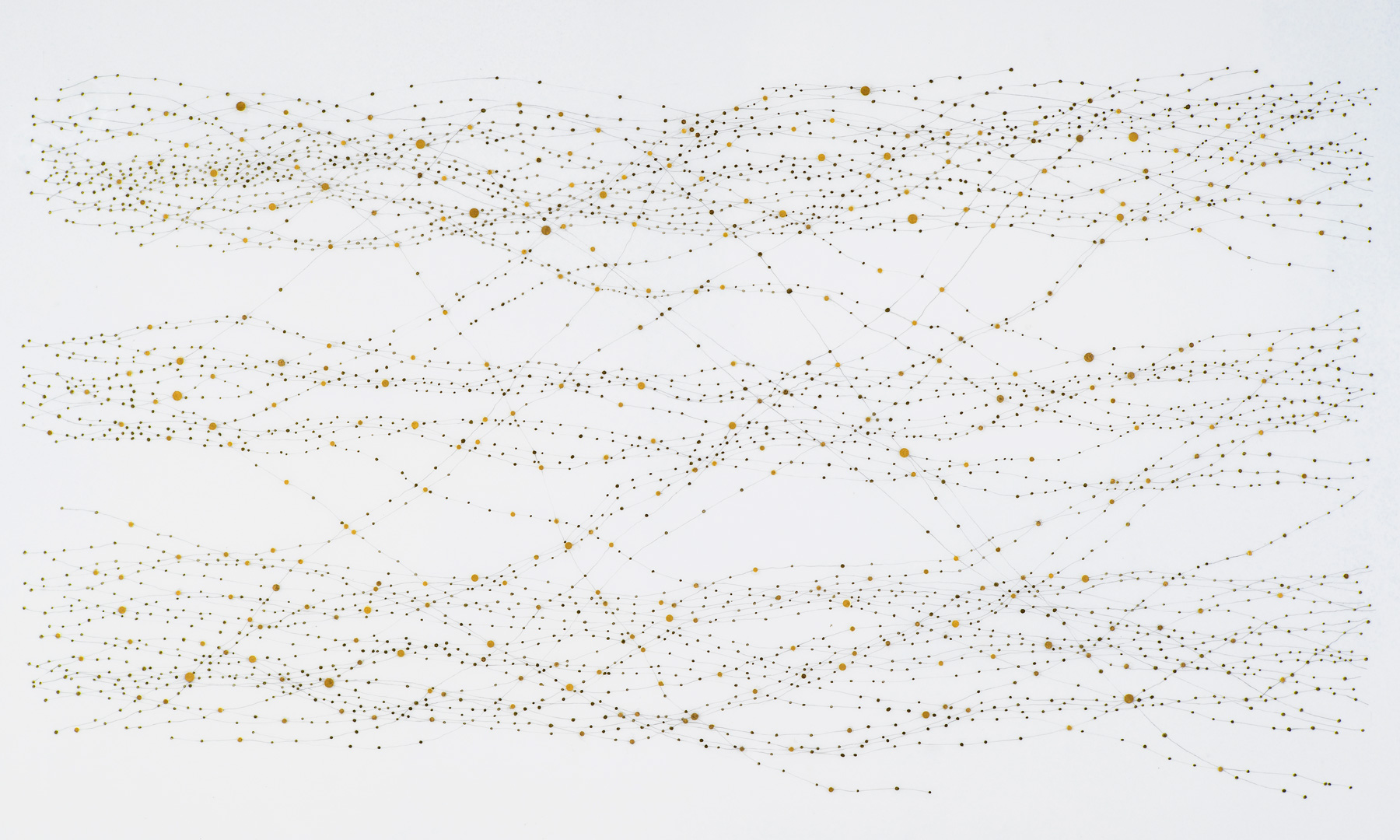
Yu-Wen Wu, Orientations I, 2015, ink, graphite on Duralar, 25 x 40 inches. Image courtesy the artist.
Blessing: Could you speak to this relationship of the abstract to something more literal within your work?
Wu: I think of those two as two sides of the same coin. And so, I have no problem moving between and within both spaces. I think there are times when you do need to be more literal and there are times when you can take that and just blow it away with something completely abstract, in a way that speaks more to the viewers’ intuition, to the viewers’ gut, rather than, say, only the intellect.
Blessing: How do you make that decision to present something more literally versus something more abstractly?
Wu: We make those decisions as we go along. It’s a little harder with public art because you have to form that arc earlier, but I always leave enough room so that it’s not this tight, bullet-point plan. I leave some open spaces for things to evolve. I think that’s really important because the chance encounters can be amazing! We have to have room in our practice for that. We’re so lucky as artists—we get to see and utilize the serendipity!
Blessing: What relationship do you see between mapping, storytelling, and art-making?
Wu: Mapping is a kind of storytelling. Data visualization is a kind of storytelling. It helps me map the things that I’m thinking about and it also helps place issues in context; for instance, in Currents I used thread to map routes of the top 10 countries of migration globally. And visually seeing that and actually physically experiencing this during the process, because this piece is huge—it’s 160 inches wide; you start to understand a little bit, just a little bit. We can’t imagine what the migration process has been like for refugees and how difficult it is. I mean I’ve come to this country but in a very different way . . . it was for better opportunities, not to escape war.
Blessing: I’m curious as to whose work you see yours in conversation with? What artists have inspired you?
Wu: That’s really tough because it’s different at different times in our life. At this time, Hank Willis Thomas is one of them. Agnes Denes, Ann Hamilton, Lygia Pape, Suzanne Lacy . . . these are the people I’ve been looking into and how they structured their practice.
But I love so many artists’ work just because the art is beautiful! I don’t have any problem with beauty. Beauty inspires! I mean the beautiful that is deep, abiding, insightful, soulful . . .and conceptually strong. And I feel we all need to be uplifted at this time. And I love drawing! You look at Louise Bourgeois’s drawings, and they’re fun and powerful. Right? And then you look at Vija Celmins’s drawings, which are so beautifully rendered, and Martin Puryear, and how he’s translated his sculptures into drawings, and drawings into sculptures. I could just keep listing artists that inspire. And the Song dynasty painters! The spatial perspectives in landscape, the choice of colors, the gestures and textures possible with so few strokes. The format as a scroll has been very influential in my work—especially for Walking to Taipei. I also do a lot of reading. I just finished Minor Feelings and also The Loneliest Americans.
Blessing: Do you have any advice for emerging artists?
Wu: I think you need to carve a space for yourself; it’s so important, and you need to be disciplined about it. So if you have to work a full-time job, make sure either the evening or a Sunday or a Saturday is dedicated to the studio. It’s easy to say, but really try, whether it’s journaling or just doing some sketches. I would say that’s probably the most important thing to do—dedicate to a routine.
Also, make sure you really think about the issues that matter to you. Immigration has always been an issue for me. Of course, it’s part of my life, right? All the affiliated experiences of being in a new country—assimilation, acculturation, harassment and discrimination, belonging and identity; all of these things I’ve gone through and continue to go through. What I’m trying to say is: try to identify the issues that really matter to you because with that we nourish a lifetime of work. We have so many things we may want to say, and so many ways we can say it.
Note: Since this interview was originally published, Yu-Wen Wu continued to develop these ideas in From Rock to Cloud, a solo exhibition at Nunu Fine Art in New York, on view September 10–October 31, 2026. The exhibition expanded her exploration of material, memory, migration, and transformation.
Main image
A photo of Artist Yu-Wen Wu in her studio. Image by Mel Taing, courtesy the artist.
Image description
Artist Yu-Wen Wu in her studio. She stands, smiling towards the camera in a relaxed pose with her arms crossed. She has light skin, dark hair, and wears glasses and black clothing. The wall behind her is covered in framed and unframed artworks. To the right of Yu-Wen is a large table with two shelves underneath holding various art materials, and to the left is another table with an artwork comprised of orbs tied together with red string. Strands of these orbs hang from the ceiling, pooling on the tabletop and on the floor nearby. The room has white walls, a white ceiling with bright lights, and gray floors.