


Towards Cripistemological Captions
As a deaf*2 person, I have spent untold hours of my life staring at the space where captions are supposed to be (or staring at bad captions) trying to ascertain, deduce, or outright guess at what is happening. My access to television, film, social media, and any other media that engages sound is largely determined by the presence and quality of captions. Captioning is of enormous consequence to my lived experience and cultural identity as a deaf* person, and as a result, it has become a vital creative/critical space and Crip/Disabled creative methodology for me.
My deafness has led me to engage critically with pervasive, marginalizing notions of loss as deficit and to locate my personhood elsewhere—to be with and in and around cripistemology.3 Conventional captions have often anchored me to an alleged lacking. They have functioned as units of measurement for what is expected to be understood but is not. My reliance on them has all too often locked me into a hierarchy of experience in which I am always lesser than the one for whom the work is made. I wait, in the bottom third, to receive what I am allowed—something delayed, abridged, and hurried along. Paradoxically, through the presence of conventional captions, I both gain a certain kind of access and remain stuck within a system that does not value me as an audience member. However, I am uninterested in upholding the structures and strictures of what I am measured against. I turn instead to cripistemological captions, which are invested in a critical reimagining of loss. They reroute experience, vantage, and time, charting new, accessible ways of imagining art in practice and in the world.
During the COVID-19 pandemic, interest in captioning and other forms of descriptive text increased significantly as basic access to modes of social exchange and the instability of audiovisual media began to be considered by a populace that had never been forced to reckon with how inaccessible and under-considered those modes have been historically. Captioning entered the mainstream art vernacular and has since been explored by artists, writers, and curators irrespective of any meaningful connection to the lived perspectives from which practices of critical captioning had earlier emerged.
The term “creative captions” has circulated as a broad way to describe work by artists, designers, and other cultural practitioners who engage with the formal and methodological potentials of captioning.4 Though an increase in the general appreciation of captions and captioning has had positive impact in the form of basic d/Deaf accessibility awareness and select inclusion of captioned works in exhibitions, much of the work on creative captions is overly concerned with sound and how to translate it for a d/Deaf audience. This is an ableist premise that reinforces a belief in d/Deafness as an inherent lack. I wonder: who are these creative captions for? Do they exist to entertain an able-bodied audience, or to educate it about d/Deaf experience, or to provide some comfort and relief by demonstrating that sound can effectively and objectively be made universally accessible? Who are these captions of? What do they enable? What might actually be possible in captioned space if it is imagined otherwise? “Creative captions” may be an enticing concept for an audience that previously ignored or dismissed the value of captioning, but it creates that enticement by radically delimiting the possibilities of captioned space and serves as an invitation to any/all to freely experiment with a method created by and for d/Deaf and hard of hearing people.
To instead consider the potential of captions in the expanded field is to reflect on the relationship between primary and marginal spaces. If captioning, as a marginal practice, is delimited by a primary artistic experience (such as transcribing the auditory content of a film), it remains secondary or supplemental to the source material. But if captions are detangled from their primary source document, their potential as an artistic medium expands proportionally. In Dr. Sarah Hayden’s essay “A Cognitive Listening,” she describes an ability to both creatively and critically deconstruct a work of art and teach “receivers” (a term Hayden borrows from artist and filmmaker Jenny Brady to replace what would conventionally be referred to as “viewers”) about captions and the culture from/for which they were developed.5 The creative/critical becoming that Hayden describes might also serve to evaluate a point of departure between the aforementioned “creative captions” and the proposed “cripistemological captions”—where one seeks to appease and entertain, the other charts a radically ulterior path where subject matter and methodology work interdependently. Cripistemological captioning can interrogate and critique. By critically engaging with a primary document, such as an artwork, within the work itself, it can deconstruct ableist conceptions of art that assume a “receiver” is able bodied and has access to a normative sensory composition. Cripistemological captions can be both of and separate from a/the primary document. Rather than seeking to convey language and sounds exactly as they are, cripistemological captions shirk any responsibility for upholding and preserving the primary document and instead lean into their own marginality.
To further render what cripistemological captioning practice might mean within art praxes specifically, I offer three examples of artists/art works engaged in the intersection of text and aurality that can be considered forebearers and enablers of cripistemological captioning principles. These works are invaluable for the ways in which they critically approach captioning practice and utilize a cripistemological framework that focuses on how knowledge produced via a Crip/Disabled experience can shape and transform our understanding and use of captions writ large.
As cripistemological captioning is indebted to embodied writing, mark making, and graffitiing practice, I oft refer to the work of the late William Pope.L in order to understand how criticality can be enacted through the layers of an artwork’s display or dissemination—how a primary space can be erected in order to enact/perform critique in its margins. Pope.L’s critical marginal scrawling is exemplified in his 2019-2020 exhibition at The Museum of Modern Art, member: Pope.L 1978-2001, a survey exhibition based around a set of thirteen early performative works. An exhibition of this scale/caliber would serve as a high-water mark for any artist’s career, but for Pope.L it was an opportunity through which to engage the machinations of the institution—to create rifts, slippages, and snares.
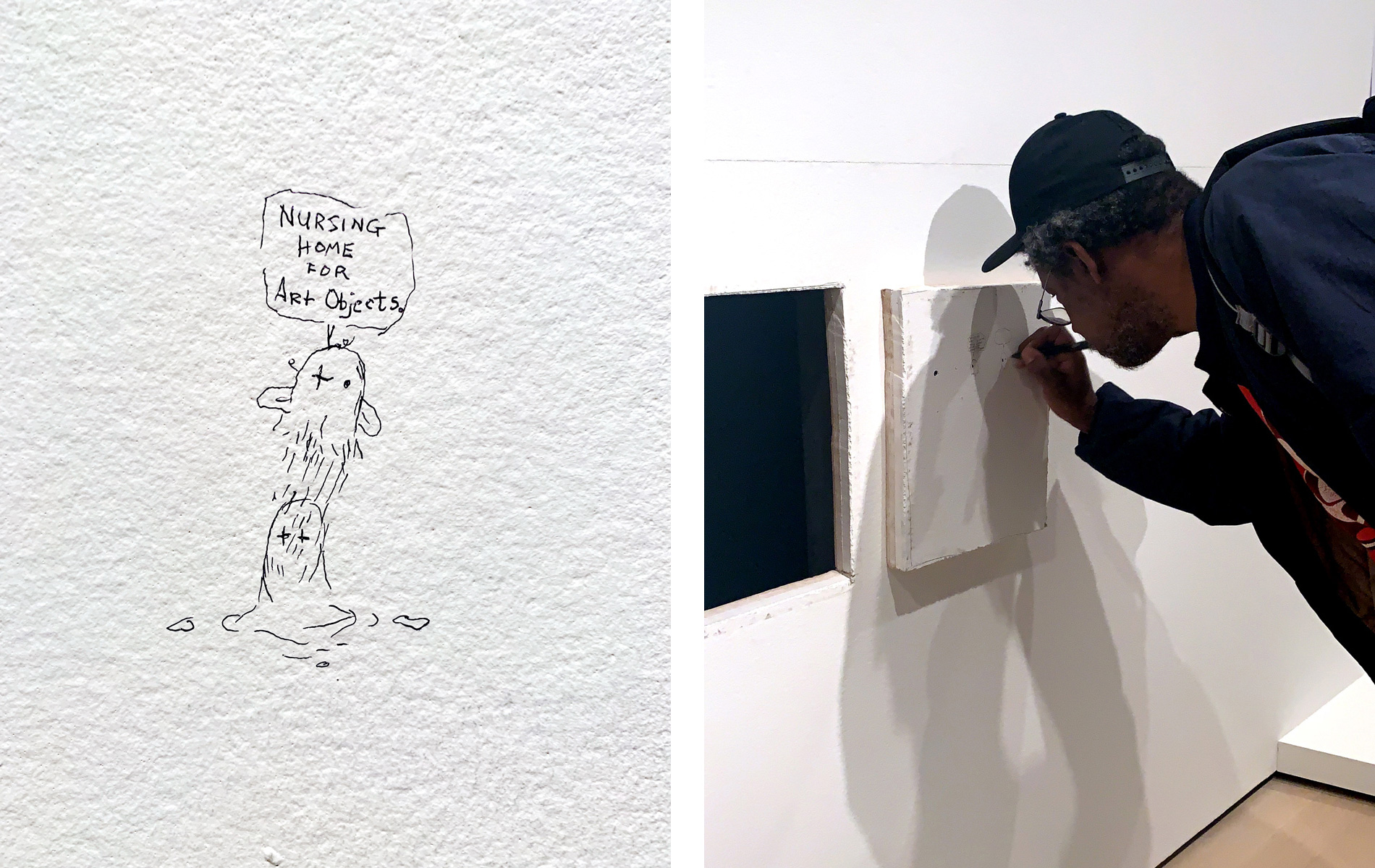
William Pope.L, member: Pope.L, 1978-2001, The Museum of Modern Art, New York City, 2020.
Pope.L visited the museum throughout the run of the show, donning a monogrammed backpack and wielding a pencil. He enacted what can be considered a cripistemological captioning of his work, wandering through the galleries and making small Pac-Man-style drawings of talking ghosts directly on the walls of the exhibition. The ghosts asked questions via cartoon speech bubbles that hovered around them, and even spoke to one another. “Have you ever felt like a retrospective?” one wondered. Another asked, “What is an exhibition?” to which a third ghost replied, “It’s a bunch of things that talk to each other.” An additional drawing depicted a ghost emerging from another ghost proclaiming the exhibition to be a “NURSING HOME FOR ART OBJECTS.” While the drawings represent a simultaneous absence and presence of the artist within the work, they also enable Pope.L to interrogate the institutions that produce retrospectives and the motivations of the artists who participate in them. The ghosts were embedded within both the exhibition space and its historical and conceptual hierarchies, using those elements to poke holes in institutional structures that attempt to possess and regulate minoritized subjects. As Pope.L writes in his treatise “Some Notes on the Ocean…”, “For meaning to be useful, it must be marked. To mark anything is to create a difference; maybe a world, maybe a wound, certainly an act, let’s call it a notion…Any notion is an ocean.”6
Cripistemological captions can also be sites of revelatory self-reflection and self-description, as is the case in Jordan Lord’s 2021 documentary, Shared Resources. Filmed over a period of five years, the film layers individual and collective recollection of the events surrounding the bankruptcy of Lord’s family. Lord pieced together the varied perspectives of their family members both through filmed interviews and exchanges and by collaborating with them in the creation of audio descriptions7 for the scenes in which they were featured. Through this, the receivers of the film can both observe the Lord family collectively and gain insight from their personalized descriptions. These audio descriptions create a surplus of narrative information and provide an opportunity for the documentary’s participants to reflect on and extrapolate from their own experiences within the space of the film. Tasked with translating the visual content of the film into words, the family members reveal new aspects of their relationship to the events of the film and their familial interdependence. They are afforded a depth of experience and self-criticality that is only possible through Lord’s use of a critical/creative descriptive practice.
One such moment occurs early in the film when Lord sits in a dimly lit living room with their parents. Their father, who sits in a leather recliner, describes how much he hates the way he is depicted in Lord’s documentary. He vocalizes worrying that he looks weak. Lord’s mother, who also sits in a leather recliner, points out that during the particular moments of the film he is referring to he was, in fact, weak as he had just returned from being hospitalized. Lord, supported by their mother, attempts to explain to their father how participating in the audio description process can respond to his concerns—that creating and recording the voice-over that corresponds with the scenes in which their father is present, gives their father a chance to share his experience, thoughts, and concerns directly. Lord’s father replies that “the voice-over will not overdo the visual part of it…humans are visual.” This exchange, which directly engages the film’s methodology and Lord’s creative philosophy, provides us with dynamic and unfettered insight into both the film’s subjects and the film process and mechanism(s) itself. Shared Resources is filled with these moments of narrative surplus, where the film is being presented, negotiated, and reflected upon simultaneously.
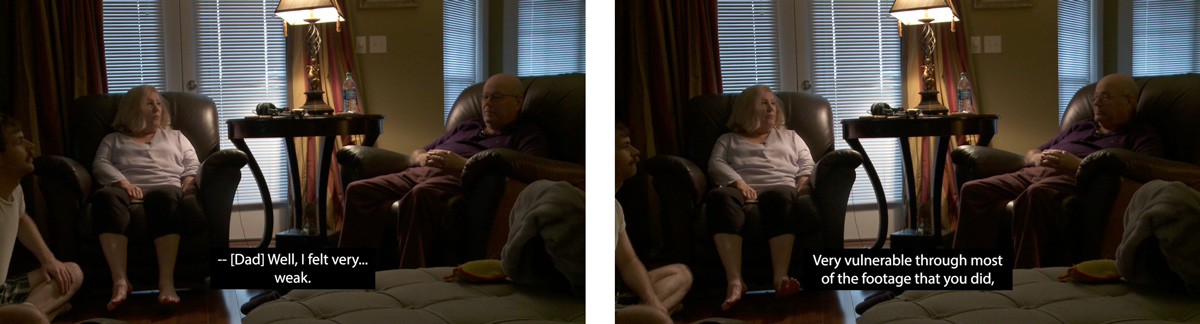
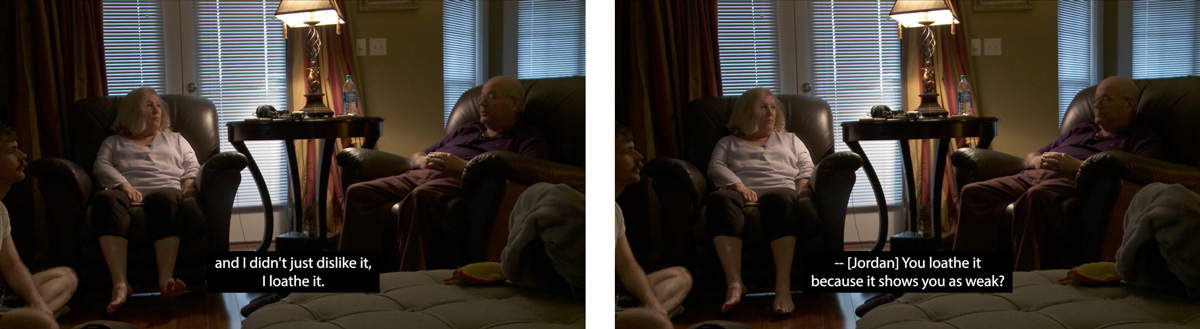
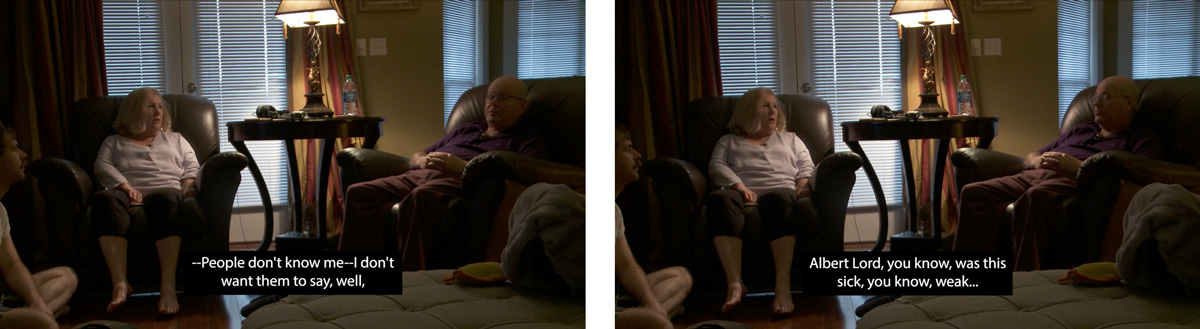
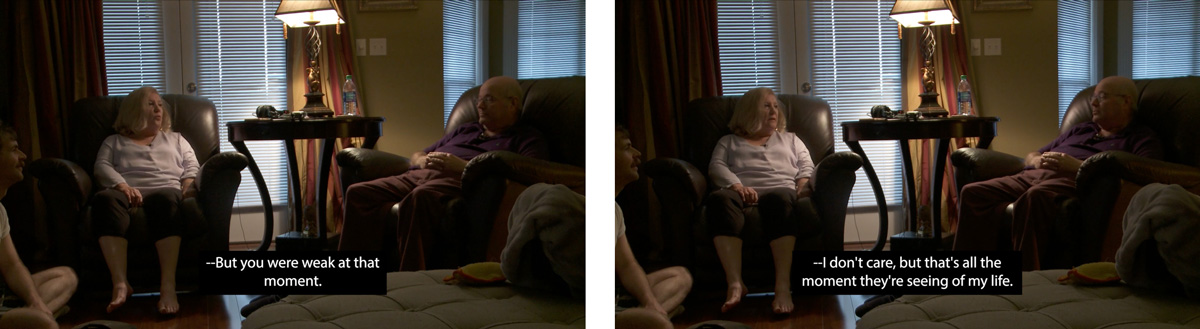
Jordan Lord, Shared Resources, 2021.
Lord’s mother provides us with an alternative relationship to the film’s process. Throughout the film she contributes visual descriptions of scenes in which she is featured. From this willingness, and the descriptions she provides, we get a sense of who she is and what is of import to her. Though her descriptions are invaluable to the depth and complexity of how she is portrayed, her willingness is not in conflict with her husband’s refusal and does not privilege her as a subject over him. In this way, Shared Resources circumvents how conventional creative works conflate presence/participation and value. The film charts something altogether different, creating a form of bespoke accessibility by providing additional information that is directly informed by cripistemological principles such as interdependence and networks of support and collaboration. The descriptive praxes of Shared Resources serve to extend the film far beyond what is shared visually/explicitly and illustrate how cripistemological strategies can generate a surplus of information that exceeds what we have come to expect from a conventionally conceived film or artwork.
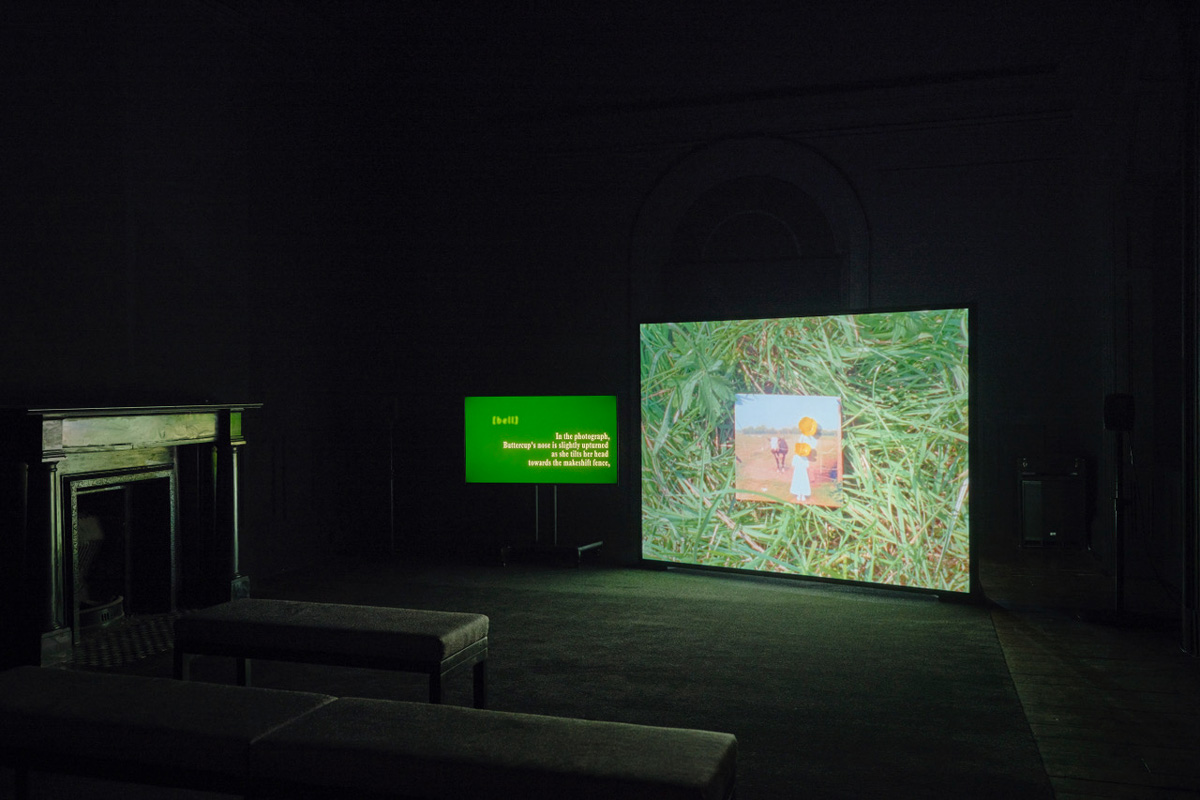
Similarly to Lord, artist Sarah Browne utilizes a cripistemological working method to imagine and expand the potentialities of film and the process of filmmaking. In her recent project Buttercup, first exhibited in 2024 at SIRIUS Arts Centre in Cork, Ireland, Browne created an experimental memoir film that exemplifies how text (descriptive, transcriptive, and beyond) can situate the filmic space beyond the edges of the frame. Buttercup, in part, develops nostalgia as a material language, exploring/expanding on a single childhood photograph of a young girl (the artist) wearing a Communion dress standing near her father and pet cow in a pasture. The film explores Browne’s closeness with bovine animals as a child, organic materials found in the fields near where she grew up, and related memories and observations—all of which emerge through the film’s captions and audio descriptions. The captioning is poetic, embodied, and thoughtful. Browne interweaves these visual and textual components across two screens. On the right, a larger screen features footage shot on a 16mm camera. On the left, a slightly smaller screen displays the film’s captions and textual material. Formally separating the captions from the conventional film frame supports the captions in their critical/creative becoming. The receiver’s attention, which conventionally would focus exclusively on image(s), is shifted by the visual weight and literal space given to the graphic text and captions. Where the film’s images linger, hover, and wait, the captions blur, fuzz, pulse, flicker, splay, and jump—pulling and directing attention in new and dynamic ways.
Sarah Browne, Buttercup, Sirius Arts Centre.
Photo by Ros Kavanagh
In kinship with Lord’s Shared Resources, Buttercup imbricates narrative content, sound description, visual description, spoken language, and visuality. Though strikingly accessible, the film develops and moves these seemingly disparate elements together and creates an experience for the receiver where delineations between captions, audio description, narration, etc. are beyond blurred…they are irrelevant. The focal point of the film is constantly shifting and reorienting across images, text, and sound. Poignant memories, recollections, and insight are blended with more pragmatic descriptions of what is visually present. Instead of feeling disjointed and disruptive, it feels familiar and lived—when we recollect we bring something from the past into the present, playing with the focus and the zoom, rendering, re-rendering, lingering on details and descriptions. Buttercup develops a vernacular of creative/critical accessibility that is instinctive and innate. Similarly to Shared Resources, this vernacular is supported by the film’s self-referentiality, most explicitly or literally so when describing how certain image(s)/footage is made through straightforward and matter of fact material and processual descriptions. This encircling (of the subject-matter, methodology, and material of the film), shifts Buttercup away from conventional storytelling structure and towards a more flexible framework informed by the cripistemological principle of open access. Additionally, Buttercup does not divide able bodied and disabled audiences—captions, descriptions, and other accessibility considerations are not supplemental, optional, or hidden/subtle. Instead, receivers/audiences experience a film that is of access, where their presence and access needs are prefigured and integral to what Buttercup is. It is emblematic of a new and holistic way of imagining art, artist, and receiver via a cripistemological framework.
As Pope.L critically engaged the layers of his artwork’s display or dissemination via ghost graffiti in his member: Pope.L 1978-2001 exhibition, Buttercup extends its cripistemological scope via a response text created by the aforementioned writer and professor Dr. Sarah Hayden entitled as if […] wearing anklesocks. The text takes the form of a poem printed across 71 index sized cards. Each card with a yellow stripe across the top, black text below and a saturated, creamy, yellow buttercup shade on the back. Though Dr. Hayden’s writing is based on Buttercup, sometimes quoting lines or parts of lines from the film, it moves further afield and takes the film with it. Hayden’s text pulls and expands the film across new boundaries, inviting us to stretch and explore further what cripistemological captions might be—something that can move from the bottom third of the screen, exit the frame, leave the space, and create something altogether different/distinct.
As a deaf* person, my attention is fractured. Along those fracture lines is some combination of what I know, an inkling of what I might be missing, and the trace of what never actually was—a betweenness, an irreconcilability, a slippage. Conventional captioning, based in an able-bodied-identifying rejection of this irreconcilability, produces something bloodless and solitary. Cripistemological captioning, instead, offers space(s) for this knowing, founded in interdependent forms of collaboration and networks of support. It is derived from a multiplicity of non-normative experiences, vantages, and epistemologies in/around aurality, orality, communication, and listening. It aims to honor and facilitate what theorist Roderick Ferguson described as minority difference/culture’s ability to function as “…sites of dissensus with the potential to create fissures and to make room for the inadmissible.”8 Cripistemological captions explore and complicate these principles by troubling the assumptions and ownerships involved in captioned space and by galvanizing shared responsibility and investment.
1. The co-writing of this essay is a part of an interdependent authorship and collaborative praxis. Though framed through a singular perspective, the work is shaped by a multiplicity of experiences held individually but felt/known together. More broadly, interdependent authorship allows for a specificity of experience while resisting the ways in which public disability disclosure overly invokes a specific, singular, and isolated body.
2. deaf* is a term used to describe a multiplicity of non-normative experiences, vantages, and epistemologies in/around aurality, orality, communication, listening, and beyond.
3. Robert McRuer and Merri Lisa Johnson, “Proliferating Cripistemologies: A Virtual Roundtable,” https://muse.jhu.edu/pub/105/article/548848/pdf. “Cripistemology,” a portmanteau of “crip and “epistemology,” is a term developed to describe knowledge produced in/around/via Crip/Disabled experience, first used in McRuer and Johnson’s article.
4. “Creative captions” as a concept has circulated for years, but its relevance to a contemporary art critical discourse is articulated in Emily Watlington’s 2019 essay in Mousse Magazine, “Critical Creative Corrective Cacophonous Comical: Closed Captions,” though the term itself is not explicitly used in the writing.
5. Sarah Hayden, “A Cognitive Listening: Attending to Captioning via the Critical “Unvoiceover,” Angelaki 28, no. 6 (December 2023): 20–49.
6. William Pope.L, “Some Notes on the Ocean…,” in Black People Are Cropped (Zurich: JRP Ringier, 2012), 9-16
7. Audio descriptions and visual descriptions translate visual experiences into text, a gesture that creates slippages/gaps and in-equivalencies between the primary document and the text description.
8. Roderick A. Ferguson, “Affirmative Actions of Power,” in The Reorder of Things: The University and Its Pedagogies of Minority Difference (Minneapolis: University of Minnesota Press, 2012)
Main image
Sarah Browne, Buttercup, Sirius Arts Centre.
Photo by Ros Kavanagh
Image description
A photo of two screens in a large, dark room. The walls are black, the floor is covered in black carpet, in the foreground are three benches, and on the left wall is a fireplace, also painted black. The screens are positioned in the back of the room. The one on the left is the size of a large television. The image on it consists of a medium green background and text — “[BELL]” in light green and “IN THE PHOTOGRAPH, / BUTTERCUP’S NOSE IS SLIGHTLY UPTURNED / AS SHE TILTS HER HEAD / TOWARDS THE MAKESHIFT FENCE,]” in yellow. The screen on the right is about four times the size of the other. The image being shown depicts a background of green grass with a photograph positioned in the middle of it. The photograph includes two people, their faces covered by yellow buttercup flowers, and a cow, all standing in a field with trees in the far background.