


deaf* roundtable
In 2014, Robert McRuer and Merri Lisa Johnson published ‘Proliferating Cripistemologies: A Virtual Roundtable’ in the Journal of Literary & Cultural Disability Studies. The document (in which 14 theorists/writers/thinkers responded to the question “How might ‘cripistemologies’ work?”) foregoes consensus and instead provides us with a chorus of complications, questions, challenges, and perspectives in and around ‘cripistemology’. In the decade (+) since, cripistemology as a form of creative and critical inquiry has moved beyond the theoretical and influenced how we can conceive of, enact, and disseminate disability-inflected/inflicted art. To explore what a cripistemological undergirding might mean for deaf* artists and cultural practitioners, we brought together Seo Hye Lee, Rotem Tamir, and Hannah Wallis to discuss what complications, questions, challenges, and perspectives can/should form a deaf* horizon.
Liza Sylvestre + Christopher Jones:
Little “d” deafness is a term and identity that has historically been shaped and defined by the identity distinctions that border it — Deaf and hearing cultures. Both of these cultures have particular sets of communication criteria that little “d” deafness (also/formerly known as “hard-of-hearing”) have been excluded from. How does deafness function in your life and in the world?
Seo Hye Lee
I grew up in a hearing household—the only deaf person in my family. I had no access to sign language, and the communication frameworks around me were entirely oral. In mainstream schools, I learned to survive through lipreading and speech, navigating a system that expected me to perform comprehension at a pace not built for me. I often pretended to understand, because asking again felt like falling behind.
Spoken language never quite felt like home. Though I speak, I still struggle with certain pronunciations. My voice exists in a world shaped by repetition and approximation—a language that is mine but not fully comfortable. I’m currently learning British Sign Language, and in that process, I’m beginning to imagine a home that might exist between speaking and signing. A mixed space. A place where communication can unfold more fully and fluidly.
Today, I make choices that reflect this ongoing journey. Most mornings, I take my dog outside before I put on my cochlear implant. In that quiet, I don’t need sound. Later, when I’m ready to re-enter the world of noise and dialogue, I activate my hearing by choice. That agency—to hear or not hear, to speak or sign—is something I carry with care. It wasn’t always available to me.
In my work, I find comfort in emails and texts. These written forms allow clarity, intention, and a kind of control over how meaning is shared. Live captioning and speech-to-text tools have also shifted how I engage with the world. They allow me to understand in real time without having to rely on others to repeat things. I no longer feel like I’m “catching up”—I’m simply included.
At times, my race has blurred how others perceive my deafness. Being Asian, I’ve been mistaken for someone who doesn’t speak English, rather than someone navigating a disability. These moments show how easily we are misread, how deafness intersects with language, visibility, and cultural expectation.
Hannah Wallis
My sound is complex, hard, amorphous and flimsy, it is at the edges and everywhere simultaneously – it is delivered through a machine, perhaps something of David Serlin’s, “modernity’s need for somatic sameness.”1 What would true un-masking look like? To be between things, the slipperiness sublime, subliminal and dangerously lose all at once. I held onto binaries, in multiple ways for a long time to survive. But they are old and laced with violence that doesn’t serve us.
Over time a between-ness has formulated that is endless, compassionate, emanating, a periphery, it is soft and flex and moveable. Sometimes this is too much, sometimes everything, sometimes it is the tiny pearl of the oyster created by the friction of sand against shell because two worlds are colliding and you are there, between them, not quite enough of either or anything, creating something anew instead.
deafness has leaky borders. Historically little ‘d’ has belied the profundity and depth of loss and gain, of a between-ness that defies the expected bounds and lives in glorious heartbreaking unknown. I often come back to Astrida Neimanis’, “as bodies of water we leak and seethe, our borders always vulnerable to rupture and renegotiation”2 . My body has taken many years to learn, is still learning, how to function in the world in the between-ness, how to leak across, up, down, into itself and into a life that can hold it. If we lean into Margaret Price’s suggestion that “to crip is a transitive act” and ask, “what lies on the other side of transition?”3 perhaps this renegotiation of our seething bodies and the between-ness of where our sensorial self exists might be a place for us all. Perhaps it is only in the letting go of these borders, of these binaries, of leaking into the little ‘d’ that something profoundly trans-cendent could take shape.
Rotem Tamir
In my late twenties, before I got married and became a parent, I often spent time without my hearing aids — especially at home. It turns out that this had a significant impact on how I perceived reality. The following story is just one example among many.
One day, I was house-sitting for my older sister — a quiet, two-story home. That afternoon, I went upstairs to rest in one of the bedrooms. Suddenly, I heard loud knocking coming from one of the wooden doors in the house — it sounded like someone was forcefully slamming repeatedly into a locked wooden door. Alarmed, I jumped out of bed. I ran downstairs to check where the noise was coming from. As soon as I got down, the banging stopped. All the doors were locked.
I went back upstairs to lie down — and shortly after, the loud, rhythmical banging started again. It was a frightening sound, like someone rapidly shaking a large wooden door with loose hinges. I jumped up again and tried calling my partner, but he was at work and couldn’t answer. I went back downstairs, trying to understand the source of the sound — and again, the noise stopped the moment I got up to check.
Eventually, the banging stopped, and I managed to rest.
When I woke up, I started looking for signs of a disturbance in an attempt to understand the source of that awful sound. The door in one of the kids rooms was closed, and I couldn’t open it. I pushed it with my body several times until it finally gave way. It was a wooden door.
Once it opened, I saw that the windows were wide open, but nothing appeared to be missing, and there were no signs of disturbance. I turned pale, not understanding what on earth had happened. I spent the entire day thinking about the incident. My imagination went into overdrive and ideas about supernatural presence were starting to seem like the only reasonable explanation.
Eventually, I decided to tell my partner what had happened — at first, without sharing any of my own interpretations. I simply described the sequence of events as they occurred, curious what he might think.
I remember telling him the story with restraint, doing my best not to insert my own ideas — just the facts. He listened quietly, then smiled and asked: “so, what do you think it was?”
I hesitantly told him my interpretation, making it clear that I tried considering every possibility and that ultimately, ghosts were the only possible explanation!
He looked at me amused and said:
“You know, Rotem… honestly, I’m not sure I want to tell you what really made that noise. Your reality is so much more interesting than the real reality — I don’t want to burst your bubble.” Eventually, after an interrogation session (admittedly, involving some light-impact torture) he finally caved: “you know, that washing machine in your sister’s house makes a hell of a racket…”
Deafness- reflections
My hearing loss started when I was around 12 years old. I began asking “What?” too many times when my parents spoke to me, so they took me to get my hearing tested. That’s when they discovered I had hearing loss in both ears. Unfortunately, they said it was a nerve issue, so it couldn’t be treated — and that we should expect it to continue to decline as I got older. At some point, they told my mother I should start using hearing aids, but she hesitated. She decided for me not to get them as she was worried about the social implications of me appearing different from everyone else, and even that no one would want to marry me. So I had to learn to live with it, knowing that I was hearing less than others.
What I really want is just to put into writing some of the small moments — the things people said, or didn’t say — that stayed with me and, in some ways, shaped how I moved through the world.
Throughout my bachelor’s degree studies, although the language we all spoke was Hebrew, many of the professors assumed everyone spoke fluent English. They would show documentaries and art films in English, without English or Hebrew subtitles. Since I had already lost much of my hearing by the age of 12, it was difficult for me to pick up spoken English from TV, as most other Israeli teenagers did at the time. Of course, I only understood this later. Back then, I just thought I was dumb for not understanding what seemed to come easily for everyone else.
I remember one specific moment — we had just watched an early Werner Herzog documentary. I couldn’t follow a word of it. Exhausted from working in the studio the night before, and sitting in a dark classroom staring at a silent screen, I eventually dozed off. Right after the screening, the furious young(ish) professor stood in front of the class and yelled at me, saying I was disrespectful.
In his defense, he didn’t know I had hearing loss. He also didn’t know that after every screening like that, I would quietly go to the library and watch the films again on my own — just to try and understand what I had missed. Another time, I asked the video art professor if they could please add subtitles to the films when available, and they casually replied: “Why? Subtitles ruin the visual experience.”
I got my first pair of hearing aids in the last year of my bachelor’s degree, when I was 26 years old. It was thanks to my boyfriend at the time — now my life partner — who noticed that while we were sitting together in lectures I wasn’t understanding what the lecturer was saying. I was also about to travel to study abroad for the first time on my own, and I knew that understanding people in another language would be an enormous challenge.
When I went to tell my mother I decided to get hearing aids, her response was:
“Now he’ll never marry you.” (He did!!)
My child was born here in the U.S. Being a foreigner and hard of hearing, I was worried about the challenges that could arise. In one of the many pediatric checkups after the birth, I told the pediatrician I was worried I wouldn’t hear my baby crying while I slept, to which she replied: “Oh don’t worry, every mother hears her baby’s cry.” (In my mind I wanted to yell in her face — not if you’re deaf, bitch!)
Liza Sylvestre: I’ve often felt the urge to “solve the problem” of my hearing loss, or at least drastically minimize the presence of it. Often this results in an internal dialogue of “I should be more fluent in ASL, I need to come up with a plan” or “why didn’t I disclose my deafness in that fill-in-the-blank situation? I don’t know what was said.” I find that even in situations in which I am in charge, like in my own classrooms or through my own artistic endeavors, I am inclined to act and communicate in ways that uphold the hearing/Deaf binaries that have conditioned me.
I have learned so much from JJJJJerome Ellis (who does not have hearing loss but whose work is, in part, about communication and its potential). When Ellis describes “The Clearing”, which is his name for the space/time that is opened by disfluent speech, I recognize that space as one I have also entered, though through a different door. In “The Clearing” space, communication moves in relation to time differently and there is so much to learn. I wonder what disfluent hearing or communication could be? In this landscape of leaky borders (as articulated by Seo Hye Lee and Hannah Wallis), who is present? What can we learn? What can be imagined? Are there examples we can look to which already function this way?
Seo Hye Lee
I still find myself shaped by the pressure to respond quickly, to appear fluent and unfazed by gaps. Spoken language, quick responses, a reluctance to pause or ask for repetition—these habits have become part of a performance. A way of passing—as hearing, as capable, as someone who doesn’t interrupt the flow. But often, in that speed, I’m not truly understanding or engaging. I’m performing comprehension to stay in step. These instincts come from a history of conditioning: schools, conversations, systems that reward immediacy and make slowness feel like a flaw. Even now, I notice how quickly I fall into those habits—resisting the pause, holding back from asking again. It’s not hesitation rooted in belief, but in conditioning: years of unspoken expectations that trained me to value fluency, to avoid disruption, to keep things moving.
At times, I catch myself turning to the person I trust most in the room. Not to have everything repeated, but to feel the rhythm of the conversation through them. A glance, a small nod, the way their body responds—these gestures become quiet anchors. In those moments, understanding doesn’t feel like catching up, but like being gently brought back into the flow.
I realize things a moment too late—like a joke just missed, or a shift in tone that passes before I can catch it. In conversations, I’ve often found myself in a different tempo than those around me. There is a delay, a soft lag, where understanding arrives on its own time. JJJJJerome Ellis describes “The Clearing” as a space opened by disfluency, where communication stretches or slips. I’ve entered that space too—not through disfluent speech, but through the delays in understanding, in catching the thread of a conversation just after it’s passed. Time and space feel different there—slower and more porous. I might understand something halfway through, or only after it has passed. But often, that difference brings people closer. When someone notices, when they pause or explain again, we re-align—not just in comprehension, but in care. That space, once filled with pressure or confusion, becomes a place of meeting. So it’s not about catching up anymore, it’s about moving differently, together. Perhaps this is one form of disfluent hearing—a rhythm that invites re-alignment, not correction; a clearing where new ways of listening might begin.
Rotem Tamir
I often find myself reflecting on how many of our struggles in communication stem from trying to categorize the information we receive—as if sorting it into computer folders: me, you, him; here, there. We tend to understand communication as something with a clear beginning and end, a sender and a receiver. But in reality, these are fluid processes.
Last night, I read a letter written by Ariella Aïsha Azoulay4 to her father. In it, she describes an old mosque in Algiers. Through old drawings and photographs, she shows how the mosque was once deeply embedded in the social and geographical fabric of its environment: the hilly terrain may have obscured parts of it from view, while narrow streets lined with artisan workshops led up to it and formed part of its space. The Jewish artisan would hear the muezzin each day and watch their Muslim neighbors walk to prayer—borders where there was lots of “leaking,” so that culture and beliefs were interwoven with friendship and architecture. But soon after the French colonial invasion, the entire area was “cleaned up”—flattened, stripped—and all that remained was the mosque itself.
Over the past year, I’ve been practicing capoeira. I think it offers a glimpse into a different kind of interpersonal communication—one that is complex, non-erasing, non-categorizing; one that holds and sustains. Capoeira is often described as a combination of dance, game, and martial art. As I recall reading—perhaps in something by Mestre Accordion5 —the idea is that this definition is only offered when people insist on explanations. Because capoeira, truly, resists being categorized.
How incredible would it be if we treated communication between us as a dance, a game, and a form of martial art—all at once? Right now, it often feels like we treat it only as combat: mine vs. yours, me vs. you, winner vs. loser. And in the end, we all walk away feeling right—but so very much alone.
Hannah Wallis
deafness and the voice feel deeply connected in me. The vibrations of my voice moving through the body at a rhythm that makes sense to me alone. Disfluency feels subjective, it is in the eye, ear, sense of the beholder. I remember being asked to record a story for a friend, they liked the way my voice sounded online, its sharpness, its haphazardness. But I didn’t know how to perform it, to lean into it, to own it. Its cadence made up of a lifetime of getting words wrong, not quite believing in what I am saying, not quite knowing if what I am saying is the right thing in the right way. We find our own ways of speaking into the world, of surviving in the void that has been built for us.
I was asked some time ago to speak about how we might build a better future. The request was an emotional one, I had only ever really been asked to provide very concrete steps in accessibility practices until then, what could be adapted to make the current systems bend, not how things could radically change for the better long-term. No-one had ever asked me what kind of future I wanted to see, build or live in, but I realized it had been growing slowly in my mind. It has grown out of the mis-pronounced words, the messiness of the support I have not been given, the learning of a universal body language and the idiosyncratic body languages of those I become familiar with, the small violences each day when someone doesn’t read my body language in return, the tenderness of the support I do receive. Leaning into the sensitivity of all these things combined. For a long time, I thought these things were my weaknesses, instead they have become materials for a better world, one in which we might all feel better understood and connected. A world in which we can bridge leaky gaps and clearings, meeting each other where our bodies find themselves.
I think the ways in which many disabled people and practitioners are meeting each other in these murky leaky spaces are everywhere. There perhaps isn’t one central example to give but in the multiple offerings of more time to rest, live, think, breathe into ideas; the gentle reminder to take up the space and support you need; the knowing look across the room that says ‘I got you’; the recognition of disfluency in communication without having to say something, without having to ask twice or even at all; the gentle tap on the shoulder to let you know that someone wants your attention, a smile as you turn and get ready to listen, process, listen, process… All these moments for me are the imagined space, the meeting points, the landscape, the leaky, messy coming together. It happens over emails, in texts, at the start of a meeting when someone knows what you need, or in the shop when someone knows that you haven’t understood, it’s not helping, its understanding, its mapping, its world building.
Liza Sylvestre + Christopher Jones: For the past several years we have been using and exploring the term deaf*, which we use to describe a multiplicity of non-normative experiences, vantages, and epistemologies in/around aurality, orality, communication, listening and beyond. As a term, deaf* is emergent, speculative, re:generative, and horizontal (of/towards the sensorium’s horizon). As distinctions like “hard of hearing” have become obsolete/problematic/etc., it has felt necessary to explore the in-between-ness of the little “d” deaf experience more directly and in generative/positive terms. The asterisk draws our attention to information located elsewhere and stretches the meaning of the term there too, towards its potentialities. In the spirit of ‘Proliferating Cripistemologies’ — how might deaf* challenge borders of strict identity criteria and how might it function in the world as a term/theory and identity distinction in its own right?
Seo Hye Lee
To me, deaf—with an asterisk—is not a label, but a landscape. It holds the flux, the refusal of fixed categories. It welcomes ambiguity, silence, pause. It suggests a way of knowing that values interdependence over fluency, slowness over immediacy, and difference over conformity. It is a term that lets me imagine a life and language that are still in the making—a space between sound and gesture, between loss and invention, between past silence and future voice.
Hannah Wallis
To define deaf* at all is to let language do its work, to process and evolve. There have been times when my deafness has been challenged or disbelieved since receiving my cochlear implant in my 20’s. Despite my deafness becoming more complete, the level of technology available somehow negates this for some people. But for me, it was once I had the implant that I felt more solid in my understanding of how to navigate my deafness. I entered this quasi-cyborg-esque realm whereby I was no longer one thing or another. My body has become a place of exploration across what is defined for me outside of it.
“a cyborg world might be about lived social and bodily realities in which people are not afraid of their joint kinship with animals and machines, not afraid of permanently partial identities and contradictory standpoints.’6
Rotem Tamir
English is not my first language, and I find myself wondering whether the discomfort I feel in responding to this question is connected to that. I think the linguistic proposal and the discussion around deaf* are important to the broader conversation, and I deeply respect the care and intention behind them. At the same time, I’m aware of a hesitation I carry: a concern that any term—even one developed with care and openness—can, over time, become another threshold. As terms accumulate theoretical and discursive weight, they risk becoming spaces that some people may not feel invited or able to enter. I find the addition of the * compelling, as it shifts the word slightly toward the realm of signs—a mix between letters, words, and symbols—which, even visually, aligns with what the term suggests: continuation, expansion, and a refusal to settle.
Liza Sylvestre: Through working and collaborating interdependently I have come to realize that my relationship to language (English, ASL, etc.) is somewhat antagonistic and I resent concepts of language purity or mastery. This has shown up in my work in different ways—such as a refusal to edit out spelling/grammatical mistakes in captioned video works (why invest time and care in a structure of rules that have been used to reprimand, exclude, and restrict access). Are there disciplinary conventions that you consciously or unconsciously push against or critically/creatively reimagine through your work? Are there aspects of art (contemporary or otherwise) that we should rethink or reapproach based on any of the deaf* ideas or experiences or methods that we have been discussing?
Seo Hye Lee
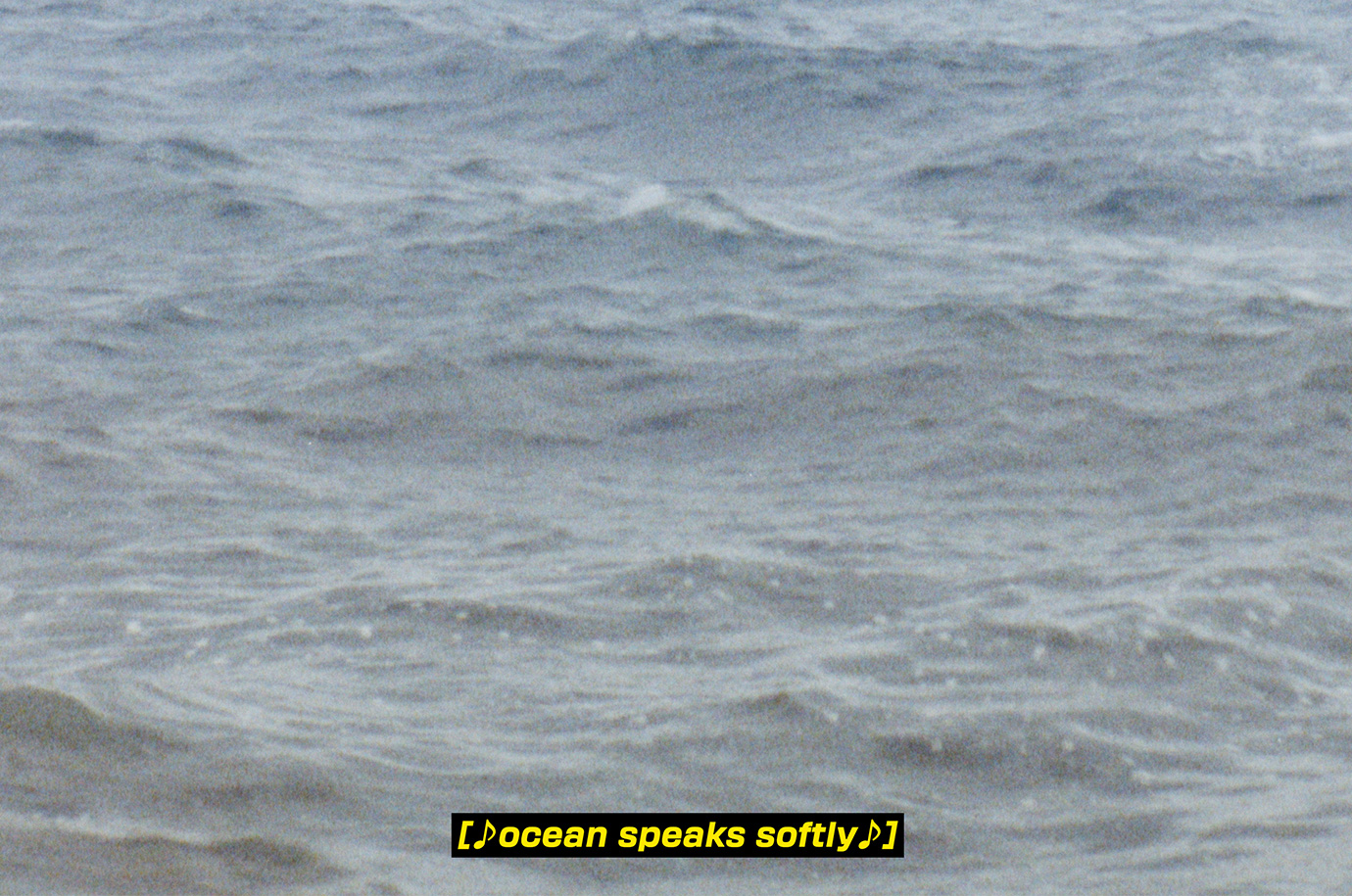
In my work, I often find myself navigating the tension between access and expression—especially through the act of captioning. While creating Portland Forecast (commissioned by Nottingham Contemporary, in collaboration with Sarah Hayden and Hannah Wallis), I worked with Collective Text7 to make the captions accessible, particularly the sound descriptions. I remember editing one line over and over before settling on: ♪ocean speaks softly♪. That line stayed with me—it captured something that felt meaningful for both d/Deaf and non-d/Deaf audiences. In this case, captioning wasn’t just about describing sound, it was about conjuring a feeling, a sensory impression. It wasn’t just about correctness, but also resonance.
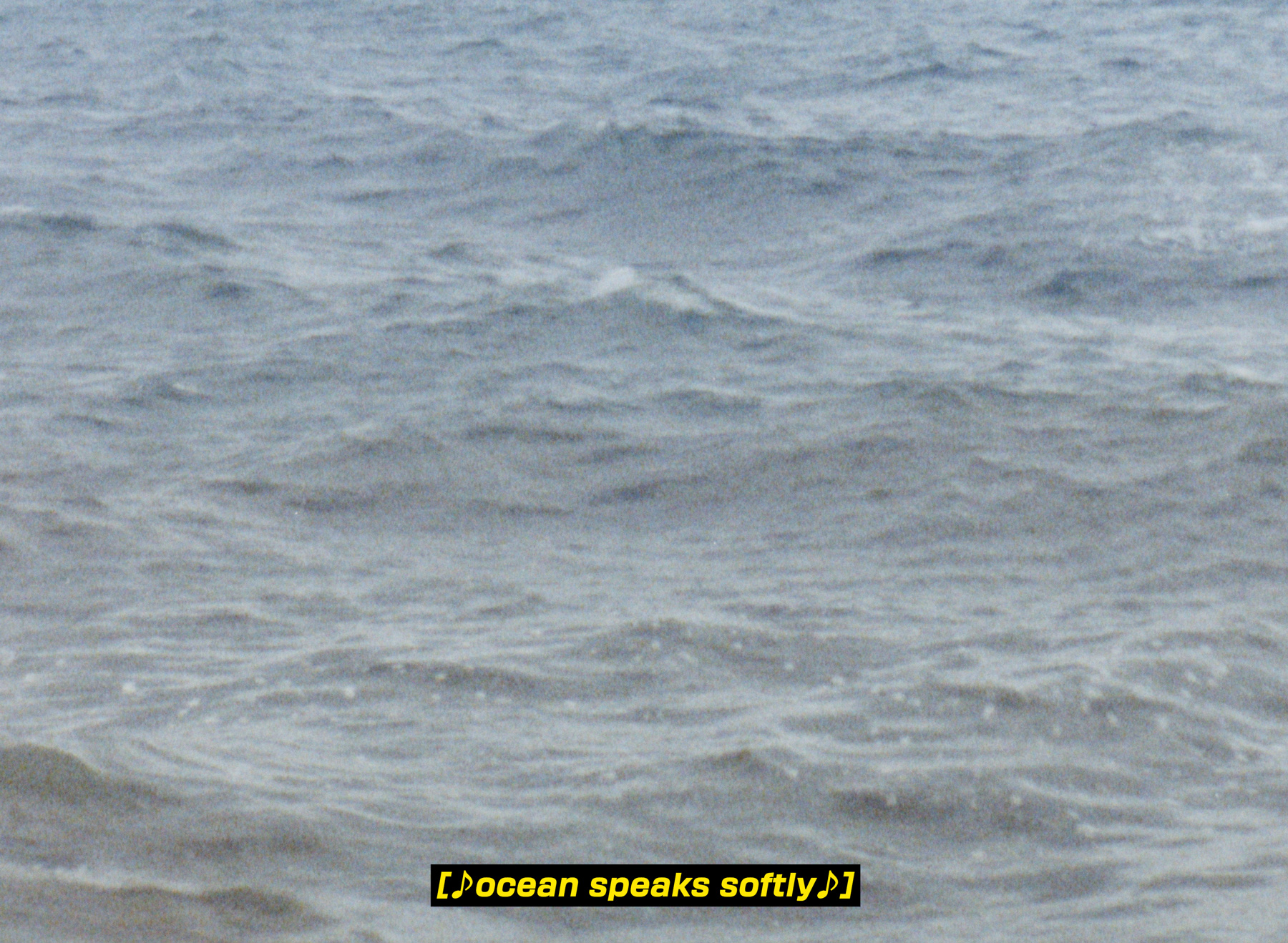
A still from Portland Forecast
Moving image, 2023 (10 min 48 seconds)
Launched in Nottingham Contemporary May 2024
Commissioned by Nottingham Contemporary
in collaboration with Sarah Hayden and Hannah Wallis,
with support from an ArtFund Reimagine Grant
I’ve also had moments where translation became part of the process, especially when showing work in different countries. Occasionally, curators or collaborators have helped translate my captions or materials into other languages. Even when a translation seems technically “correct,” I often find myself asking: is the context right? The social and cultural meanings around language shift so easily. These experiences have made me more aware of how meaning is shaped not only by words, but by who’s speaking, who’s receiving, and what histories are present in the exchange.
In my practice, questioning conventions often happens through more layered means—small shifts, collaborative adjustments, and slow reframings that emerge in dialogue with others. Precision often gives way to suggestion. I’m interested in what happens when language holds space for ambiguity—when it allows something open-ended, incomplete, or in process.
Hannah Wallis
It’s hard to pinpoint sometimes how a practice is pushing against convention, it’s such slow work. What I do know is that I am listening. All the time. With my whole body. Language can move beyond what is merely said or written (sign language attests to this), communication goes beyond words and grammar. It is what is felt and understood through our connections to others and the world. This feels like a radical act in the world right now. It is not necessarily about a series of actions that can be put in place but about a mindset to remain open, porous, leaky, flexible, adaptable and strong enough to get everything wrong. I talk a lot about moving beyond the idea of ‘duty of care’ into a desire; for careful connection and reciprocal understanding. It is not enough to execute a duty, but to shift the social, cultural, political mindset to one that recognises messiness and difference and multiplicity as the measure by which we allow ourselves and others to exist. As a practitioner, especially one who works from an arts organisational perspective, I often say that I cannot promise safety, because I can’t always know what that looks or feels like for someone. But what I can promise is trust, responsibility and accountability. I will be careful at all times, listening, wholly, with a body that has its own leaky landscape.
Rotem Tamir
My grandmother always told me that the most important thing is to learn. “Those who have knowledge have power,” she would say, again and again, like a mantra. When I was a child, I didn’t understand what she meant. My understanding of that sentence has continually shifted over time.
In my work, I push against the idea that knowledge is something primarily acquired through language, fluency, or mastery. Much of how I learn comes through fragmented knowledge and sensory experience. In recent years I’ve focused on learning about the culture my grandmothers came from—Jews of Sephardic origin who settled in the Middle East and North Africa—a culture that, where I grew up, was suppressed and barely taught. As a child, I learned not through books, but through food, laughter, hospitality, and countless candles lit for the dead.
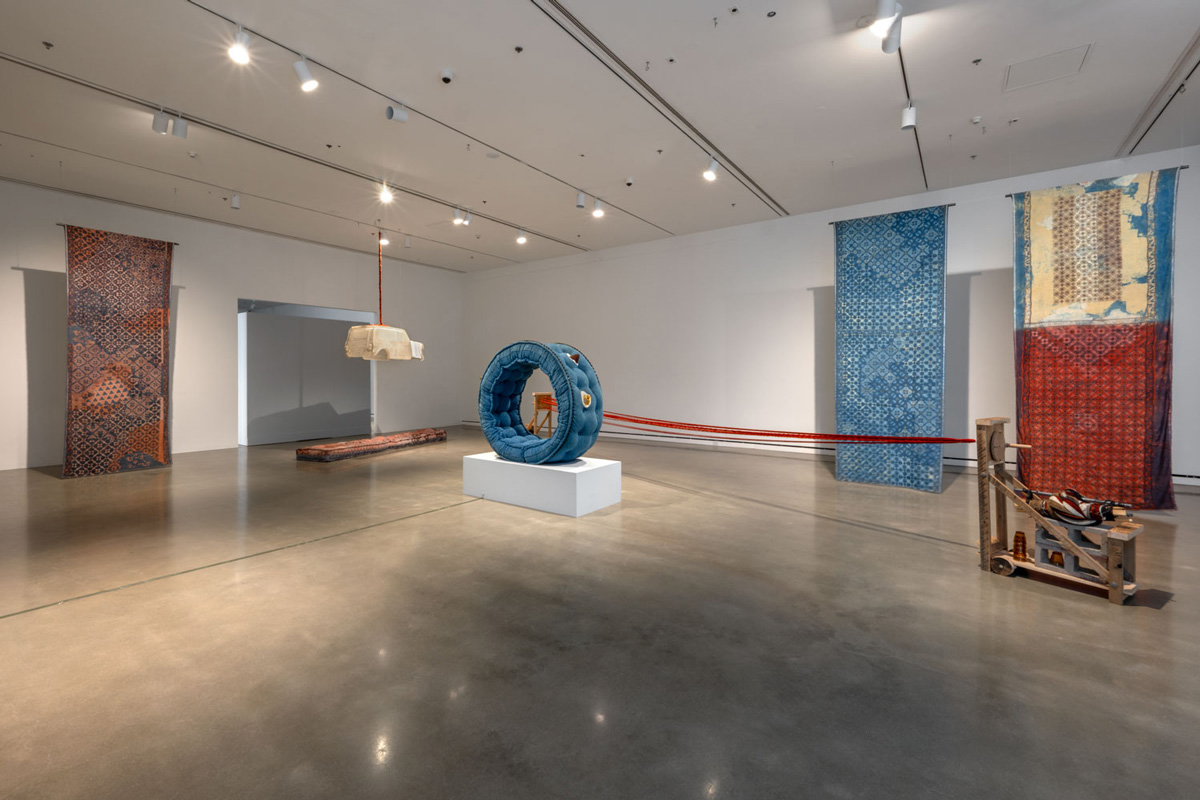
Rima: Passages in Sephardic Sculpture, installation view.
Rotem Tamir, 2024, Rochester Art Center.
Photo credit: Rik Sferra
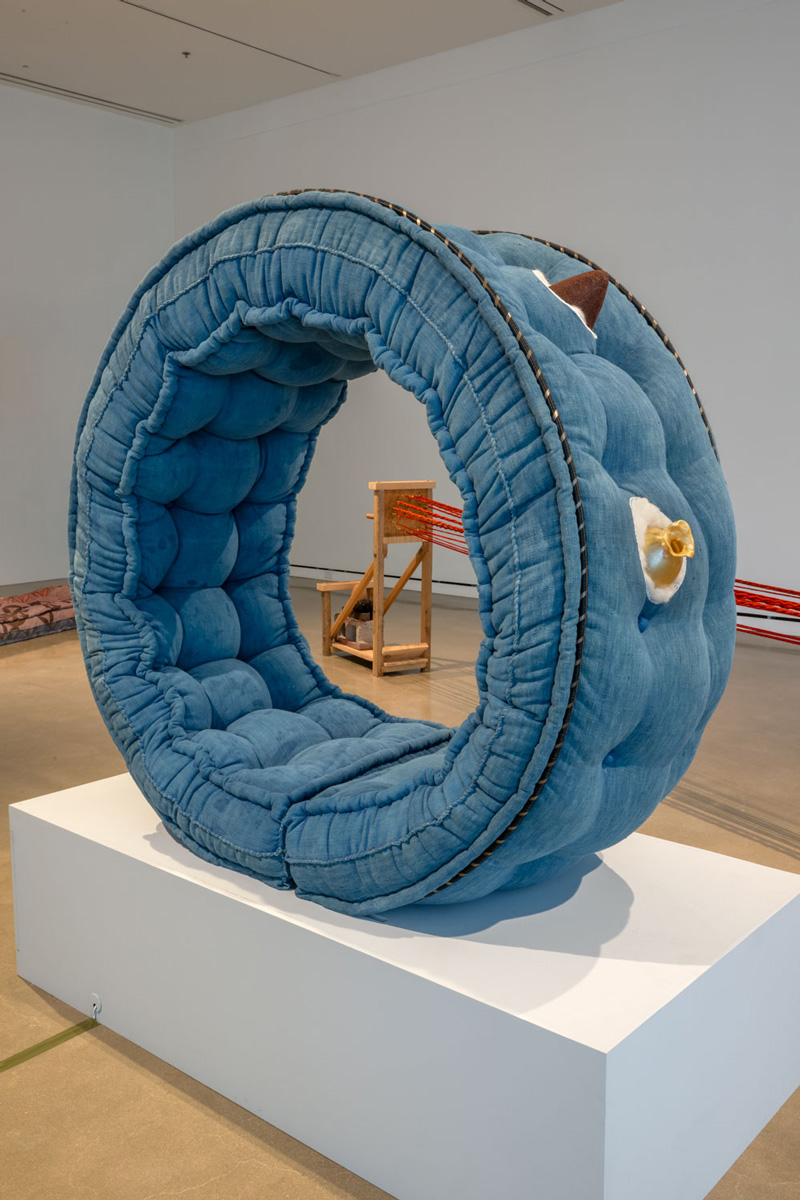
Mother of the World (Um el-Dunya)
Sound by Nir Jacob Younessi.
Rotem Tamir, 2024.
Photo credit: Rik Sferra
To access audio: www.rotemtamir.com/rima-passages-in-sephardic-sculpture
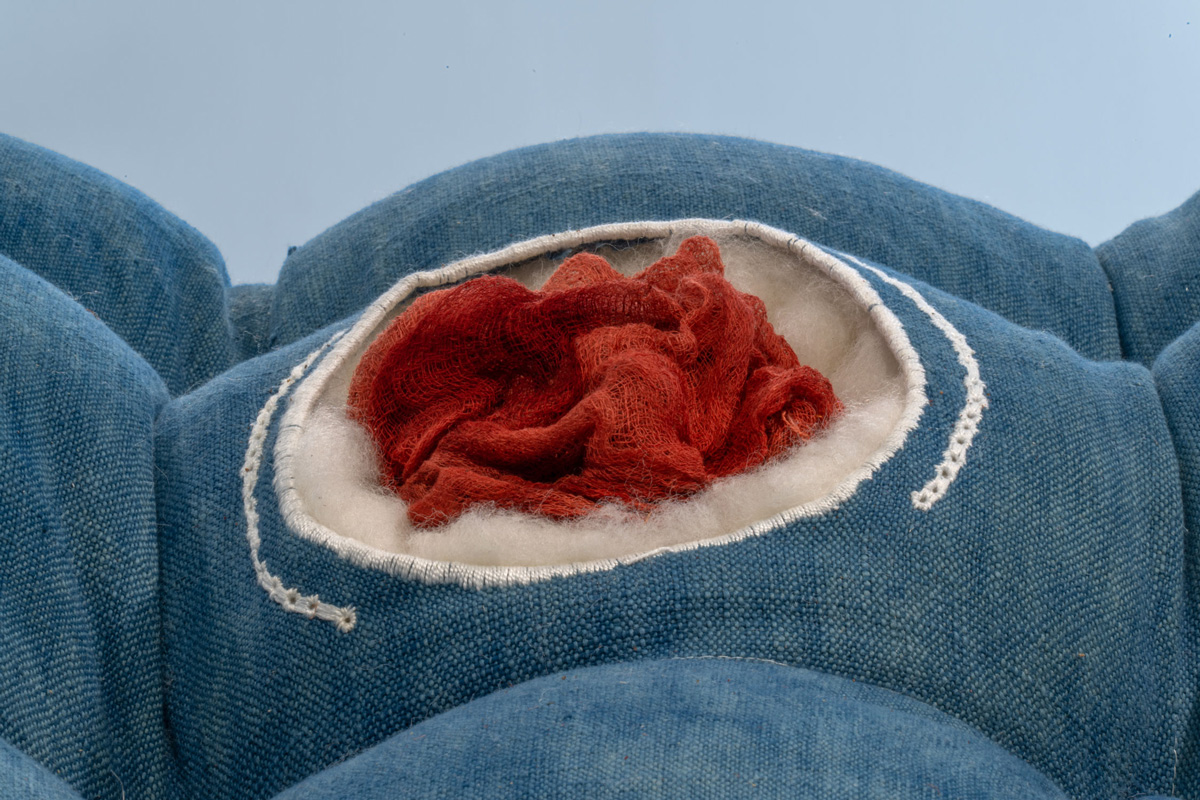
Mother of the World (Um el-Dunya), close-up view.
Sound by Nir Jacob Younessi.
Rotem Tamir, 2024.
Photo credit: Rik Sferra
Sound plays a central role in this process. In my installation Rima (2024), the work Mother of the World (Um el-Dunya) uses sound not as information, but as bodily experience. In collaboration with sound artist Nir Jacob Younessi, recordings of my father and grandmother singing Judeo-Iraqi and Judeo-Libyan songs emerge from within a hand-sewn mattress, filling the space with intimate, cracked, celebratory, and at times alarm-like voices. They are not meant to be translated or explained, but encountered—through proximity, listening, vibration, and the body.
In this way, my sculptures and installations ask for a different relationship to knowledge—one that is sensory, relational, and embodied. Rather than aiming for purity, fluency, or mastery, the work holds together things that don’t fully resolve, that exist side by side—what in Hebrew might be called sha’atnez. This tension is not a problem to be solved, but a condition to live with. It’s where learning happens for me, and where art can offer another way of knowing.
Works cited
Almeida, Bira. Capoeira: A Brazilian Art Form – History, Philosophy, and Practice. North Atlantic Books, 1986.
Azoulay, Ariella. The Jewelers of the Ummah: A Potential History of the Jewish Muslim World. Verso, 2024.
Ellis, JJJJJerome. “The Clearing: Music, Dysfluency, Blackness and Time.” Prospections, 2022.
Haraway, Donna. Manifestly Haraway; The Cyborg Manifesto. University of Minnesota Press, 2016.
McRuer, Robert and Merri Lisa Johnson. “Proliferating Cripistemologies: A Virtual Roundtable.” Journal of Literary & Cultural Disability Studies, vol. 8, no. 2, 2014, pp. 149-169.
Neimanis, Astrida. Bodies of Water: Posthuman Feminist Phenomenology. Bloomsbury, 2017.
1. Robert McRuer and Merri Lisa Johnson, “Proliferating Cripistemologies: A Virtual Roundtable.” Journal of Literary & Cultural Disability Studies, vol. 8, no. 2, 2014. p 150.
2. Astrida Neimanis, Bodies of Water: Posthuman Feminist Phenomenology, Bloomsbury, 2017.
3. Robert McRuer and Merri Lisa Johnson, “Proliferating Cripistemologies: A Virtual Roundtable,” 154.
4. The letter by Ariella Aïsha Azoulay referenced appears in her book The Jewelers of the Ummah (2024), a collection of essays and letters exploring history, colonialism, and diasporic memory through personal and archival materials.
5. Mestre Accordion is a prominent capoeira master, musician, and teacher who played a key role in introducing capoeira to audiences outside Brazil. One of his notable books is Capoeira: A Brazilian Art Form – History, Philosophy, and Practice (North Atlantic Books, 1986).
6. Donna Haraway, Manifestly Haraway; The Cyborg Manifesto. University of Minnesota Press, 2016. p 15.
7. Collective Text is a leading organisation in the sector for captioning and audio-description. You can download their call to action guide for free, which they say is a call to think differently and accessibly about captioning in film-making.
Main image
A still from Portland Forecast
Moving image, 2023 (10 min 48 seconds)
Launched in Nottingham Contemporary May 2024
Commissioned by Nottingham Contemporary
in collaboration with Sarah Hayden and Hannah Wallis,
with support from an ArtFund Reimagine Grant
Image description
An image of the surface of a body of water. At the bottom of the image is a long black rectangle featuring yellow writing on top of it, flanked by brackets and two music notes on either side, which reads: “OCEAN SPEAKS SOFTLY.” The water is rippled, with small waves throughout and some white bubbles or foam in the foreground. The water takes up the entirety of the frame, ranging in color from a medium blue in the background to a grayish blue in the foreground. There is some variation in color across the surface, created by the texture of the waves and heightened by the grainy quality of the image.